




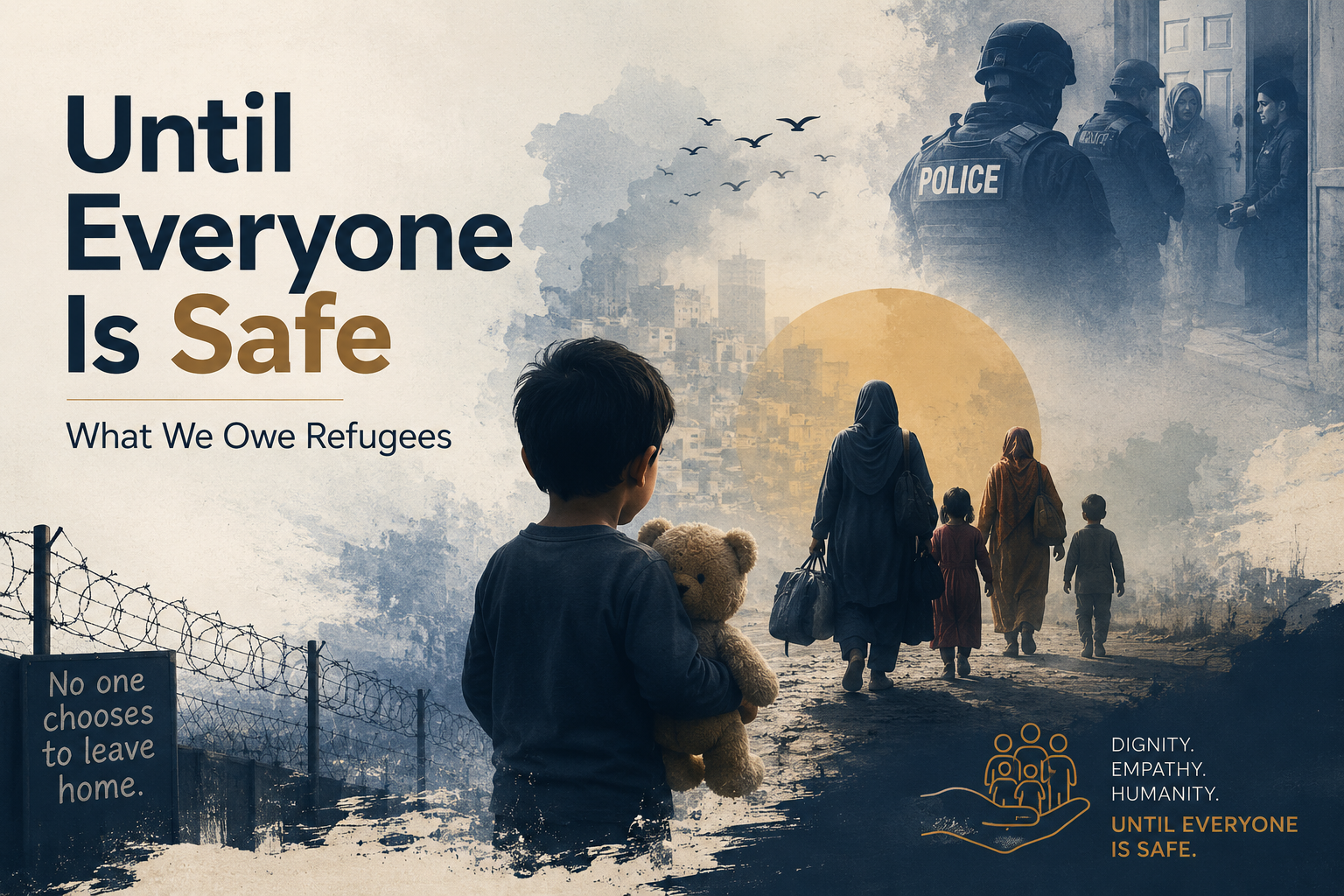
On World Refugee Day, the author reflects on a deportation raid next door and the burden refugees continue to bear for crises beyond their control.
A few months ago, I witnessed what remains one of the most painful experiences of my life.
The apartment next door to mine was being raided by the police. Inside were Afghan women and children trying desperately to resist deportation. There was no adult male family member present. Through my window, I could hear crying, pleading and confusion. At one point, a female police officer shouted, “Bas karo, dramay mat karo, niklo.”
For nearly half an hour, the family pleaded and resisted before the door was eventually forced open. When the police finally took the family away, only a handful of belongings remained scattered across the apartment. What has stayed with me ever since is the image of a small boy clutching a stuffed toy tightly against his chest as he disappeared down the stairwell. It seemed to be the only thing he had left to hold on to.
The memory returns to me often. Partly because of the family itself, but also because of the manner in which they were treated. The women inside were terrified. Their lives were being overturned in real time, yet their fear was met with impatience and contempt. The implication behind those words, “dramay mat karo”, was difficult to miss. Their distress was being dismissed as performance. Their grief was an inconvenience.
World Refugee Day arrives this year as displacement reaches levels few could have imagined a generation ago. By the end of 2025, a total of 129.4 million people worldwide were either forcibly displaced or stateless, according to the UN Refugee Agency. The figure includes 41.6 million refugees, 9 million asylum seekers and 68.7 million internally displaced persons. Nearly 45 million of them are children under the age of eighteen.
The scale of the crisis is difficult to comprehend. Numbers tell us how many people have been uprooted, but they reveal very little about what it means to live with the constant uncertainty of not knowing where home is, whether you will be allowed to stay where you are, or what awaits you if you are forced to leave.
For Pakistan, the refugee question is inseparable from a long and troubled regional history. For more than four decades, Afghans have crossed the border fleeing one catastrophe after another. Many arrived as children and grew into adulthood here. Others built businesses, raised families and became part of the social fabric of the towns and cities in which they settled. An entire generation has spent more of its life in Pakistan than in Afghanistan itself.
Pakistan has also paid a devastating price for militancy. Thousands of civilians and security personnel have lost their lives. Entire communities have lived through bombings, military operations and displacement of their own. The return of the TTP as a major security threat has revived fears that many believed had been left behind.
But how did Afghan refugees become the repository for frustrations?
The women living next door were not members of the Taliban. The little boy clutching a stuffed toy had nothing to do with the TTP. The families now being rounded up, detained and deported are not the people shaping policy in Kabul or Islamabad, negotiating with armed groups or determining the course of regional politics. Yet they increasingly find themselves carrying the consequences of decisions in which they had no part.
The TTP is elusive. The Afghan Taliban sits across the border. Refugees live, or rather lived, among us. They are visible, accessible and politically powerless. Public anger has a tendency to settle where resistance is weakest.
Over the past few years, Afghan refugees have increasingly been discussed through the language of security, illegality and burden. Something important is lost when entire populations are reduced to categories. Human beings with complicated lives, histories, and attachments are transformed into a problem requiring administrative resolution.
This shift is visible not only in policy but in everyday interactions. It is visible in the ease with which frightened families can be treated as inconveniences. It is visible in the assumption that fear itself requires justification. It is visible in the casual cruelty of telling women facing the prospect of deportation to stop creating “drama”.
The phrase has stayed with me. It reflected a growing inability, or perhaps unwillingness, to recognise the suffering of refugees as suffering. Once people are viewed primarily through the lens of security, their grief becomes suspect and their humanity becomes conditional.
States have the right to regulate borders and formulate immigration policy. No serious discussion can ignore that reality. But there remains a difference between managing migration and turning refugees into repositories for frustrations generated elsewhere. There remains a difference between addressing security concerns and collectively punishing people who exercised no influence over the circumstances being invoked to justify their removal.
The family next door is gone now. The apartment has new tenants. Life in the building has returned to normal.
I do not know where that family ended up or where they spent the night after they were taken away. What I do know is that they had nothing to do with the TTP or with the calculations being made in Islamabad and Kabul. Yet it was their lives, not those of the policymakers and militants shaping the region’s future, that were being upended.
That thought has lingered with me ever since.
On a day dedicated to refugees, it lingers still.