




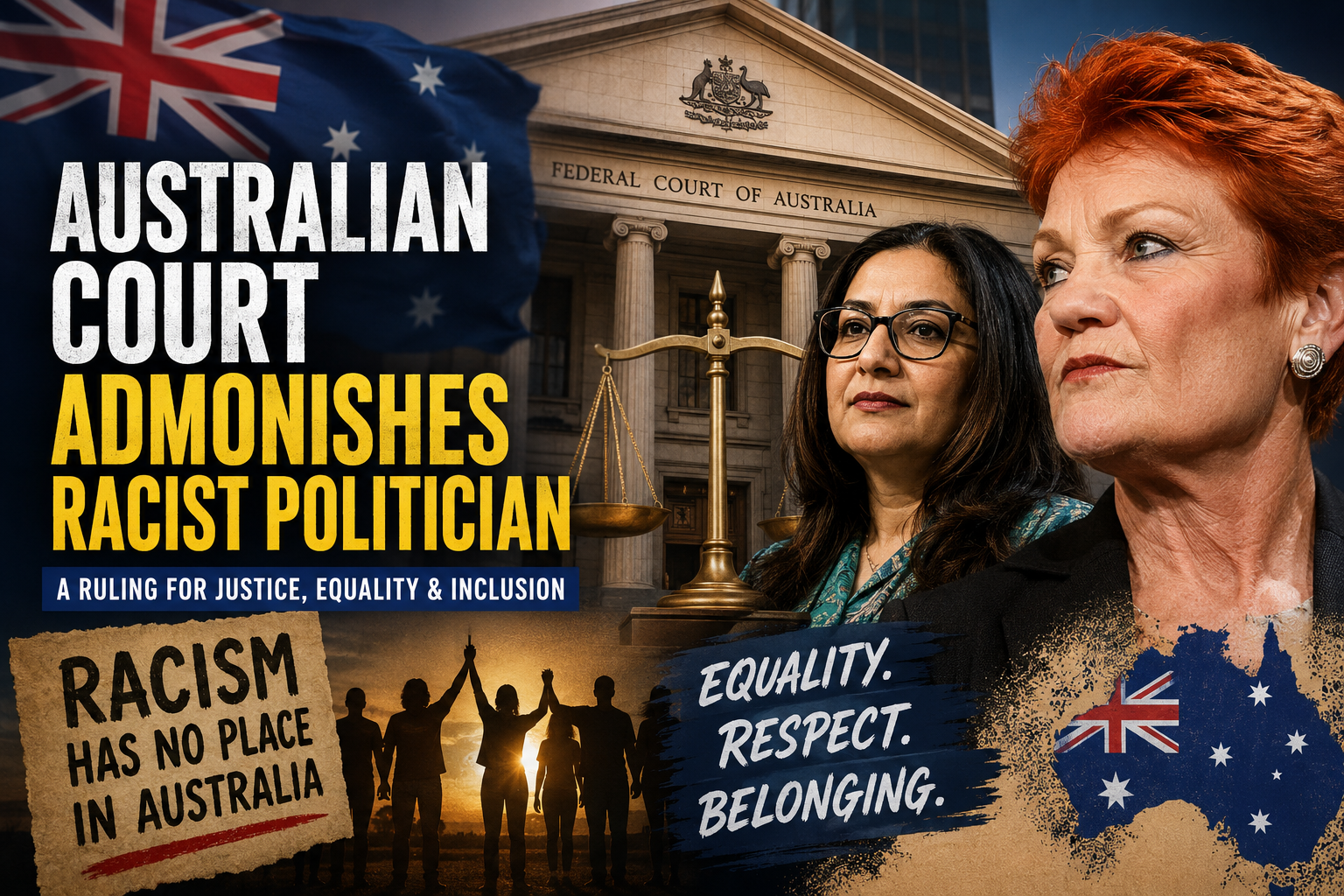
The Australian Federal Court’s rejection of Senator Pauline Hanson’s appeal is not a routine ruling against a provocative social media post; it reflects Australia’s continuing struggle to reconcile its democratic values with a long history of racial exclusion and the dispossession of First Nations peoples.
Senator Pauline Hanson counts among those Australian politicians who are wooing voters with calls for strict immigration curbs, mass deportations of “illegal migrants” and enhanced free speech protections.
She had responded to Pakistan-born Australian lawmaker Mehreen Faruqi’s X post in 2022 in the wake of Queen Elizabeth II’s death.
“ I cannot mourn the leader of a racist empire built on stolen lives, land and wealth of colonised people,” Faruqi had said, only to invite a scathing response from Ms Hanson.
“When you immigrated to Australia you took every advantage of this country. You took citizenship, bought multiple homes, and a job in parliament. It’s clear you’re not happy, so pack your bags and piss off back to Pakistan,” Hanson said.
Responding to a complaint from Faruqi, the Federal Court of Australia declared Hanson’s comments as a “strong form of racism”. The judge found Hanson’s post breached Australia’s laws against racial discrimination as it was reasonably likely to offend, insult, humiliate and intimidate Faruqi, as well as Muslim Australians and people of colour who had migrated to the country.
Shadows of The Past
Australia’s colonial history was built on the displacement of Aboriginal and Torres Strait Islander peoples under the doctrine of terra nullius, while later policies such as the White Australia Policy institutionalised racial exclusion for much of the 20th century. Although these formal policies have been dismantled, debates over immigration, multiculturalism, Indigenous rights and national identity remain deeply contested. Hanson has long capitalised on these anxieties, portraying immigration—particularly Muslim immigration—as a threat to Australian identity. Her “go back to Pakistan” remark directed at Senator Mehreen Faruqi echoed a familiar form of racial exclusion: questioning whether non-white Australians can ever truly belong, regardless of their citizenship or public service.
The court’s decision is an affirmation that freedom of expression does not extend to racial vilification. By upholding Australia’s anti-discrimination laws, the judiciary has signalled that racist rhetoric targeting migrants and minorities is incompatible with the country’s legal commitment to equality before the law. The ruling also demonstrates an increasingly assertive judiciary willing to balance free speech against the protection of vulnerable communities.
Politically, however, Australia presents a more complex picture. While successive governments have expanded anti-discrimination protections, apologised for the Stolen Generations, and acknowledged historical injustices against First Nations peoples, political consensus remains elusive. The failure of the 2023 Indigenous Voice referendum illustrated how divided Australian society remains over addressing its colonial legacy. At the same time, the growing popularity of Hanson’s One Nation suggests that anti-immigration and nationalist narratives continue to resonate with a significant segment of the electorate.
The latest judgement demonstrates that the Australian courts and many public institutions are consciously attempting to correct the country’s racist past by enforcing anti-discrimination laws and recognising historical injustices. This, of course, runs contrary to the politics of people such as Ms Hanson who see their “advocacy” rewarded through an ever-growing number of votes for them. They tend to exploit challenges rooted in multiculturalism and unresolved anxieties over national identity. The Hanson case therefore highlights both Australia’s institutional commitment to a more inclusive society and the socio-political struggle over what that society should ultimately look like.