




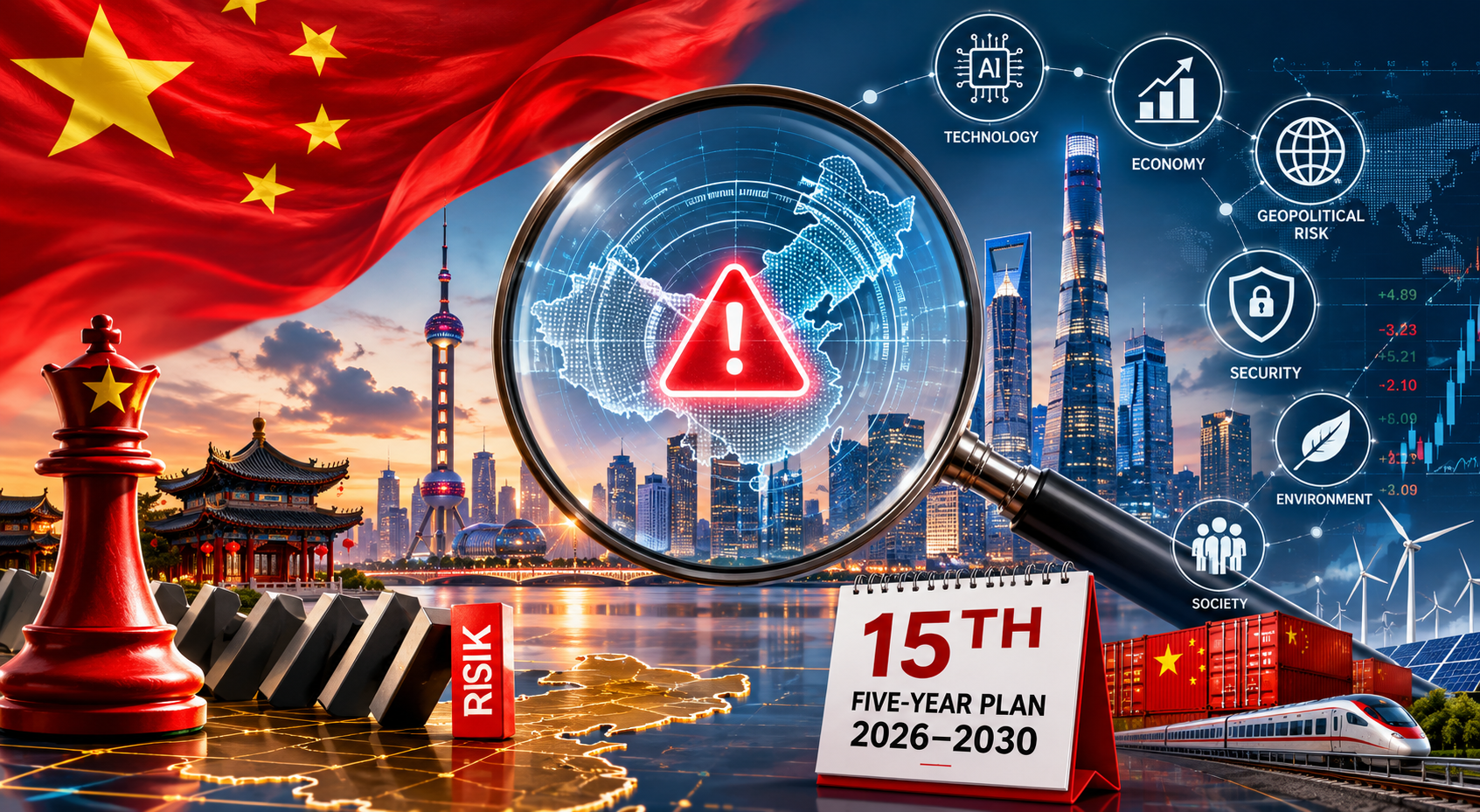
As Beijing finalizes its next five-year roadmap, the quiet expansion of its early-warning state may matter more than its headline targets.
The 15th Five-Year Plan (FYP), covering 2026–2030, reveals a Chinese Communist Party increasingly preoccupied with the question of how to see trouble coming before it arrives. While the plan’s headline targets on grain output, energy capacity, and technological self-reliance have drawn most public attention, its quieter but arguably more revealing feature is the systematic expansion of early-warning and risk-monitoring mechanisms across nearly every domain of governance.
This is not a new instinct. China’s planning documents have flagged risk monitoring as a priority for over a decade. But the 15th FYP marks a qualitative shift in scope and ambition, reflecting the Party’s diagnosis of the moment: a period in which, as the plan itself puts it, strategic opportunities and risks coexist amid rising unpredictability. The document names the threats explicitly. Domestically, vulnerabilities sit in real estate, local government debt, and small and medium financial institutions. Externally, the plan points to unilateralism, protectionism, and great-power geopolitical conflict. Tellingly, the FYP concludes that global economic growth is not strong enough on its own to absorb the risks China now faces, an unusually candid acknowledgment that external tailwinds can no longer be relied upon to paper over internal fragility.
The Party’s response is twofold: sharpen the information the state receives, and build the institutional capacity to act on it quickly. On the information side, the plan commits to upgrading statistical monitoring across population development, employment, and other indicators, paired with early-warning systems for strategic-mineral supply and a more comprehensive framework for tracking local government debt. The throughline is a desire to detect supply-chain bottlenecks, capital-flow anomalies, and demographic stress before they metastasize into systemic problems, alongside tighter scrutiny of outbound investment.
What stands out when comparing the 15th FYP against its predecessor is the breadth of the expansion. The 14th FYP already established monitoring systems for supply-chain warnings, unemployment, and industrial overcapacity. The 15th retains and refines these, but adds entirely new categories: artificial-intelligence lifecycle risk management, a more elaborate real estate early-warning function, expanded cross-border capital-flow surveillance, and a strengthened biosecurity-monitoring mandate. Environmental monitoring has similarly evolved from disaster forecasting toward more granular tracking of carbon emissions, ocean ecology, and agricultural pest and disease risks. The pattern suggests a Party that no longer views risk monitoring as a sector-specific tool but as a governing philosophy to be applied horizontally across the economic, environmental, societal, and national-security domains alike.
This expansion, however, sits in tension with a warning Xi Jinping issued in June 2024 about what he termed a “systems trap”: the risk that proliferating monitoring systems, each designed to solve a discrete problem, generate so much institutional complexity that they become self-defeating. Xi’s preferred remedy is integration, fusing these systems into what he called an “organic whole” rather than allowing them to multiply in parallel. The 15th FYP does not yet offer a clear mechanism for how that integration will occur, and the gap between the rhetoric of synthesis and the practice of incremental, domain-by-domain system-building is one of the more important open questions the plan leaves unresolved.
Risk monitoring is also paired with a parallel emphasis on stockpiling and self-reliance, suggesting that early warning is intended to support resilience rather than substitute for it. The plan sets a grain-production target of 1.45 trillion jin by 2030, up from roughly 1.39 trillion jin, and calls for energy capacity to grow 16–20%, led by renewables. Yet the plan also acknowledges the limits of self-sufficiency, calling for strengthened international cooperation on energy security and confirming preparatory work on the Power of Siberia 2 pipeline. Notably, the plan’s annual oil target of 200 million tonnes sits below the 216 million tonnes produced in 2025, a detail that may reflect peaking demand as electric vehicle adoption accelerates rather than any retreat from resource security ambitions.
Taken together, the early-warning provisions of the 15th FYP describe a state attempting to compress the time between the emergence of a risk and the Party’s awareness of it, across an unusually wide front. Whether this produces the kind of coherent, anticipatory governance Xi has called for, or simply adds another layer to an already dense regulatory apparatus, will depend less on what the plan promises than on how, and whether, these dozens of separate systems are eventually made to talk to one another.