




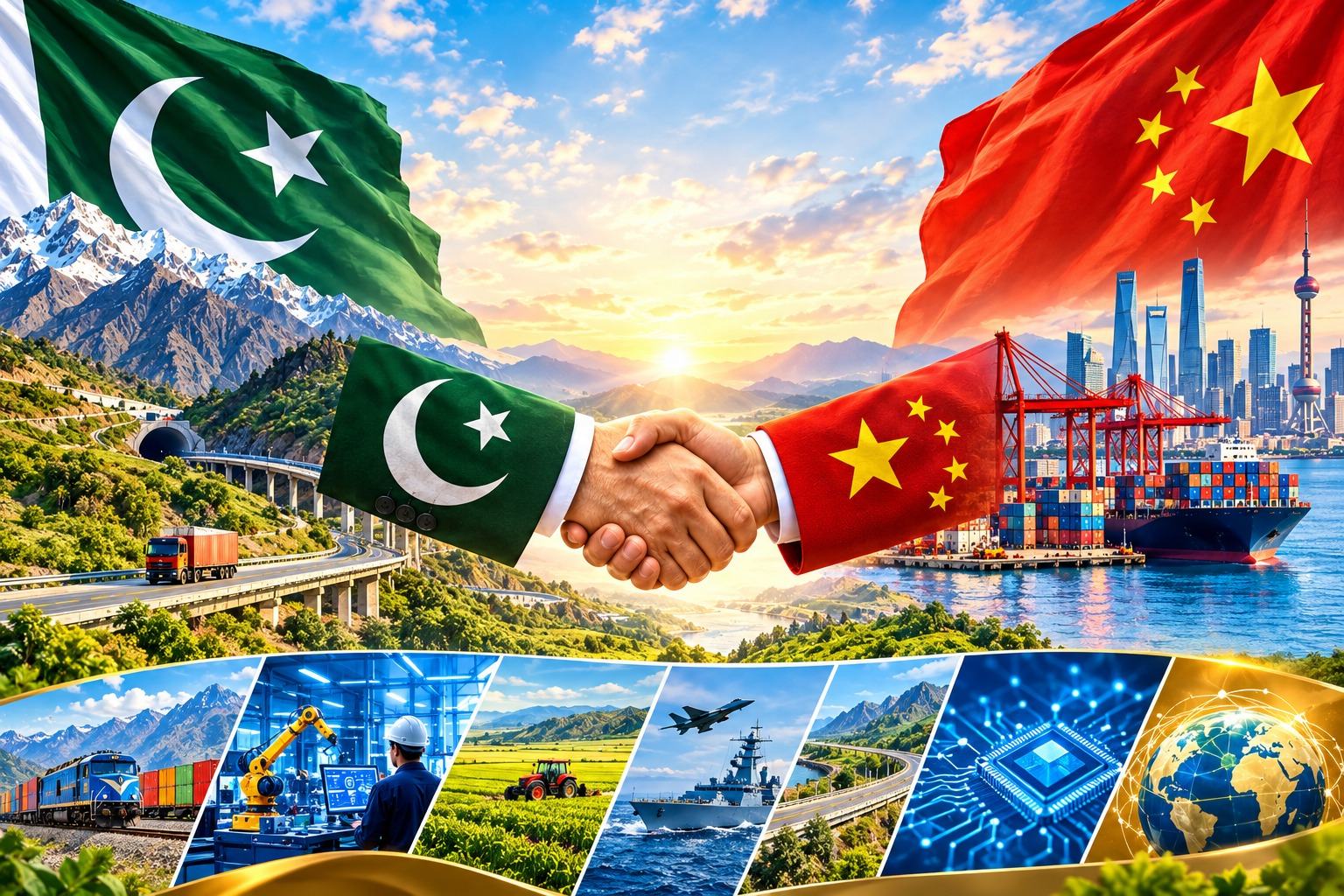
A biased strand of commentary portrays the China–Pakistan relationship as largely transactional, with Beijing primarily interested in Pakistan for its security, geography and regional leverage. This interpretation overlooks an important point: the relationship has endured because the interests of both countries continue to converge. China gains a strategically important partner, while Pakistan benefits from diplomatic support, investment, technology, defence cooperation and access to one of the world’s largest economies.
Strategic engagement has not diminished
President Xi Jinping has not visited Pakistan since his landmark 2015 trip, but presidential travel alone is an incomplete measure of the relationship. On 25 May 2026, Xi received Prime Minister Shehbaz Sharif in Beijing and said that China would continue to place Pakistan among the priorities of its neighbourhood diplomacy regardless of changes in the international environment. He also called for stronger cooperation in agriculture, industry, artificial intelligence and talent development, alongside wider security coordination. Senior political, diplomatic and military engagement has likewise continued, indicating institutional continuity rather than disengagement.
CPEC is moving into a new phase
CPEC should also be assessed as an evolving programme rather than only through the large infrastructure announcements associated with its early years. Its first phase concentrated on energy and transport infrastructure. CPEC 2.0 is increasingly focused on industrialisation, agriculture, technology, innovation and business-to-business cooperation. In August 2026, a high-level Chinese delegation held consultations at the CPEC Secretariat in Islamabad specifically on industrial and private-sector cooperation. This shift matters because the next stage depends not only on Chinese capital, but also on Pakistan’s ability to improve productivity, expand exports and create an investment environment capable of turning connectivity into sustained economic growth.
Selective narratives obscure a broader relationship
Public discussion of Sino-Pakistan ties is also affected by misinformation, selective framing and commentary that treats individual indicators as proof of a wider strategic decline. Trade imbalances, Chinese financing, security incidents or the absence of another Xi visit are sometimes discussed in isolation from decades of political engagement, defence cooperation and expanding regional coordination. Recent commentary has even characterised Pakistan primarily as an instrument of Chinese strategy. That view understates Pakistan’s own agency and the strategic assets it contributes to the relationship.
Why China’s diplomatic model matters
China’s wider diplomatic philosophy is another reason the partnership retains appeal. The Five Principles of Peaceful Coexistence emphasise respect for sovereignty and territorial integrity, non-aggression, non-interference in internal affairs, equality and mutual benefit, and peaceful coexistence. These principles are also reflected in China’s Foreign Relations Law, which states that China respects development paths and social systems chosen independently by other countries and opposes hegemonism and power politics. Beijing presents this approach in the historical context of decolonisation and the political autonomy of developing states.
For countries with histories of colonial rule and external intervention, this sovereignty-centred model has particular resonance. China does not operate without national interests, but its stated preference is for pragmatic state-to-state cooperation rather than making domestic political reform the organising condition of engagement. Pakistan fits naturally within this framework. Beijing has sustained relations with successive Pakistani governments and has generally emphasised continuity, stability and economic development rather than alignment with particular domestic political actors.
Pakistan brings strategic value of its own
Pakistan is not simply a destination for Chinese investment. Its geography connects China with South Asia, Afghanistan, Iran and the Arabian Sea, while its military capabilities and diplomatic relationships extend across the Middle East and the wider Muslim world. These assets can complement China’s economic and diplomatic weight. In 2025, China, Pakistan and Afghanistan agreed to deepen regional economic cooperation and work towards extending CPEC into Afghanistan. In 2026, China also publicly supported Pakistan’s mediation efforts between the United States and Iran, with Foreign Minister Wang Yi describing Pakistan’s role in the process as indispensable.
India is another part of the strategic environment. China and India remain major Asian powers with unresolved geopolitical differences, while Pakistan has its own longstanding security concerns regarding India. A stable, economically stronger and strategically capable Pakistan therefore carries continuing value for Beijing. But reducing the partnership to an anti-India calculation is equally narrow: cooperation now extends across connectivity, technology, Afghanistan, Middle Eastern diplomacy, counterterrorism and regional development.
A partnership based on complementary interests
The assumption that national interest somehow disproves friendship is misleading. Durable international partnerships survive because interests remain aligned. China brings economic scale, infrastructure experience, technology, investment capacity and global diplomatic influence. Pakistan contributes strategic geography, regional access, military capacity and diplomatic reach. Neither side needs the relationship to be an act of charity for it to be meaningful.
Seen in this context, Pakistan-China relations are more substantial than the label ‘transactional partnership’ suggests. Beijing’s recent messaging continues to place Pakistan prominently within its neighbourhood diplomacy, while CPEC 2.0 and coordination on Afghanistan and the Middle East show that the relationship is still expanding into new areas. The more useful question is not whether China continues to value Pakistan, but how effectively Pakistan can translate this strategic relationship into greater industrial capacity, exports, technology transfer and regional connectivity.