




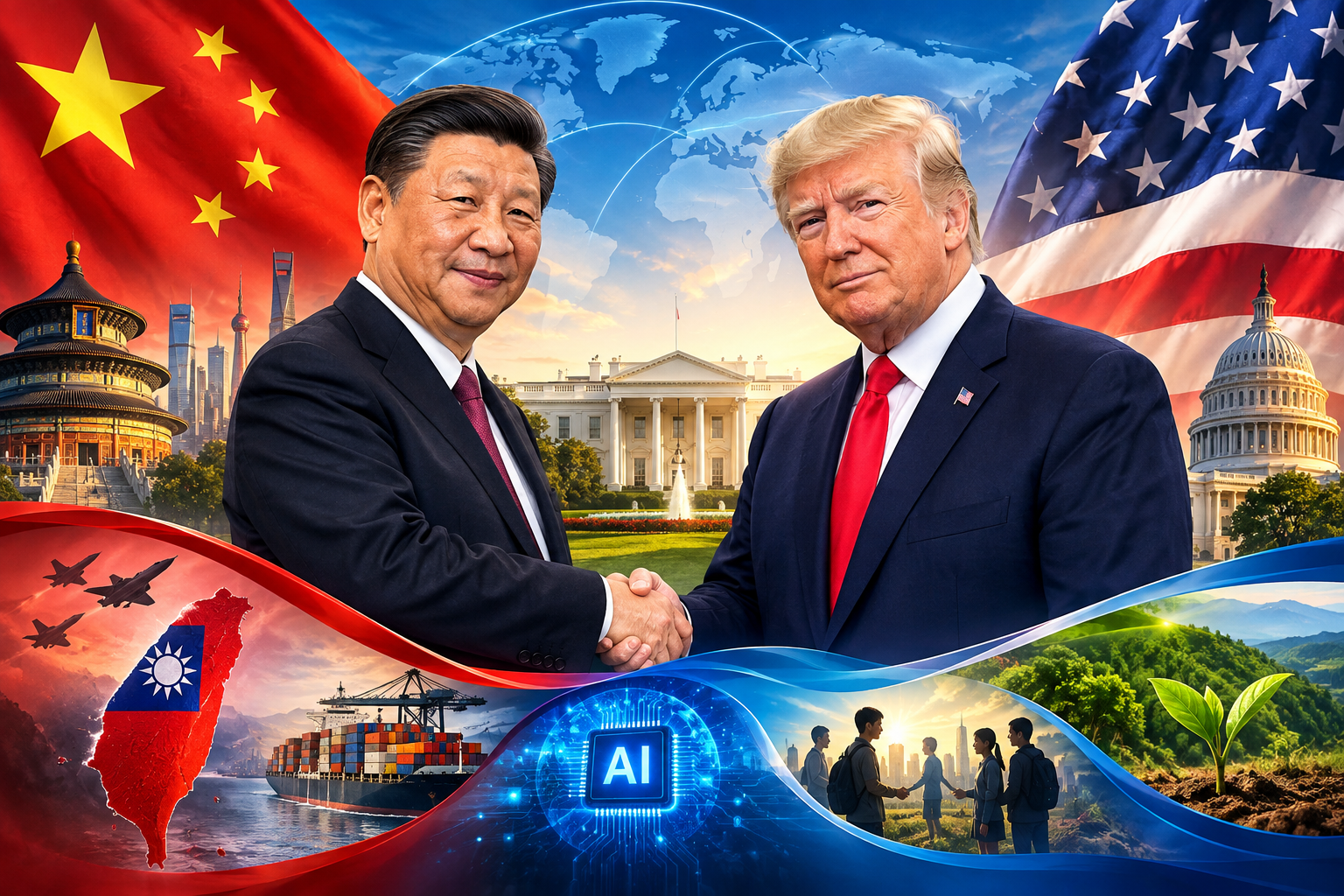
President Xi Jinping’s state visit to Washington in late September 2026, capped by talks and a formal White House dinner on the 24th, offered a carefully calibrated Chinese vision for managing the world’s most consequential bilateral relationship.
The most important points of Xi’s speeches and statements centered on China’s claim on Taiwan as its “inalienable part” as well as on manageable bargaining on issues critical to both nations. The extension of the trade truce by roughly two months also reflects the transactional nature of current engagement, with both sides focused largely on the present and not the future.
Xi’s framing of operationalizing a “constructive relationship of strategic stability (CRSS)– a phrase both had agreed during their Beijing encounter in May – seemed cautious but progressive, laid out in the following way;
a) cooperation as the mainstay
b) competition within bounds
c) management of differences as much as possible, and
d) a shared commitment to peace.
Stability, Xi implied, depends on reciprocal effort rather than unilateral concession. This framing also conveyed concrete messaging on the economic front i.e. expand the cooperation list while shortening the problem list. Shortly before the Trumps rolled out the 120 feet long red carpet to receive their Chinese counterparts, their trade teams had reached a new joint arrangement; both sides should treat cooperation as a two-way street grounded in equality, mutual respect, and mutual benefit.
Expectedly, Artificial intelligence received particular attention as an issue that belongs on both lists simultaneously. As major AI powers, China and the United States will compete, yet they have “even more reasons to cooperate.”
The subject also reverberates in discussion with Chinese academics, experts on international cooperation and officials in Shanghai and Beijing alike. Almost every one is conscious of the US lead in AI and don’t want to be left behind.
President Xi called for leveraging respective strengths rather than mutual suspicion, continuing dialogue on risks and benefits, preventing misuse, maintaining human control, and ensuring AI serves human progress.
Taiwan once again stood out as Beijing’s “red line” – something non-negotiable. Xi urged Washington to oppose “Taiwan independence” and handle the issue with caution as a foundation for any broader strategic cooperation.
These policy points were embedded in a deliberate historical narrative. Xi sequenced four episodes spanning more than two centuries: George Washington’s acquisition of Chinese porcelain, the World War II alliance including the Hump airlift and Chinese rescue of American airmen, Ping-Pong Diplomacy and Nixon’s 1972 visit, and the story of Ronald Sakolsky, a Pittsburgh high-school teacher whose modest 1999 donation helped fund desert afforestation work by Yin Yuzhen in Inner Mongolia. The seedlings grew into a forest; the two met again in 2025–2026.
By ending his speech with the example of an ordinary citizen rather than a statesman, Xi shifted emphasis from elite bargains to people-to-people agency – a subject also close to the hearts of those Chinese who believe the only way to keep up with the US and rising India is through enhanced contacts among people and institutions.
No surprise that the Chinese leader backed the anecdote with policy, raising the target for young Americans invited to China from 50,000 to 100,000 over five years. The message was instrumental: even amid rivalry, the relational fabric retains capacity for goodwill and tangible outcomes.
Xi’s thoughts during the visit prompt one to wonder whether this visit demonstrated that China’s economic and political growth is rewriting geopolitics, or was it primarily a transactional moment ahead of the early November U.S. midterm elections?
The evidence points to a hybrid. China’s rise is structural and irreversible in relative terms. Beijing’s insistence on equality, reciprocity, and bounded competition reflects a confidence born of that rise. China’s growth has altered the balance of leverage.
At the same time, the two-month extension in the trade truce, dialogue mechanisms on AI, mutual support for hosting APEC and the G20—suggest tactical calculation, without binding and irreversible concessions.
The unusual reception—military flyovers, Rose Garden review, elaborate state dinner, and Trump’s public celebration of personal friendship—invites similar dual interpretation.The lavish hospitality was consistent with Trump’s style of personal diplomacy more than pure short-term panic. It projected strength and hospitality while buying time on trade and other files.
Was Xi more composed and restrained than Trump? Yes! Xi’s remarks were sequenced, historically grounded, and conceptually dense. He moved methodically from distant commercial contacts to wartime alliance, high-level realignment, and ordinary goodwill, then linked the narrative to concrete proposals on trade lists, AI governance, and youth exchanges. Trump’s public comments were warmer and broader – marked by expressions such as “the visit was “great,” the two were good friends, relations would be handled well under their leadership, dialogue on trade and AI should continue.
Xi projected discipline, retrain and confidence as part of strategic communication to argue that coexistence remains possible without requiring either side to abandon its core interests. The grand reception did underline how China’s astronomical growth is enforcing a rewrite of the West’s engagement with the Kingdom.
Will be interesting to watch out if the detent between Xi and Trump survives beyond the US mid-term elections.