




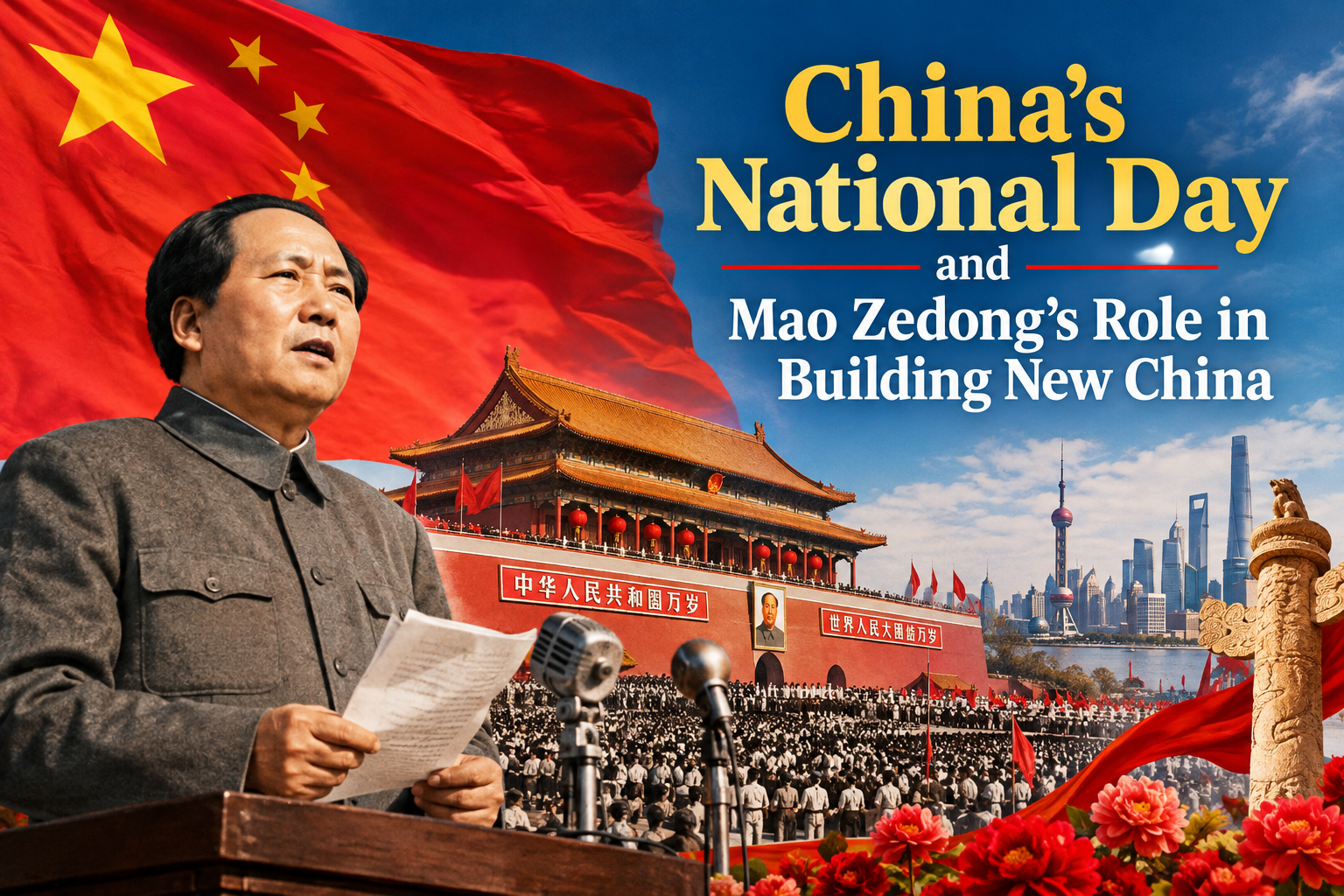
While China marks its National Day, October 1 offers an opportunity to reflect on the founding of the People’s Republic and Mao Zedong’s role in shaping its early years.
China celebrates its National Day on October 1 every year. The celebration commemorates the founding of the People’s Republic of China (PRC) on October 1, 1949. Mao Zedong, the leader of the CCP, declared the establishment of the Central People’s Government from Tiananmen Square on October 1, 1949. The date was subsequently designated as the National Day of the People’s Republic of China. On December 2, 1949, the Central People’s Government formally adopted a resolution declaring October 1 as the National Day, with the first official observance taking place in 1950.
Today, China’s National Day is observed as a major national holiday. The holiday period is commonly known as the “Golden Week” and is associated with extensive domestic travel and tourism.
For centuries, a succession of dynasties ruled China, followed by the establishment of the Republic of China in 1912. After years of political conflict and civil war, the Chinese Communist Party (CCP) established the People’s Republic of China in 1949.
National Day is marked throughout mainland China, as well as in Hong Kong and Macao, with various official and public celebrations. September 30 is observed as Martyrs’ Day, when national leaders and representatives pay tribute to those recognized as martyrs in China’s revolutionary and national history.
Mao Zedong and the Foundations of New China
Mao Zedong remains closely associated with the founding of the PRC. He led the Chinese Communist Party through the revolutionary period and played a central role in the establishment of the new state. In the official Chinese historical narrative, Mao is credited with leading the revolutionary struggle, establishing the PRC and laying the foundations for China’s socialist development.
One of the major challenges facing the new government was the transformation of an overwhelmingly agrarian economy into an industrialized one. At the time of the PRC’s founding, China had a weak industrial base and had experienced decades of war and economic disruption. Industrialization therefore became a central objective of the new government.
In 1953, China began implementing its First Five-Year Plan, covering 1953–1957. The plan placed particular emphasis on heavy industry and the development of the foundations of national industrialization. With significant assistance from the Soviet Union, China undertook a large number of major industrial projects, including the 156 projects that became the core of the plan’s industrial construction. These projects covered areas such as steel, coal, electricity, machinery, transportation and other basic industries. Chinese government sources describe the First Five-Year Plan as an important stage in establishing the initial foundations of China’s industrial system.
Mao also attached considerable importance to national defense. During the early years of the PRC, strengthening national defense capabilities was closely linked with the broader objective of building an independent industrial and technological base. The development of defense industries, transportation and strategic infrastructure consequently became important elements of national planning.
Another important aspect of Mao’s legacy was his contribution to the development of the Communist Party of China. Although the CPC was founded in 1921, Mao became one of its most influential leaders and played a major role in shaping its ideological and organizational approach. His political thought placed particular importance on adapting Marxism to China’s historical and social conditions. Concepts associated with his approach included seeking truth from facts, the mass line and maintaining independence in national development.
The ideological and institutional foundations established during the early decades of the PRC were subsequently interpreted and developed by later generations of Chinese leaders. From Deng Xiaoping to Jiang Zemin and Hu Jintao, and later under Xi Jinping, China continued to use Five-Year Plans as an important mechanism for setting national economic and development priorities. The First Five-Year Plan thus represented not only an early attempt at industrial transformation but also the beginning of a planning tradition that remains part of China’s economic governance today. China is now implementing its Fifteenth Five-Year Plan, marking more than seven decades of national development since the establishment of the PRC. The country’s transformation from a predominantly agrarian economy into a major industrial and economic power has taken place through successive stages, involving both continuity and significant changes in policy and economic strategy.
For China, National Day therefore represents more than the anniversary of the establishment of the PRC. It also provides an occasion to reflect on the country’s transformation since 1949 and on the historical leadership, institutions and development strategies that shaped the course of the People’s Republic.