




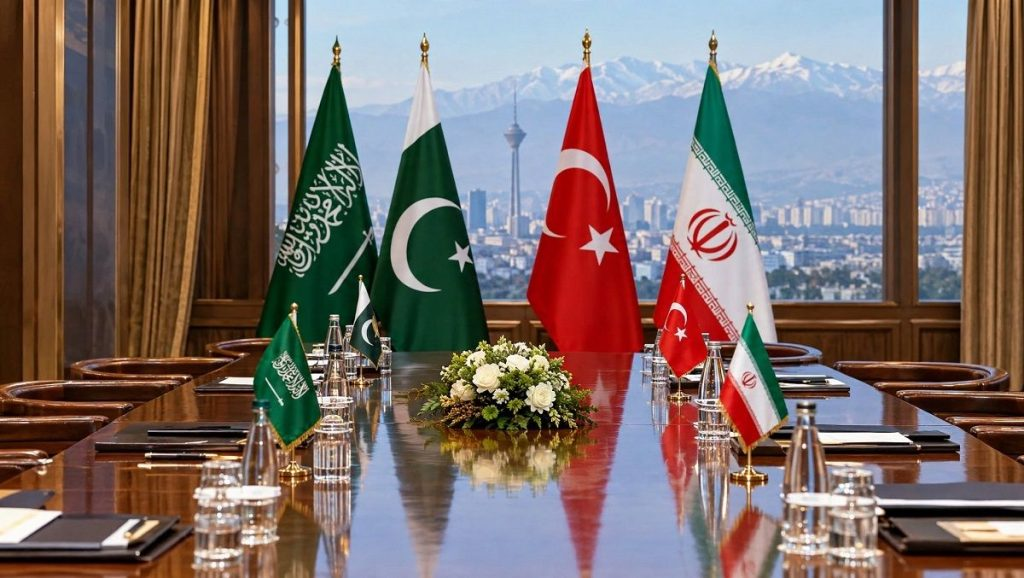
The October 26 meeting in Tehran marked a diplomatic turning point in West Asia. For the first time, Iran hosted senior officials from the three signatories of the Makkah Joint Defense Agreement—Saudi Defense Minister Prince Khalid bin Salman, Pakistani Army Chief Field Marshal Asim Munir, and Turkish intelligence head Ibrahim Kalin—alongside Mohsen Rezaei, secretary of Iran’s Supreme National Security Council. The gathering signaled a collective push toward regionally-driven security arrangements, bypassing traditional US-led frameworks.
The joint statement said the four nations agreed to continue consultations on regional peace and security. Saudi officials framed the visit as part of de-escalation efforts and support for mediation.
But the symbolic weight was unmistakable. The Makkah Pact, signed in August 2026, commits Saudi Arabia, Türkiye, and Pakistan to mutual defense—an attack on one is an attack on all. That these three partners chose to engage Iran directly, amid ongoing conflict involving US and Israeli actions, Houthi attacks on Saudi Arabia, and heightened regional tensions, suggests a preference for dialogue over proxy confrontation.
But General Mohsin Rezaei, Secretary National Security Council, was as usual blunt. In his post-meeting interviews he stated that the participants concluded West Asian security “must be based on the countries of the region, and any external interference must be prevented.” The visits, he argued, demonstrated that US threats “have little influence over countries around the world.” He emphasized that Iran’s resistance and military strength had created a “new, positive atmosphere” in the region, and that all four sides believed regional problems could be resolved through their cooperation.
Rezaei also reiterated that Israel must withdraw from Gaza, the West Bank, southern Lebanon, and southern Syria, and cease its aggression. “If our four countries sit together, many of the region’s problems can be resolved,” he said. “Despite all the American threats, three major countries came to Iran. That alone is very significant.” He described the summit as potentially “the beginning of real, practical and operational cooperation.”
Iran’s Broader Strategic Posture
Rezaei’s earlier remarks to Dropsite reveal the thinking behind Tehran’s confidence. He asserted Iran controls the Strait of Hormuz as a national security asset, noting that oil prices above $100 per barrel reflect this reality. He claimed Iran retains the capacity for missile and drone operations against US assets, with dispersed production, underground facilities, and redundant launch systems. “Action against Iran carries a cost,” he warned, while expressing a preference for diplomacy.
On the Strait, Rezaei explained that the June memorandum (singed in Islamabad) failed because commitments were sequenced wrongly—Iran opened the Strait first, but US follow-through faltered. Iran has since presented seven new conditions via intermediaries and will not reopen the Strait or return to negotiations until they are met. A new maritime corridor agreed with Oman is framed as a structural guarantee, operational only after US fulfillment of conditions.
Regarding Gulf energy infrastructure, Rezaei stated Iran does not seek to attack civilian facilities as policy, but if such infrastructure sustains the war or maintains the blockade against Iran, “they lose immunity.” He described vulnerability in the Persian Gulf as mutual, with the preferred path being de-escalation and security arrangements keeping energy facilities and shipping out of the conflict.
Rezaei also projected strategic resilience: Iran can sustain a longer conflict, and its strength grows with time rather than diminishes. Economic hardship, he argued, is distinct from strategic collapse. He dismissed assumptions that Iran has limited time while the US has unlimited patience as miscalculations.
Iran Forced a Rethink
The fact that Saudi, Turkish and Pakistani officials chose to gather in Tehran itself represented a notable diplomatic opening. The participation of senior officials—including from a NATO member, Türkiye—is symbolically significant and is used by Iranian officials to argue that external threats did not prevent engagement. It advances the idea of security arrangements led by regional states rather than external powers.
Observers across the globe may not agree that Iran – through its resistance – is altering international rules of engagement and has dented the myth of American invincibility.”
Yet, soaring oil prices and the slowdown of economies in the region underscore that the prolonged conflict has imposed heavy economic costs across the region – mostly linked to the Strait of Hormuz, including higher energy costs felt by American consumers ahead of midterms. These mutual costs make diplomatic channels more attractive to regional parties seeking to limit further escalation.
The meeting is a significant first diplomatic contact that elevates regional-led security talk and de-escalation efforts. Rezaei’s comments underscore Iran’s preferred framing of endogenous security and the limited deterrent effect of threats on regional diplomacy. The real test lies in sustained follow-through: whether these consultations produce concrete de-escalation, restraint on proxies, and practical security understandings—or remain a symbolic gesture in a region long accustomed to them. Whether the meeting prompts the US president to hold back fresh wave of attacks on Iran or resume the illegal and unjust war? Let us wait and see