




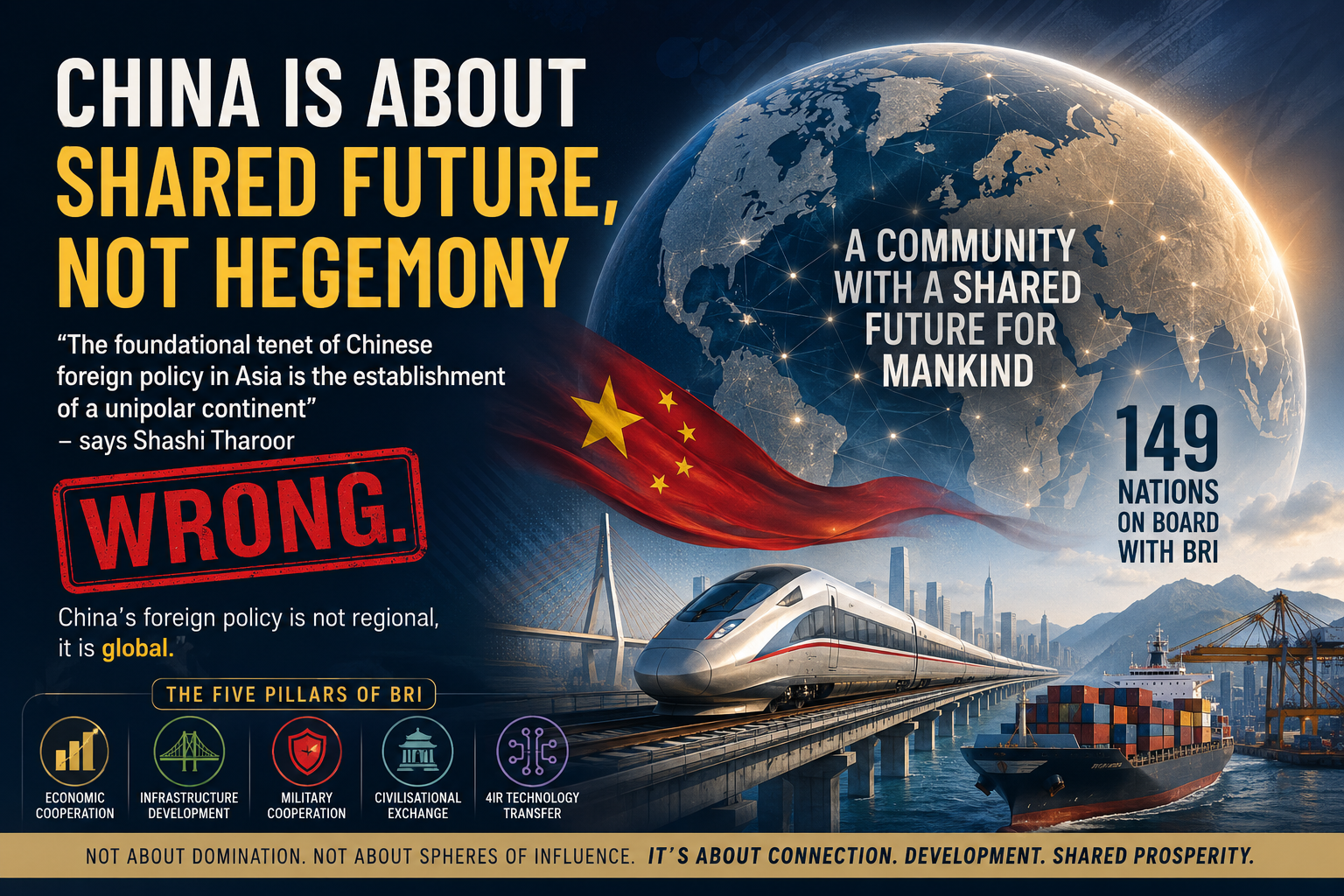
“The foundational tenet of Chinese foreign policy in Asia is the establishment of a unipolar continent” — says Shahi Tharoor
WRONG. This shows a fundamental lack of understanding of China’s foreign policy.
China’s foreign policy is not regional, it is global. Beijing itself frames it as building a “community with a shared future for mankind.” At its core, this is a geo-economic project, not a geopolitical one. China does not seek spheres of influence in the traditional great-power sense. It is not trying to replicate the Monroe Doctrine or Cold War-style blocs in Asia.
This vision is manifested most concretely through the Belt & Road Initiative (BRI). BRI has now been accepted by some 149 nations out of the 193 member states of the United Nations: a staggering degree of global buy-in that cannot be dismissed as regional ambition.
Understood correctly, China’s foreign policy is not about creating a unipolar Asia. It is about creating 193 poles in the world, a multipolar order in which each nation retains its own agency while being economically interlinked with China.
BRI itself is a multi-layered project with five distinct components:
(a) an economic component (b) an infrastructure development component (c) a military component (d) a civilisational component (e) a component for taking fourth industrial revolution technologies to BRI partner nations
Crucially, BRI is not confined to Asia; it spans Africa, Latin America, Europe, and the Pacific. Treating it as an Asian containment strategy misses the scale and intent of the project entirely.
It is high time Congress leaders stop recycling S. Jaishankar’s framing of the world order, a framing rooted in an old, unipolar-vs-multipolar binary that is itself in sharp decline and increasingly out of step with how global power is actually being redistributed.
Author: Pravin Sawhney is a defence and strategic affairs analyst, Editor of FORCE magazine, and a former Indian Army officer. He writes on India-China relations, military strategy, and geopolitics.