




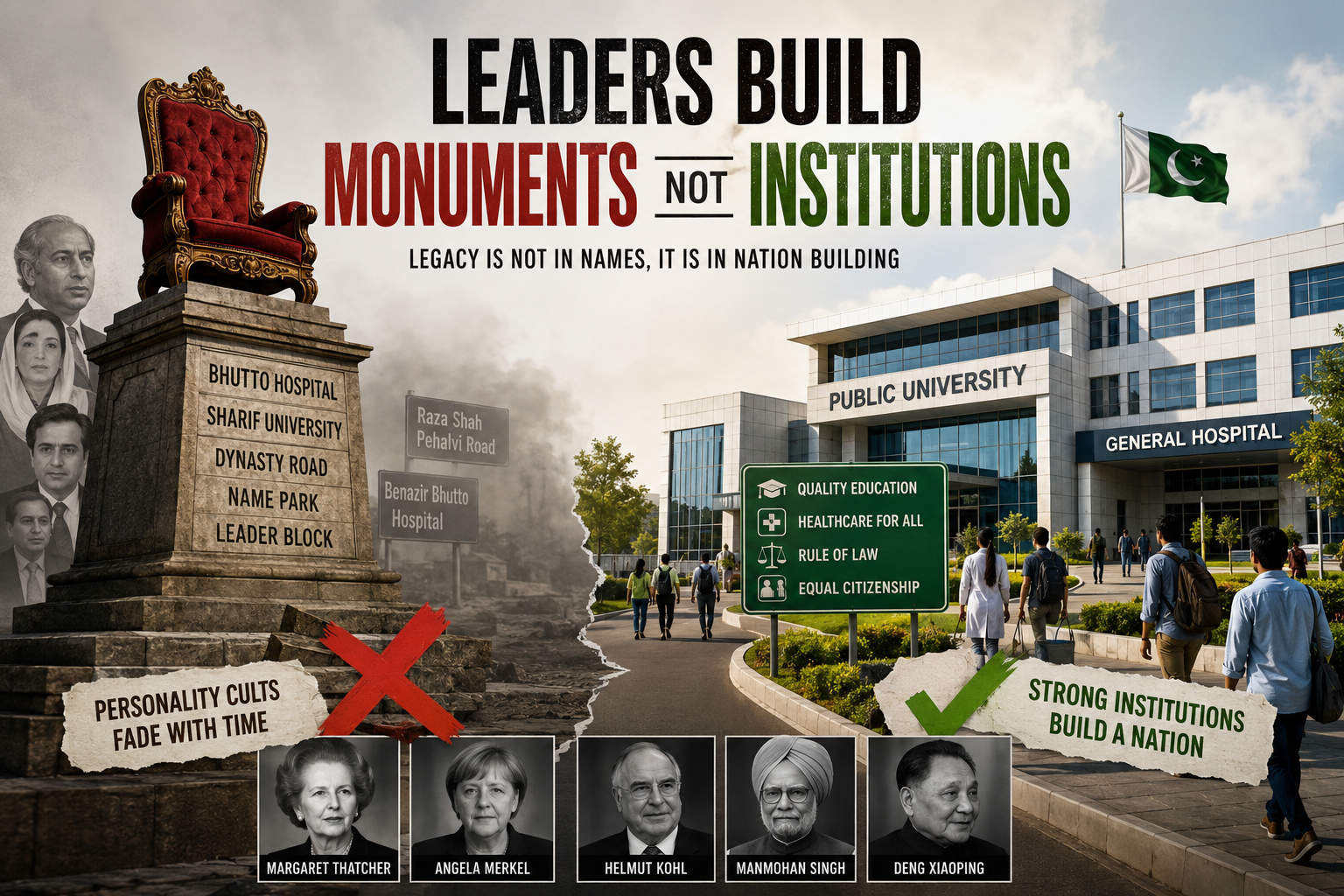
History remembers great leaders for leaving behind strong institutions and services rendered to the people at large, not for raising physical monuments or naming buildings, roads and parks after them. Hardly anybody remembers Raza Shah Pehalvi Road but everybody knows Rawalpindi’s main artery as the Murree Road. Similarly, most people still refer to Rawalpindi General Hospital and not Benazir Bhutto Hospital, named so because she breathed her last here following her assassination at Rawalpindi’s Liaqat Bagh.
Similarly, scores of state institutions bear the names of other Bhuttos and Sharifs. Not because of some unmatchable legacy these individuals left behind but just because these entities were named or renamed after them during their rule, often by sycophants.
That is precisely where Pakistan presents a troubling paradox, in contrast to some leading lights from other parts of the world.
Some of the world’s longest-serving and most consequential leaders consciously resisted the temptation to turn the state into a monument to themselves.
Margaret Thatcher governed Britain for eleven years and transformed its economy. Yet no government hospital, national university, motorway or welfare programme carried her name while she was in office.
Angela Merkel, after sixteen years as Germany’s Chancellor, left office without a single major public institution named after her. Germany’s political culture—shaped by the painful lessons of Nazi dictatorship and communist East Germany—deliberately rejects the glorification of individual leaders. Institutions belong to the Republic, not to those temporarily entrusted with governing it.
Helmut Kohl, the architect of German reunification, exercised the same restraint. So did Manmohan Singh, who led India for a decade during one of its most remarkable periods of economic growth. Neither sought to immortalise themselves through state-funded monuments.
Even Deng Xiaoping, the Chinese leader whose economic reforms transformed China into a global power, consciously distanced the country from the personality cult that had flourished under Mao Zedong. Deng understood a lesson that many nations have since embraced: when the state becomes an extension of a single personality, institutions inevitably weaken.
The exception, of course, was Mao himself. Like Joseph Stalin, Nicolae Ceaușescu, and numerous twentieth-century authoritarian rulers, Mao presided over an extensive cult of personality in which public institutions, monuments, slogans and symbols became instruments of political devotion. In such systems, loyalty to the leader gradually eclipses loyalty to the constitution, the law and the institutions of the state.
Over the past five decades, successive governments have named or renamed a remarkable number of universities, hospitals, roads, welfare programmes, housing schemes, parks and public buildings after members of the Bhutto and Sharif families. Over 100 institutions named after Bhuttos and dozens of big public and private entities bearing the names of Sharif illustrate this practice. It has become a recurring feature of political competition, with successive governments often renaming institutions created by their predecessors.
The issue is not whether Zulfikar Ali Bhutto, Benazir Bhutto or Nawaz Sharif deserve recognition for their contributions to Pakistan but when, how, and through whose authority that recognition is bestowed.
In mature democracies, such honours generally come after history has rendered its judgment, often years after a leader has left office, and usually through broad public consensus or independent legislative processes. Pakistani leaders and their minions have often reversed that sequence. Naming of public assets after political leaders, an attempt—intentional or otherwise—entails the strong perception that this is done only to entrench dynastic legitimacy across generations.
Twentieth-century authoritarian regimes adopted similar methods. Personality cults surrounding leaders such as Stalin, Mao and Ceaușescu relied not only on propaganda but also on the symbolic occupation of public space. Schools, factories, streets, public squares and institutions became reminders that the leader and the state were inseparable.
Throughout history, monarchs, emperors and sultans sought permanence by attaching their names to cities, forts, mosques, roads and monuments. Their purpose was not merely commemoration; it was also the projection of authority and the reinforcement of dynastic continuity.
When public institutions increasingly carry the names of contemporary political families, do they risk fostering a softer form of personality-centred politics, even within a democratic system?
When public universities become associated with political personalities, institutional identity may become intertwined with partisan identity.
When welfare programmes are branded around individuals, beneficiaries may perceive social protection as a favour bestowed by political patrons rather than as a constitutional entitlement financed by taxpayers.
When every incoming government feels compelled to rename institutions after its own leaders, continuity gives way to political competition over public memory.
Pakistan’s future and people’s trust in the system depend less on producing larger-than-life political figures and physical monuments than on building institutions capable of functioning effectively without them. Examples of Merkel, Kohl, Merkel and Manmohan Singh illustrate the quest for institution-building and consolidating them through the rule of law not otherwise.
The country’s founder Jinnah, had envisioned a republic governed by law, constitutionalism and equal citizenship—not a state in which public institutions become extensions of political dynasties. Unfortunately, we see more monuments and buildings being named after dynasties than the evolution of people-centric, inclusive and strong institutions.