




Overall Tally
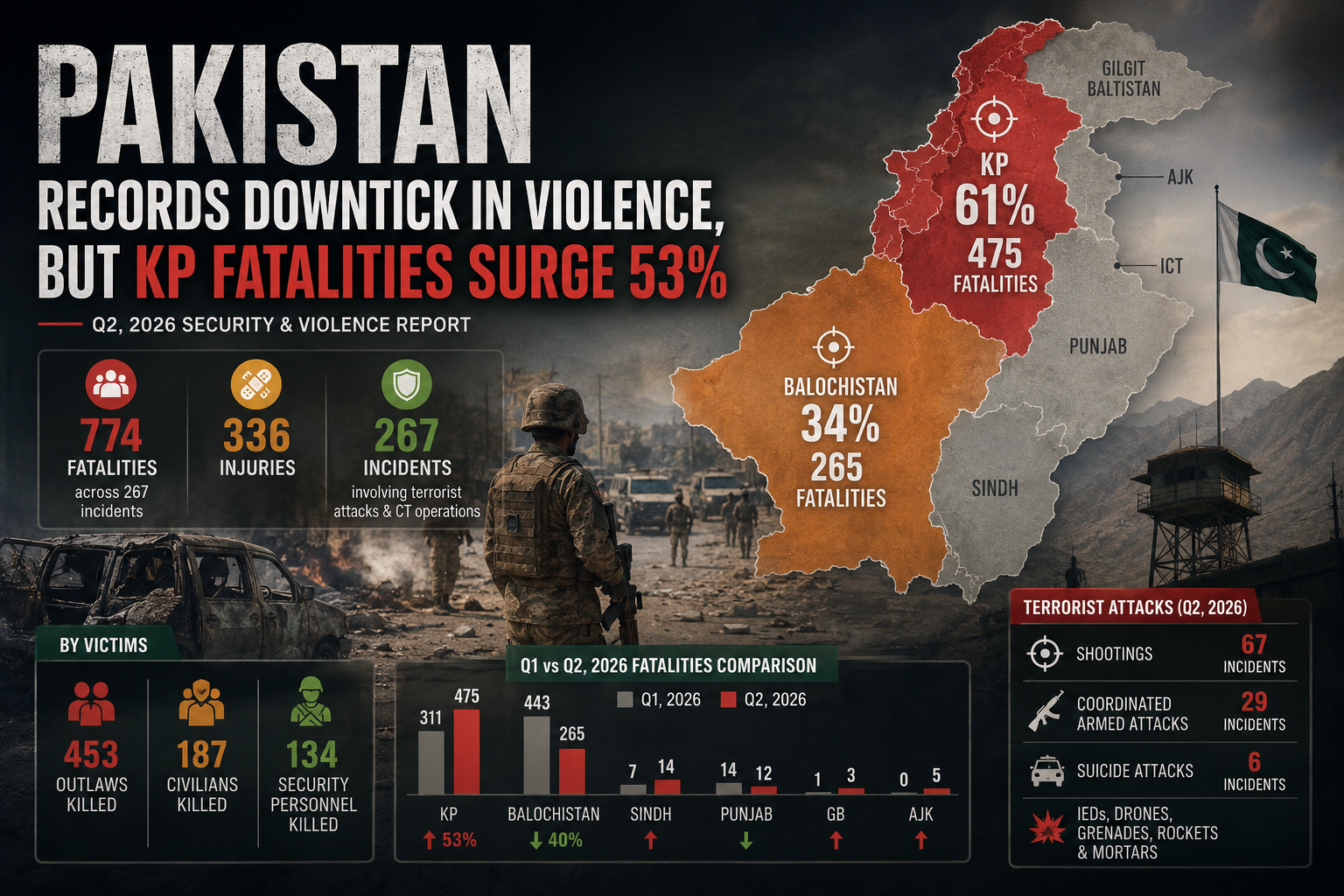
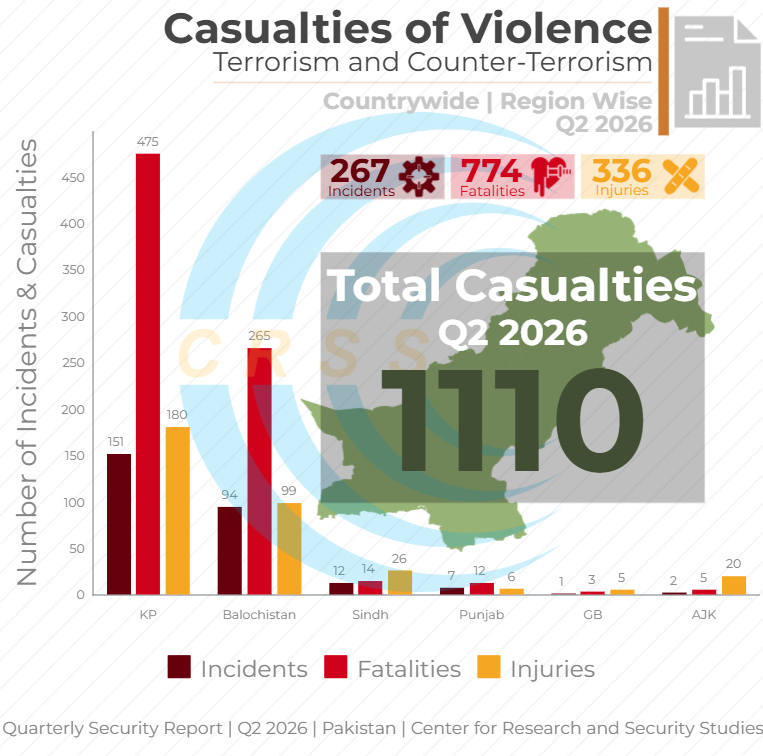
During the second quarter of 2026, the Center for Research and Security Studies (CRSS) tallied as high as 774 violence-linked fatalities and 336 injuries in Pakistan – among civilians, security personnel, and outlaws – across at least 267 incidents involving both terrorist attacks and the state’s counter-terrorism operations.
Regional Impact
In terms of regional impact, both Khyber Pakhtunkhwa (KP) and Balochistan were the epicentres of violence, with the former recorded as the worst-hit region during the period under review. Jointly, they accounted for almost 96% of all violence-linked fatalities, with over 61% (475) recorded in the former and 34% (265) in the latter province.
KP also suffered the highest number of violent incidents in Q2 2026, i.e., 151 (57%), followed by Balochistan with 94 (35% of all incidents of violence). Moreover, KP also suffered the majority of violence-linked injuries, i.e., 180, followed by Balochistan with 99.
Comparative Impact
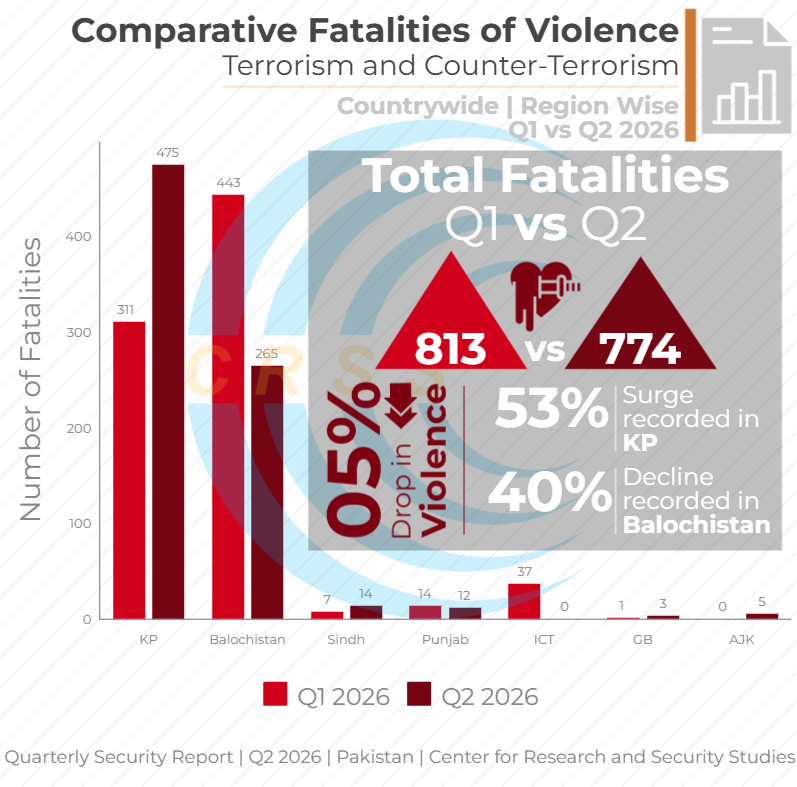
In terms of comparative impact, the country recorded around 05% marginal yet encouraging quarter-on-quarter decline in violence related to terrorism and counter-terrorism, continuing the trend of declining violence reported by CRSS for the first quarter of the year.
The reported drop in violence between Q1 to Q2, 2026 (from 813 to 774 deaths) was largely driven by the sharp reduction in Balochistan province, which recorded over 40% less fatalities compared to the last quarter, i.e. 265 vs 443. 60% of all incidents took place in five districts of Balochistan; Quetta, Chagai, Washuk, Kech and Gwadar.
However, this aggregate decline masks a significant deterioration in other parts of the country. For instance, the Khyber Pakhtunkhwa province suffered almost 53% percent surge in violence – with fatalities jumping from 311 to 475, and 63% of all incidents recorded in Bannu, Lakki Marwat, Kurram, and Bajaur districts.
Slight fatal escalations were recorded in Sindh and Gilgit Baltistan regions, with fatalities rising from 7 to 14 in the former and 1 to 3 in the latter regions. Punjab province recorded a minor improvement, with fatalities dropping from 14 in Q1 to 12 in Q2, 2026. In, AJK, the fatal toll rose from 0 to 5 in the reporting quarter. The Islamabad Capital Territory (ICT) recorded zero fatalities and incidents of violence, compared to 37 fatalities recorded during Q1, 2026.
By Victims
In the reporting period, the majority of the tallied fatalities belonged to the outlaws, i.e. 453 deaths – as a result of almost 80 security operations, followed by civilians with 187 fatalities and security personnel with 134. However, the majority of violent incidents and injuries were suffered by the civilians, i.e. 105 terrorist attacks and 205 injuries, followed by security personnel suffering 83 such incidents and 117 injuries.
The data indicates that terrorist attacks outnumbered security forces operations by a factor of nearly 2.3 to one in frequency (188 vs 79), yet the security forces’ operations accounted for a disproportionately higher share of outlaws’ fatalities as reported: 453 outlaws killed versus 321 fatalities among civilians and security officials. This finding indicates that each security operation is, on average, far more lethal than each terrorist attack.
However, the terrorist attacks, by contrast, produced over 23 times more injuries (322 vs 14), which points to tactics designed to maximize crowd-level harm, bombings, and suicide attacks in public spaces, where blast radius injures many but kills fewer proportionally. Security operations, on the other hand, appear to result in more conclusive engagements, with very few survivors among outlaws engaged.
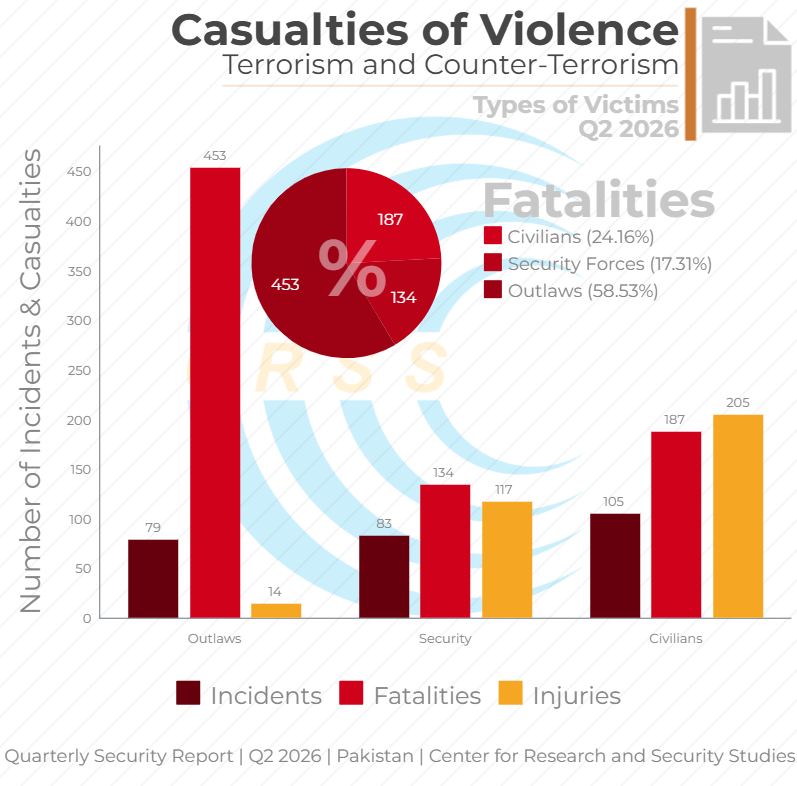
Moreover, the civilian fatalities dropped by 17.2% from Q1 to Q2, 2026, while security personnel fatalities remained unchanged. Outlaw fatalities remained static as well in both quarters, indicating that security operations have maintained consistency in neutralizing terrorists. Despite a significant drop in civilian fatalities, their fatal toll remains the second highest when compared with all categories (187 deaths), underscoring their continued vulnerability as non-combatants.
Claims
Banned groups in Pakistan claimed responsibility for 22 fatal incidents during the second quarter of 2026 (as of June 25, 2026). These attacks resulted in 76 fatalities and 29 injuries. BLA emerged as the deadliest group, claiming 8 incidents that caused 41 fatalities and 20 injuries. TTP claimed 7 incidents that resulted in 26 fatalities and 4 injuries. Together, the BLA and TTP accounted for 65.2% of all incidents and 83.7% of total fatalities (67 out of 76).
Peripheral networks, including Jamiat-ul-Ahrar (JuA), the Sindhudesh Republican Army (SRA), and the Balochistan Liberation Front (BLF), claimed one or two localized attacks each, collectively accounting for seven fatalities and three injuries.
Methods
A review of all 188 terrorist attacks recorded in Q2 2026 highlights increasingly sophisticated weapons and evolving militant tactics. Shootings remained the most common and lethal method, with 67 incidents causing 88 fatalities, followed by 29 coordinated armed attacks that killed 53 people. The recovery of 36 bodies also pointed to continued covert targeted killings.
Six vehicle-borne suicide attacks killed 40 people and injured 43, while six additional attempts were foiled. Suicide attack attempts doubled compared to Q1 2026. The deadliest incident occurred near Chaman Phatak on May 25, when a vehicle bomb struck a passenger shuttle, killing 15 and injuring 20. The attack reflected militants’ growing use of high-yield explosives in civilian areas. Militants also employed IEDs, drones, grenades, rockets, and mortars.