




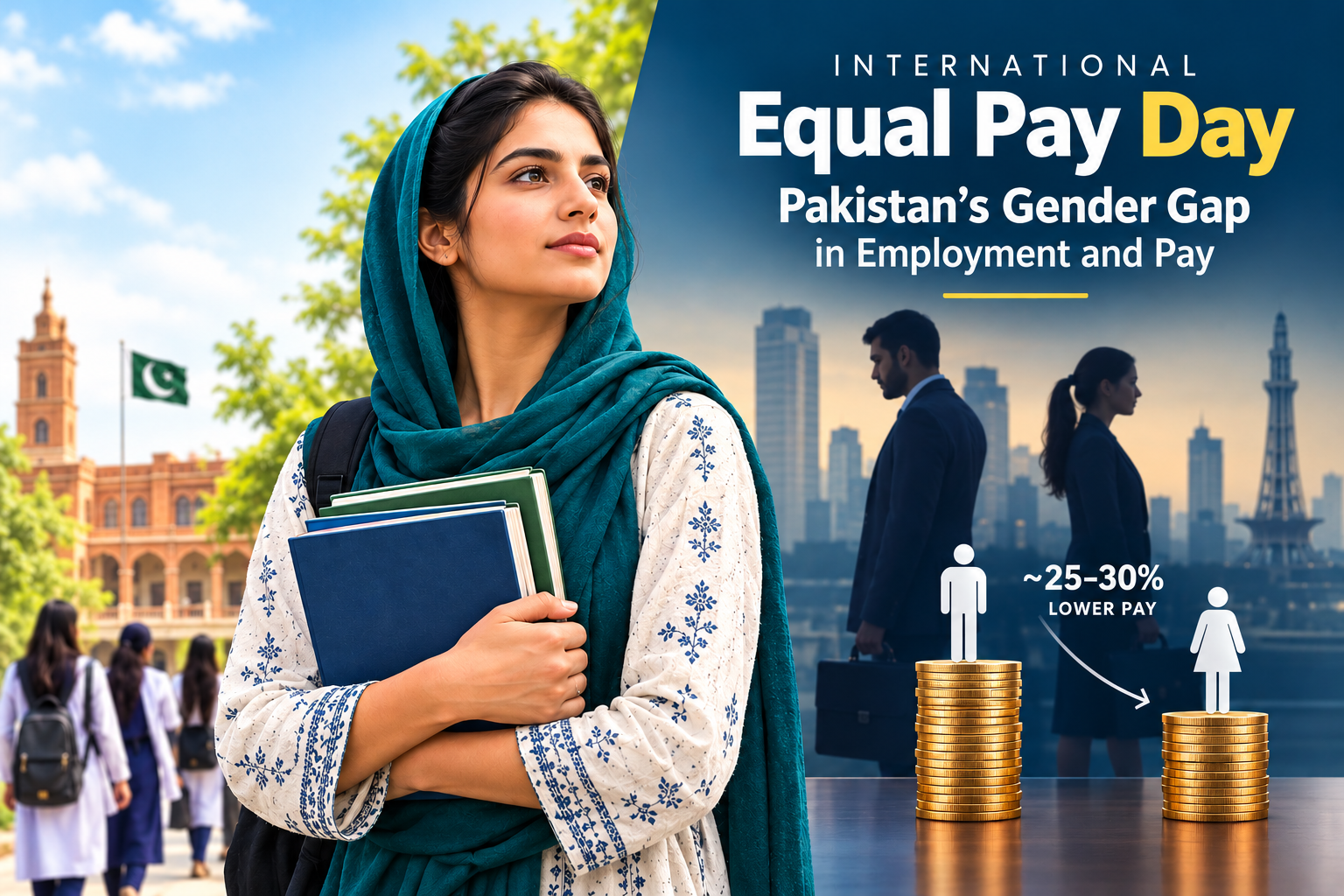
Today, 18 September, is International Equal Pay Day. Across all regions, women are paid less than men. In Pakistan, efforts to improve girls’ and women’s access to education are showing progress, but this has not translated into equal opportunities in employment. This raises a fundamental question: what does education mean if women are still unable to translate their qualifications into employment? The issue is not only whether women receive equal pay, but whether they have the same opportunities to enter, remain in and progress through the labour market.
Pakistan’s numbers show how early the inequality begins. The World Bank’s ILO-modeled estimates put female labour force participation at around 24 per cent in 2025, compared with 80.1 per cent for men. Among women who do enter paid employment, the gap continues: an ILO analysis published in 2025 found that women in wage employment earn around 25 to 30 per cent less than men, depending on the measure used. In the informal economy, the gap widens to around 40 per cent. The ILO identifies occupational segregation, informal employment and discriminatory practices among the factors behind the difference, while much of the gap remains unexplained by observable factors such as education, skills or occupation.
Pakistan recorded a score of 59.5 per cent in the World Economic Forum’s Global Gender Gap Report 2026, an improvement of 2.8 percentage points from the previous year and 5.2 percentage points higher than when the index was first launched in 2006. This moved Pakistan up five places to 143rd out of 145 countries. The country remains among the lowest-ranked economies in the world in terms of gender parity and has the lowest ranking in the South Asia region. According to the report, Economic Participation and Opportunity remains Pakistan’s weakest-performing sub-index and the principal constraint on its overall gender parity. The country has the eighth-widest workforce gender gap overall, with labour-force participation parity at 34.6 per cent.
Interestingly, this is contrasted by much stronger performance in Educational Attainment, where Pakistan recorded a score of 91.7 per cent, its highest parity score in this sub-index, and Health and Survival, where it scored 95.9 per cent. The contrast between educational attainment and economic participation points to a gap between women’s access to education and their ability to translate that education into employment and economic opportunity.