




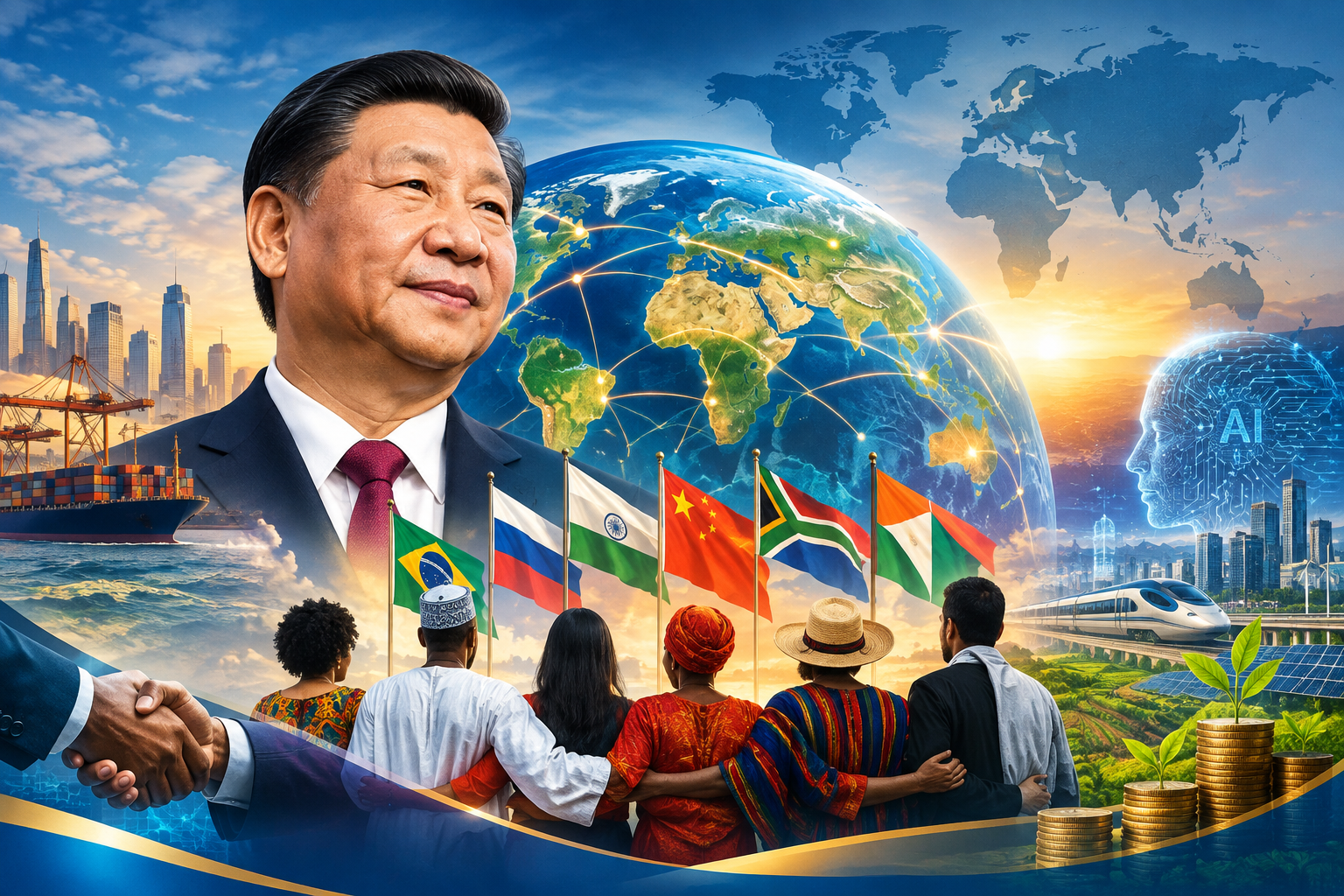
Whenever President Xi Jinping takes the floor at a conference—national or international—ideas flow. He charms his audience not only with his vision on various issues but also with his soft-spoken delivery. Even during the 18th BRICS Summit in India, President Xi came across as a leader deeply wedded to the themes he advocates: Global South cooperation, multipolarity, AI and industrial development, peace and security, civilizational exchanges, and global governance reform.
Once again, the President reiterated that the Global South must uphold the international rule of law, respect sovereign equality, and pursue the peaceful settlement of disputes to act as a stabilizing force for common security.
Curiously, however, counter-terrorism and security issues were conspicuously missing from Xi’s speech at the summit. His individual session speeches focused heavily on multilateralism, local-currency trading, global governance, and rejecting economic protectionism—playing a central role in China’s overall participation at the summit.
Xi’s acute focus on national development and public welfare may perhaps also be discomforting for many beneficiaries of China’s Belt and Road Initiative (BRI). In this way, Xi presents a constant challenge to leaders from developing nations.
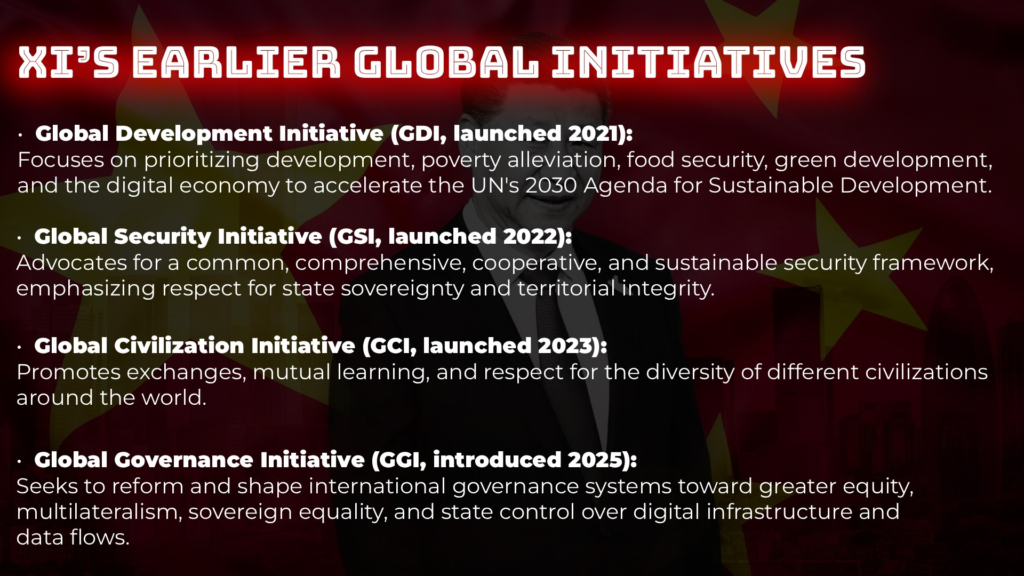
Xi Jinping’s central message was that BRICS has moved beyond being a mere economic grouping to become a major platform for the Global South. He stressed that the Global South is gaining strength, that the movement toward a multipolar world is “unstoppable,” and that BRICS should help reshape the international order in a more just and equitable direction. He explicitly linked this agenda to his four core Global Initiatives—Global Development, Global Security, Global Civilization, and Global Governance.
Initiatives To Deepen BRICS Cooperation
At the BRICS summit, President Xi proposed yet another five initiatives for deepening BRICS cooperation.
1️⃣ The Open-Source and Inclusive AI Initiative: Xi announced that China will pioneer the establishment of a BRICS AI open-source community, support cooperation in developing and applying large language models, hold specialized AI seminars and training courses, and build an open ecosystem for AI.
2️⃣ The Trade and Investment Facilitation Initiative: China proposes to establish a BRICS Special Economic Zone partnership, under which countries can set up an intelligent portal and coordinate policies. In an effort to cultivate new drivers of economic and trade cooperation, China will host the BRICS Forum on Trade in Services next year.
3️⃣ The Digital Industry Cooperation Initiative: China will push to establish a BRICS digital ecosystem cloud platform, conduct digital skills training, facilitate technological exchange, and promote industrial alignment to jointly enable the development of the digital economy.
4️⃣ The Intelligent Manufacturing Cooperation Initiative: China stands ready to assist fellow BRICS countries in building smart factories, developing standards and norms, and jointly promoting manufacturing transformation and upgrading.
5️⃣ The Science and Technology Talent Development Initiative: China proposes setting up a BRICS engineer cultivation alliance for joint engineer development and the mutual recognition of competency standards. China will also launch a BRICS youth exchange program for scientific and technological innovation to cultivate high-caliber talent.
Essentially, Xi stands for economic autonomy and a strategic restructuring of the global order—presumably through BRICS. He articulates these ideals and ambitions from every available platform, keen to expand, strengthen, and create conditions that could transform the Global South.
This commitment also carries a cautionary message to BRI members: dignified survival lies in public welfare. That is achieved through development, which requires translating plans into reality. Mere slogans, bravado, or excellence in foreign relations cannot extricate nations from debt and poverty.
One wonders if leaders from most of the Global South can stay in step with the multitude of ideas that Xi propounds and considers transformational for the destiny of nations.