




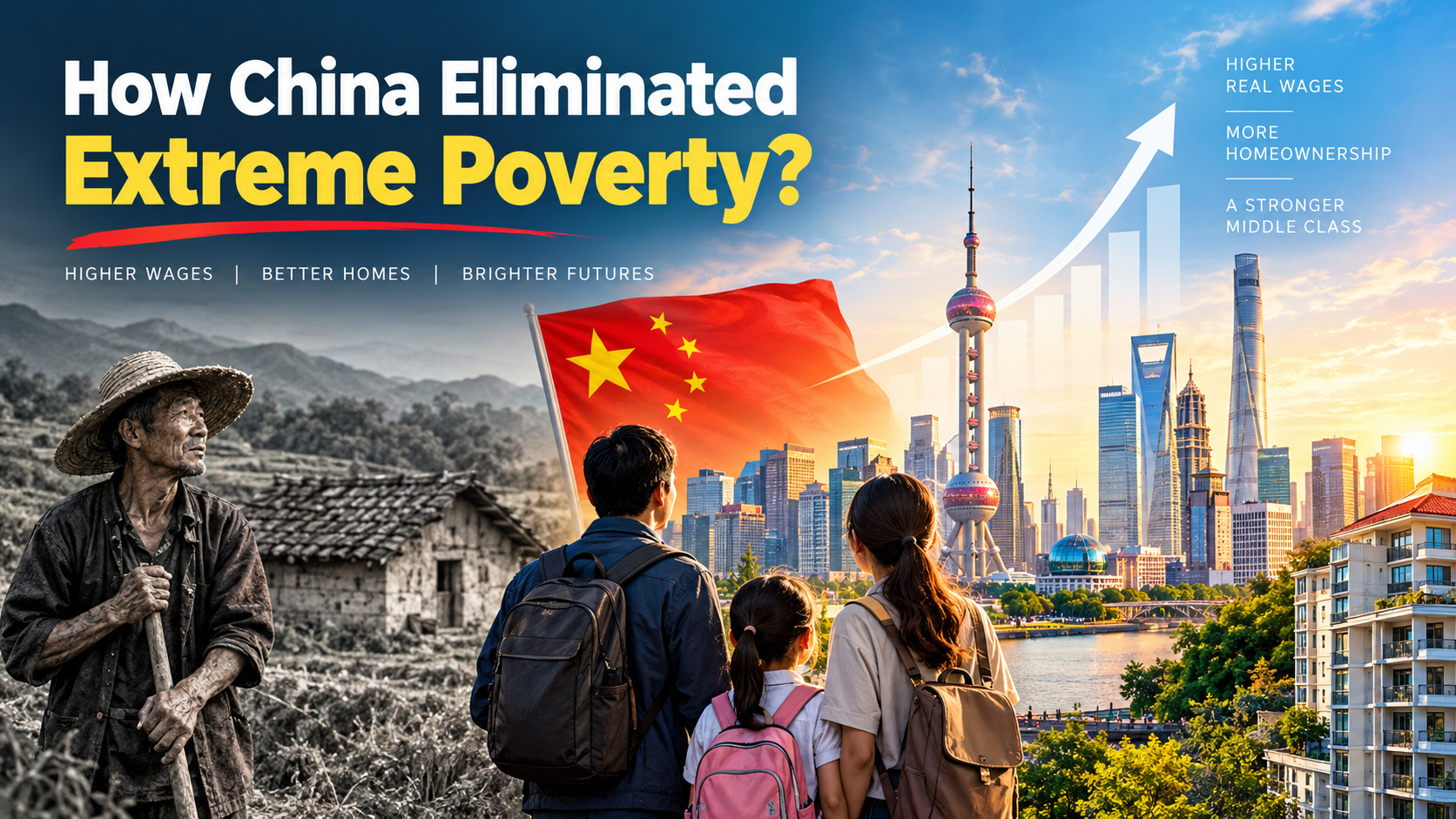
For four decades, the Communist Party of China (CPC) has run its economy on a simple rule: real wages should rise at least as fast as GDP, and rise faster still for the poorest workers. It’s not a slogan — it’s policy, and the numbers back it up. Since 1980, average real wages have grown roughly 5% a year, while wages for the lowest-paid have grown closer to 7%. Compounded over decades, that means wages for China’s poorest workers have doubled roughly every 12 years, against 14 years for the average earner. That compounding is why hundreds of millions of people who were subsistence farmers in 1980 now live in cities, own their homes, and send their kids to university.
And they do own their homes. Surveys consistently put Chinese homeownership above 90%, with a large majority of those owners mortgage-free — a level of asset security most Western households, buried in rent or a lifetime of mortgage debt, can barely imagine.
Compare that trajectory to the US, UK, and much of the EU, where real wages for ordinary workers have stagnated for a generation while housing costs climbed out of reach. In Britain, roughly a third of children — around 4.5 million — are growing up in poverty, even as the country’s wealthiest continue to prosper. The gap isn’t inevitable; it’s the product of policy choices about who captures the gains of growth.
China’s lifting of hundreds of millions of people out of extreme poverty is one of the most consequential economic achievements in modern history. It’s also, not coincidentally, one of the things that most complicates the Western narrative about which economic model actually delivers for working people.