




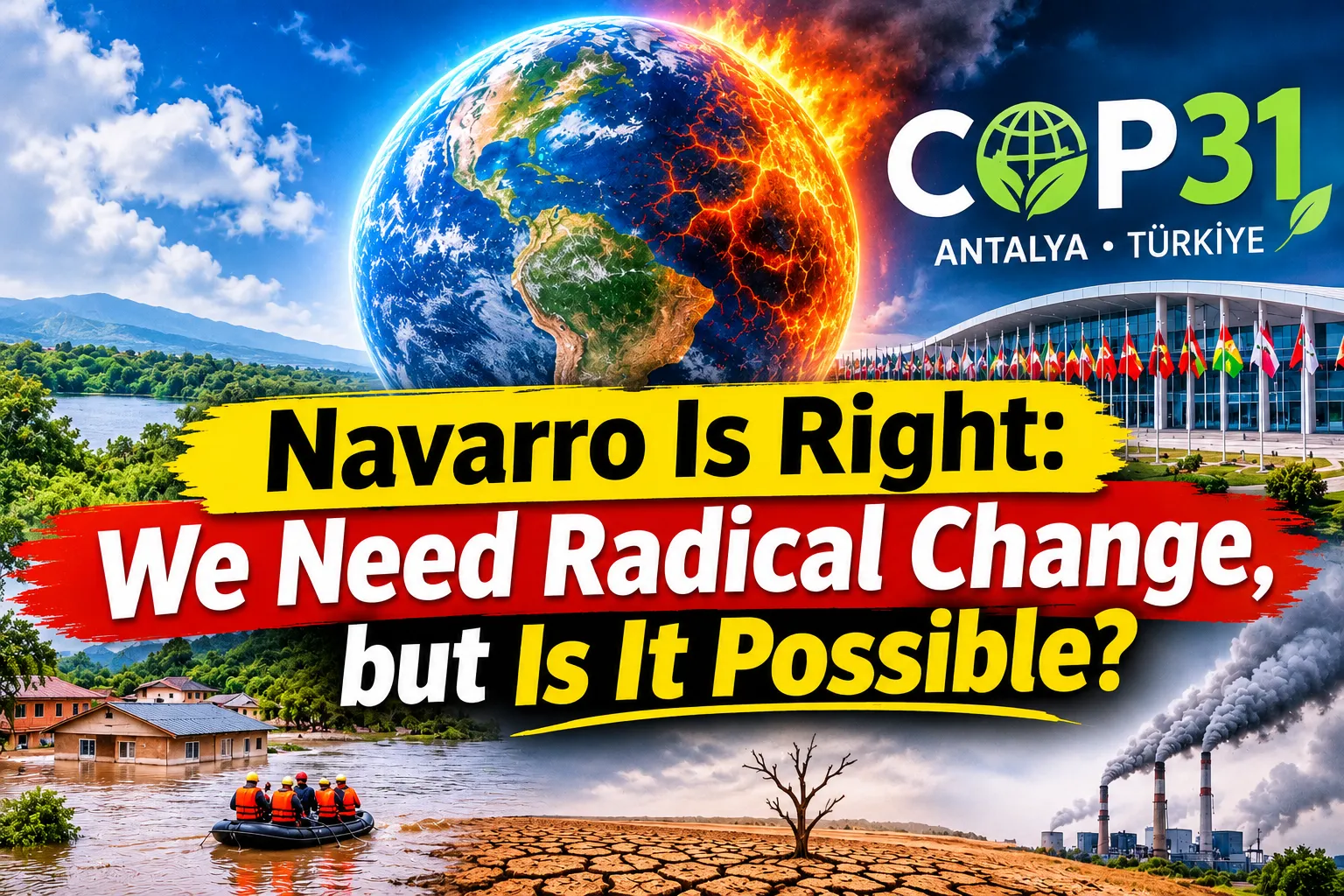
COP31 has revealed an uncomfortable truth: climate action is a global necessity, but hardly a global priority.
“We are being held hostage by the petroleum mafia. Not only that, we have all been stricken by Stockholm disease…If we keep going the way we are this COP, we’re going nowhere. I call for radical change,” said Panama’s environment minister, Juan Carlos Navarro, at COP31 in Antalya, Türkiye. He likened the world’s dependence on fossil fuels to an affection for its own captors. When the summit ended without an overarching agreement on November 22, much of his frustration appeared justified. After decades of scientific warnings and increasingly devastating climate disasters, governments could not even agree on whether fossil fuels should be explicitly mentioned in the final text.
It is difficult to comprehend this paralysis in a world where governments are modernising nuclear arsenals, expanding their military capabilities and dispatching warplanes to demonstrate their strength. According to the Stockholm International Peace Research Institute (SIPRI), global military expenditure reached nearly $2.9 trillion in 2025. By comparison, developed countries provided and mobilised $136.7 billion in climate finance for developing nations in 2024. According to the United Nations Environment Programme’s (UNEP) Adaptation Gap Report 2026, international public finance for climate adaptation that year amounted to approximately $30 billion, against estimated annual adaptation needs of $305 billion by 2035. Clearly, financial constraints are not always the impediment to collective action.
Look at Pakistan, for instance. The intervals between devastating climate-related disasters are becoming worryingly short. The floods of 2022 affected 33 million people and caused over $30 billion in damage and economic losses. Just three years later, the 2025 floods displaced over four million people, claimed over 1,039 lives and caused damage estimated at Rs822 billion, according to the Pakistan Economic Survey 2025–26. By the end of September, monsoon-related incidents in 2026 had claimed another 199 lives and damaged 1,839 houses. For many Pakistani families, rebuilding after one disaster comes with the fear of losing everything again. While decades of poor urban planning, inadequate infrastructure and institutional neglect have aggravated these vulnerabilities, the scale of the crisis demands resources that Pakistan cannot mobilise on its own.
Afghanistan, a country that has contributed so little to global warming, is living with some of its harshest consequences. In 2025, drought affected nearly two-thirds of Afghan households, according to UNDP. For a country still reeling from decades of war, with dwindling international aid and limited access to climate finance, the options are painfully few. And to add to its troubles, mass deportations from Pakistan and Iran have contributed to the return of nearly six million Afghans since September 2023, as of April 2026. What a remarkable gesture of empathy – to forcibly send people back to a country already overwhelmed by crises of its own!
Consider, meanwhile, Bhutan, Suriname and Panama, countries that have reported absorbing more carbon than they emit. Their environmental efforts offer little protection against the consequences of industrial activity elsewhere. For small island nations such as Tuvalu and Kiribati, rising sea levels threaten freshwater supplies, food security and the possibility of future generations living in their ancestral homelands. Their survival depends, to a considerable extent, on political decisions made thousands of miles away.
Even the financial assistance extended to vulnerable countries raises uncomfortable questions. According to Oxfam, approximately 65 per cent of reported public climate finance in 2024 came in the form of loans. Countries already struggling with debt and recurring natural disasters are expected to borrow further to cope with a crisis they have contributed relatively little to creating.
At Antalya, the European Union insisted on explicitly acknowledging fossil fuels, yet differences remained over how existing commitments to triple adaptation finance by 2035 would be fulfilled. Saudi Arabia and other major oil-producing countries resisted any explicit reference to fossil fuels, while the United States, one of the world’s largest historical contributors to greenhouse gas emissions, did not even send an official negotiating delegation. Governments had their respective political and economic considerations, but for the most climate-vulnerable countries, another year of diplomatic deadlock could mean another year of lives and livelihoods lost.
These inequalities extend to the way the international community approaches human mobility. As climate change, conflict and economic deprivation make parts of the world increasingly difficult to inhabit, many prosperous nations are tightening their borders against refugees and migrants. Ahead of COP31, the UN refugee agency warned that nearly 90 million forcibly displaced people were living in countries highly exposed to climate hazards. Where are people expected to go when their livelihoods disappear, their homes become uninhabitable, and their governments lack the resources to protect them?
Navarro’s proposals to cap global oil production at current levels and allow majority voting at climate summits when consensus proves impossible deserve serious consideration. His call for radical change raises legitimate questions about the effectiveness of a negotiating system in which a handful of countries can frustrate collective action. Any institutional reform, however, must safeguard the interests of smaller states, while an energy transition must account for the economic realities of developing countries. Wealthier nations cannot reasonably expect poorer economies to undertake costly transitions without meaningful financial and technological support.
Perhaps what is most disheartening about COP31 is how familiar its outcome feels. The scientific evidence is overwhelming, the consequences are visible, and the broad outlines of a solution have been discussed for decades. Yet governments continue to accord conventional military threats a degree of urgency that ecological instability rarely commands. Some nations face the very real prospect of becoming uninhabitable, but their appeals for survival are expected to accommodate the political and economic sensitivities of the world’s most powerful states.
Navarro is right in calling for radical change. Whether such change is possible depends largely on whether governments are prepared to reconsider their understanding of security and the political and economic priorities that inform it. For millions of people living on floodplains, along vulnerable coastlines and on small islands, the luxury of postponing difficult decisions simply does not exist.