




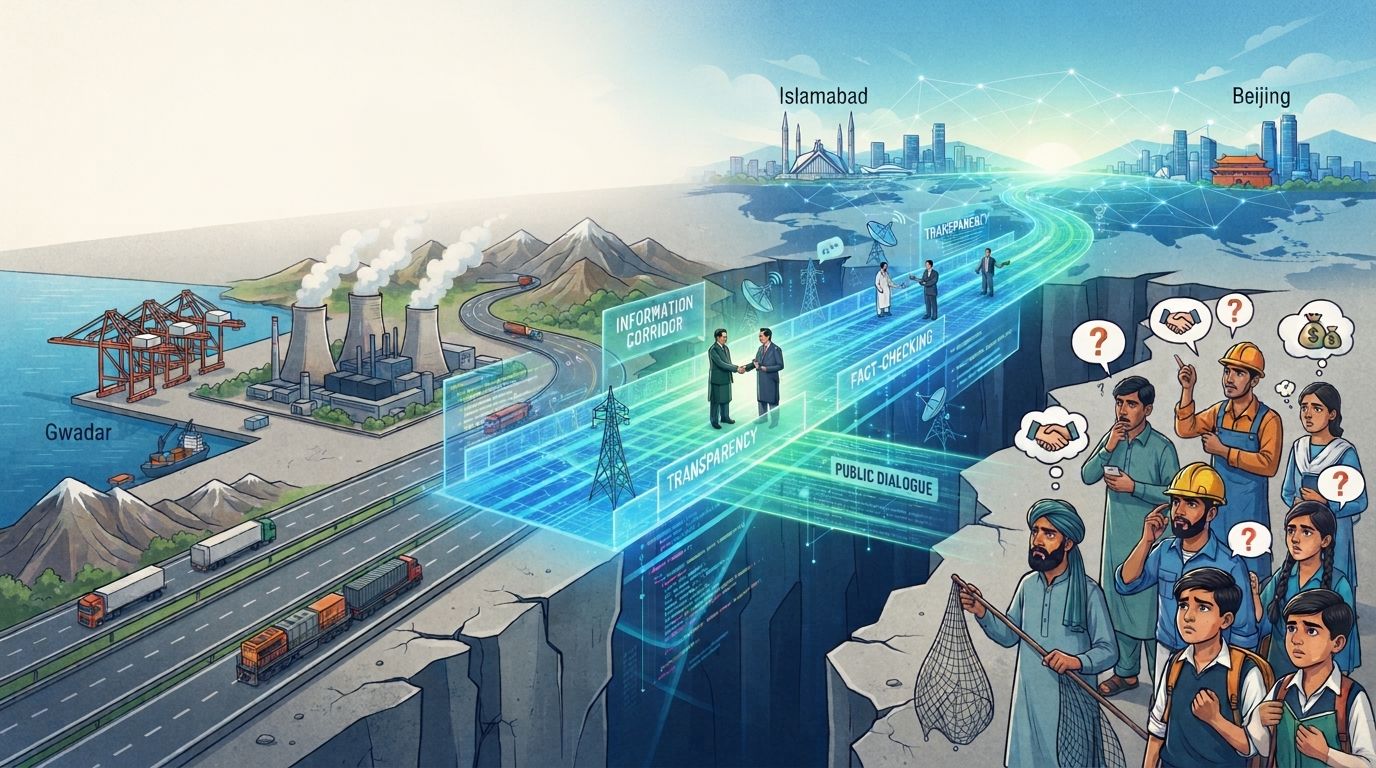
The China-Pakistan Economic Corridor (CPEC) has been a central part of Pakistan-China relations for more than a decade. Launched in 2013 and formally advanced through agreements signed during President Xi Jinping’s 2015 visit to Pakistan, the initiative was initially valued at around $46 billion; its announced portfolio increased to approximately $62 billion by 2017 (Garlick 2018). It was presented as a way to improve Pakistan’s energy and transport infrastructure while strengthening connectivity between China and the Arabian Sea. Yet the scale of the investment has not automatically translated into public confidence. As Pakistan and China introduce the China-Pakistan Information Corridor (CPIC), the question is whether better communication can address this trust deficit or whether confidence also depends on how CPEC’s unresolved concerns are handled.
CPEC has delivered visible infrastructure and energy projects. Power plants linked to the corridor, including projects at Sahiwal, Port Qasim, Hub, and Thar have added generation capacity, while road and transport investments have improved connectivity within Pakistan. These gains should be acknowledged, but claims about their impact need to be precise. For China, the corridor was also designed to connect Kashgar in Xinjiang with Gwadar on the Arabian Sea, offering an additional route for regional connectivity.
The trust deficit surrounding CPEC did not emerge overnight. It reflects a gap between promises made by institutions and the experiences of people living in areas affected by the projects. Questions have been raised about the transparency of financing arrangements, project agreements, costs, implementation, and the distribution of economic benefits. Local participation is particularly important. A 2022 study of residents in Gwadar, published in The Pakistan Development Review, found that many appreciated the infrastructure development but felt excluded from the process and disappointed that their expectations for improved livelihoods had not been met (Ali and Sanauddin, 2022). The concerns of fishing communities are especially relevant because their livelihoods depend on access to the sea and local resources.
The Saindak copper-gold project provides another example of concerns surrounding natural resource management in Balochistan. According to the Human Rights Commission of Pakistan’s 2025 report, concerns have been raised over the province’s limited share in the project, with Balochistan’s allocation reported at 2 percent, compared to 50 percent for Chinese stakeholders and 48 percent for the federal government. The report also refers to a PKR 500 million deposit requirement for obtaining mining licences, which has been identified as a major barrier for local communities and businesses seeking to participate in resource extraction. Although the revenue-sharing arrangement was revised in 2022, questions about provincial control over natural resources and the distribution of economic benefits remain relevant.
Employment is another important dimension of local participation in CPEC. A 2026 assessment by the Pakistan Institute of Development Economics (PIDE) on Balochistan’s skills gap and CPEC job potential found that local participation remains limited, particularly in skilled and technical positions. The report identifies a mismatch between the skills available locally and the requirements of higher-skilled jobs (Rauf and Achakzai, 2026). This gap raises questions about whether local communities are adequately prepared to benefit from the employment opportunities created by development projects. Infrastructure investment alone does not guarantee equal access to these opportunities. Training, education and local recruitment are therefore essential to ensure that nearby communities can participate in and benefit from economic development.
Security remains another major challenge for CPEC. Attacks targeting Chinese nationals have raised concerns in Beijing and affected the environment in which development projects operate. In March 2024, five Chinese engineers and their Pakistani driver were killed in an attack near Besham. Earlier incidents included the 2021 Dasu bus bombing and the 2022 attack on Karachi University’s Confucius Institute. These attacks have involved groups with different motives and operating areas and should not be treated as a single, uniform security threat. Nevertheless, repeated attacks have made the protection of Chinese personnel and development projects a major concern in Pakistan-China relations.
Against this background, Pakistan and China launched the China-Pakistan Information Corridor (CPIC) in Islamabad on October 26, 2026. The initiative is built around four pillars: media; business and enterprise; think tanks; and culture, tourism and youth. Its objectives include verified news exchange, fact-checking, business linkages, joint research and greater people-to-people engagement. These initiatives could help address inaccurate reporting, explain complex projects and improve public understanding of bilateral cooperation. The inclusion of think tanks and youth exchanges also provides an opportunity to move beyond official statements and encourage broader discussions on Pakistan-China relations.
However, CPIC’s effectiveness should not be measured solely by the amount of positive information it circulates. Since the initiative has only recently been launched, it is too early to assess its impact. Its credibility will depend on whether it provides accurate and accessible information, including about project delays, implementation challenges and public concerns. Misinformation should be challenged with evidence, but legitimate criticism should not automatically be labelled anti-CPEC or anti-China. Independent journalists, researchers and local communities can help identify gaps that official communication may overlook. Excluding critical voices would risk reinforcing the very distrust that CPIC aims to address. Building public confidence also requires action beyond communication. Pakistan and China need to improve transparency by making project information, financing arrangements, implementation updates and expected local benefits more accessible. Consultations with local communities should take place before and during project implementation rather than only after grievances emerge. Investment in local skills development and fair recruitment practices can help residents access better employment opportunities. Regular public reporting on the project achievements, delays and unresolved concerns would further strengthen accountability and make communication more credible.
CPIC can provide a useful platform for addressing misinformation and strengthening people-to-people ties, but it cannot substitute for accountable project implementation. CPEC’s long-term success will depend not only on how the partnership is presented but also on what people experience from it. Public confidence is more likely to grow when communication is accompanied by transparency, meaningful participation, security and tangible local benefits. Connecting minds will require more than promoting a positive narrative; it will require responding openly to the questions people are already asking.
References
1. Ahmad, O. (2024, November 20). Pakistan’s security challenges threaten to undermine its relationship with China. Stimson Center. https://www.stimson.org/2024/pakistans-security-challenges-threaten-to-undermine-its-relationship-with-china/
2. Ali, Z., & Sanauddin, N. (2022). The perspective of native people regarding developmental projects of China Pakistan Economic Corridor (CPEC) in Gwadar, Balochistan. The Pakistan Development Review https://pide.org.pk/research/the-perspective-of-native-people-regarding-developmental-projects-of-china-pakistan-economic-corridor-cpec-in-gwadar-balochistan/
3. CPEC Secretariat. (n.d.). CPEC projects progress update. Government of Pakistan. https://www.cpec.gov.pk/progress-update
4. Garlick, J. (2018). Deconstructing the China–Pakistan Economic Corridor: Pipe dreams versus geopolitical realities. Journal of Contemporary China. https://www.tandfonline.com/doi/full/10.1080/10670564.2018.1433483
5. Ministry of Finance, Government of Pakistan. (2025). Pakistan Economic Survey 2024–25: Transport and communication. https://www.finance.gov.pk/survey/chapter_25/13_Transport_and_Communication.pdf
6. Radio Pakistan. (2026, October 26). China-Pakistan Information Corridor launched in Islamabad. https://radio.gov.pk/26-10-2026/china-pakistan-information-corridor-launched-in-islamabad
7. Rauf, U. A., & Achakzai, B. (2026). Balochistan’s skills gap and CPEC job potential: A human capital assessment. PIDE Knowledge Brief. https://pide.org.pk/research/balochistans-skills-gap-and-cpec-job-potential-a-human-capital-assessment/
8. World Bank. (2021). Variable renewable energy locational study. Pakistan Sustainable Energy Series. https://documents1.worldbank.org/curated/en/883241610741226840/pdf/Main-Report.pdf
9. Balochistan’s Crisis of Trust (2025). Human Rights Commission of Pakistan, Pdf https://hrcp-web.org/hrcpweb/wp-content/uploads/2020/09/2025-Balochistans-crisis-of-trust.pdf