




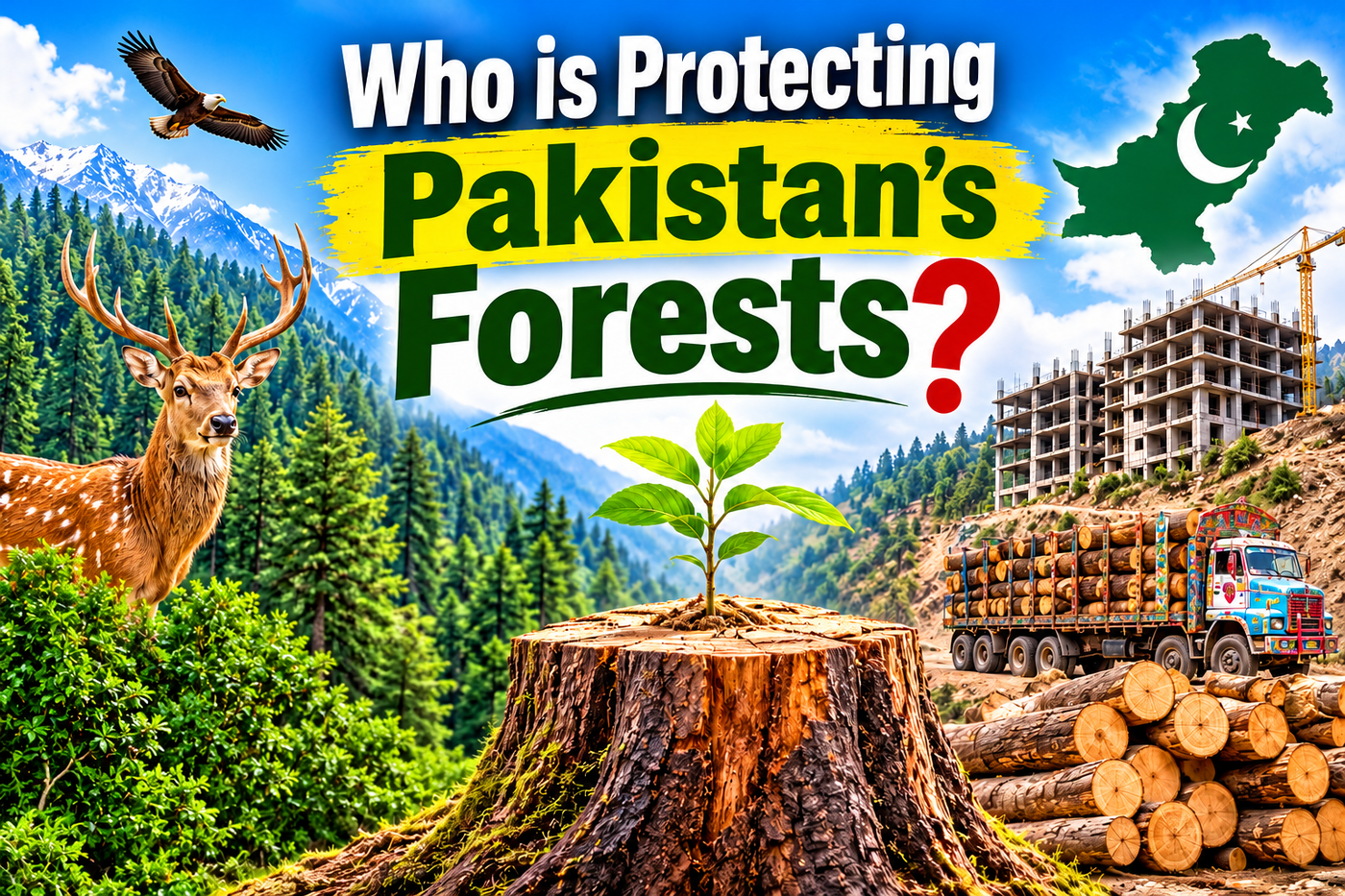
Pakistan’s natural resources are increasingly falling victim to greed, corruption and institutional failure. Forests, wildlife habitats and mineral-rich areas are being exploited by powerful vested interests, often with the support or complicity of those entrusted with protecting them. Trees are disappearing, reserve forests are being converted into commercial and residential developments, and local communities are losing their natural environment and traditional sources of livelihood. This exploitation continues despite existing laws, government institutions and repeated commitments to environmental protection.
Recent videos showing hundreds, possibly thousands, of timber logs being transported from Allai and Battagram in Hazara Division have raised concerns about the scale of deforestation in the region. In Galiyat and Murree, large stretches of reserve forests have reportedly been converted into high-rise buildings, hotels and commercial developments, both along major roads and in surrounding areas. Haripur and other districts of Hazara have also faced similar concerns, reportedly involving officials responsible for protecting these forests. In Kohistan, substantial forest areas have allegedly disappeared through collusion between timber merchants and officials at different levels of the Forest Department.
Makanial, near Islamabad’s Margalla Hills, presents another troubling example. Commercial and residential schemes have emerged on Guzara forests, which are meant to serve the needs and livelihoods of local communities. Questions have also been raised about the demarcation of forest lands between Khyber Pakhtunkhwa and Islamabad, as well as the adjoining Murree region. Local records and historical documents have reportedly been altered, misplaced or manipulated to justify changes in boundaries and facilitate the appropriation of valuable forest land. These allegations require independent investigation, as the loss of centuries-old forests cannot be dismissed as a routine administrative matter.
What makes this destruction particularly disturbing is the reported involvement of some of the very officials responsible for preventing it. From forest guards to senior officers, individuals within the department have allegedly become part of networks facilitating illegal logging and land grabbing. Political pressure also plays a role, with government departments reportedly bending rules to clear forest land for lucrative housing societies and commercial projects. As a result, institutions established to protect natural resources can become complicit in their destruction.
Pakistan has introduced various legal and administrative measures to control deforestation, including restrictions on commercial timber harvesting introduced in the early 1990s. However, more than three decades later, forests continue to disappear. Existing forest laws provide for penalties against illegal logging, but weak enforcement and inadequate accountability often allow offenders to escape meaningful consequences. When the financial rewards from illegal timber trade and land transactions are substantial, minor fines become little more than a business expense.
New laws and fresh bans will achieve little if those responsible for enforcing them remain vulnerable to political pressure, financial incentives and personal interests. Pakistan needs independent institutions, scientific forest management, transparent land records and strict accountability. Officials found facilitating illegal logging, land grabbing or the destruction of protected forests must face appropriate legal consequences. Strong institutions are not created merely by passing legislation or issuing government notifications. They depend on individuals who have the integrity and courage to enforce the law, even when powerful interests are involved.
Recommendations
Khyber Pakhtunkhwa needs an urgent and credible programme to protect its forests, biodiversity and wildlife habitats. The provincial government should consider the following measures:
- The provincial government should establish an independent panel comprising experts in forestry, wildlife, biodiversity, local livelihoods, media and civil society. The panel should monitor environmental damage, examine the conduct of relevant stakeholders and recommend policy changes. It should have access to official records and the freedom to report its findings without political interference.
- A temporary suspension should be considered for disputed logging, land development and other activities threatening forests and wildlife habitats until an independent assessment of existing damage and future risks is completed.
- The government’s forest management policy needs an independent review. Existing forests should be mapped through reliable geospatial technology, with their boundaries publicly documented and protected. Officials found facilitating illegal logging, land grabbing or forest destruction should face disciplinary action or prosecution, depending on the nature of their involvement.
- New natural reserves and protected areas should be notified to safeguard the province’s unique biodiversity and wildlife habitats. Local communities must be included in their management and receive tangible economic benefits from conservation. They cannot be expected to protect forests if their livelihoods are ignored or powerful commercial interests are allowed to take over their traditional resources.
- The provincial government should publish an annual report containing independently validated data, geospatial images, records of forest losses, information about commercial development and details of enforcement action against violators. This would provide a measurable basis for assessing government performance and ensuring that development does not come at the expense of the environment.
Pakistan does not lack natural wealth, environmental legislation or government departments. What it lacks is the consistent political will and institutional integrity to protect these resources. Forests cannot defend themselves, while local communities often lack the financial and political power to resist land and timber mafias. If those appointed to protect public resources become part of the networks exploiting them, no number of laws will make much difference. The real challenge is to end a culture of impunity in which public resources are treated as private property and environmental destruction is justified in the name of development. Pakistan must ensure that its natural wealth serves future generations and local communities rather than enriching a powerful few at the expense of the environment.