




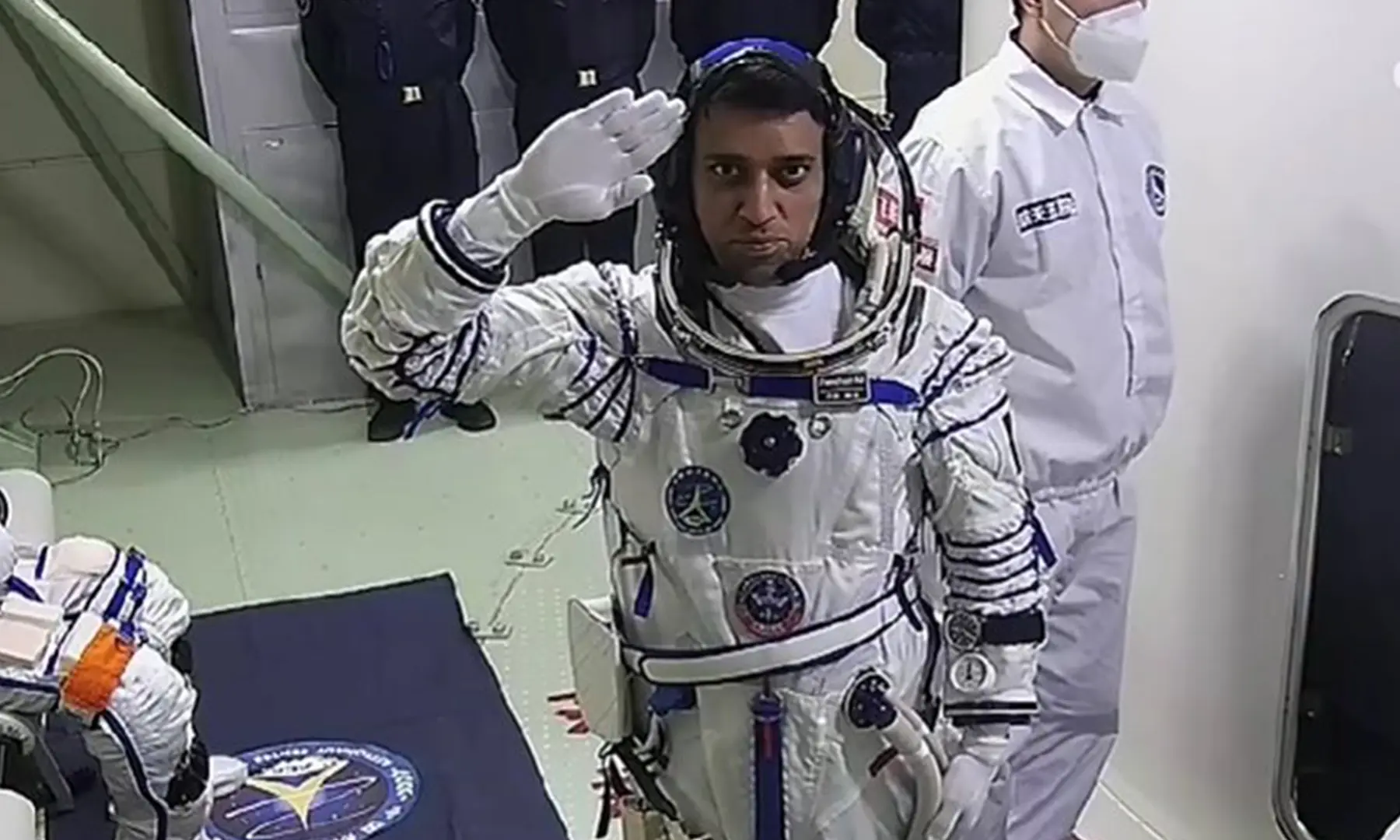
Beyond the historic achievement of sending its first astronaut into orbit, Pakistan’s participation in China’s space program offers an opportunity to strengthen scientific cooperation, develop institutional capacity and deepen bilateral relations.
The Shenzhou-24 mission, carrying Pakistani astronaut Muhammad Zeeshan Ali to China’s Tiangong space station, marks a historic milestone in Pakistan-China relations. Ali has become Pakistan’s first astronaut to enter orbit and the first foreign astronaut to join China’s crewed space program. While the achievement is significant for Pakistan’s space ambitions, it also reflects the expanding scope of bilateral cooperation in science, technology and research.
The mission builds on the cooperation agreement signed in February 2025 between Pakistan’s Space and Upper Atmosphere Research Commission (SUPARCO) and the China Manned Space Agency (CMSA). Under the agreement, Pakistani candidates would receive astronaut training in China, with one selected to participate in a mission aboard Tiangong. Ali’s participation turns that commitment into a practical undertaking and provides Pakistan with an opportunity to gain experience in human spaceflight and scientific research.
When Pakistan launched its astronaut screening in 2025, 40-year-old PAF Wing Commander Muhammad Zeeshan Ali was managing the tests. After medical and endurance filters knocked out front-running fighter pilots, a final internal round opened. Zeeshan applied, passed every stage, and earned his seat. He then spent seven months in Beijing learning technical Mandarin from scratch, since every control and emergency command on the Tiangong Space Station is in Chinese. By launch, he was reacting to crisis drills instinctively alongside Tang Hongbo and Wu Yi.
Ali’s participation goes beyond symbolic representation, as he joins the mission as a trained payload specialist responsible for supporting scientific experiments in orbit. Zeeshan is setting up four SUPARCO-selected experiments from Pakistani universities, including a blue algae project for space food systems, with all data shared between Pakistan and China. With over 60% of Pakistan’s population under 30, this is our Yang Liwei moment. As Zeeshan told Pakistani students before liftoff: “Look up at the sky, remember I carry your dreams up there.”
Ali underwent specialised training at China’s Astronaut Center, preparing for the technical and operational demands of the mission. His preparation included learning Chinese, familiarisation with spacecraft systems and coordination with Chinese crew members. As a payload specialist, his primary responsibility aboard the space station is to support scientific experiments.
The mission also carries a scientific dimension beyond Ali’s historic participation. Four joint research projects involving Pakistani researchers will examine hybrid composite materials, self-healing materials, quinoa seeds and microalgae and cyanobacteria. These experiments explore areas such as spacecraft protection, material durability, food production and life-support systems. Their potential applications extend beyond space exploration, offering opportunities for research relevant to agriculture, industrial development and future space missions.
For China, the mission demonstrates the international role it seeks for its space program. Since completing the basic configuration of Tiangong in 2022, Beijing has presented the station as a platform for scientific research and international cooperation. Bringing a Pakistani astronaut into its crewed program allows China to demonstrate that its space infrastructure can accommodate participation from other countries. It also reflects Beijing’s broader approach to science diplomacy, in which cooperation in advanced technological fields can establish professional relationships, encourage knowledge-sharing and strengthen institutional ties.
For Pakistan, the mission provides access to specialised training, spaceflight experience and collaborative research. It may also encourage greater interest in science, technology, engineering and mathematics among younger Pakistanis. However, the lasting value of this milestone will depend on how effectively the country builds on the experience and research generated through the mission.
The next stage should therefore focus on continuity. Pakistan and China could expand joint research projects, training exchanges and opportunities for Pakistani scientists and engineers to work with Chinese institutions. The experiments conducted aboard Tiangong should be followed by accessible research findings, practical applications and stronger links between SUPARCO, universities and industry. Pakistan will also need sustained investment in education, research facilities and its own space institutions to translate the experience into domestic scientific capacity.
The mission represents a partnership moving into more advanced areas of cooperation. It reflects China’s willingness to extend its space program to an international partner and Pakistan’s efforts to broaden its scientific and technological capabilities. However, the significance of this achievement should ultimately be measured not only by Pakistan’s first astronaut reaching orbit, but also by the opportunities it creates for future generations of scientists and researchers. If followed by sustained collaboration and investment in domestic capabilities, this historic flight could mark an important step in China-Pakistan relations and demonstrate how scientific cooperation can contribute to shared development.