




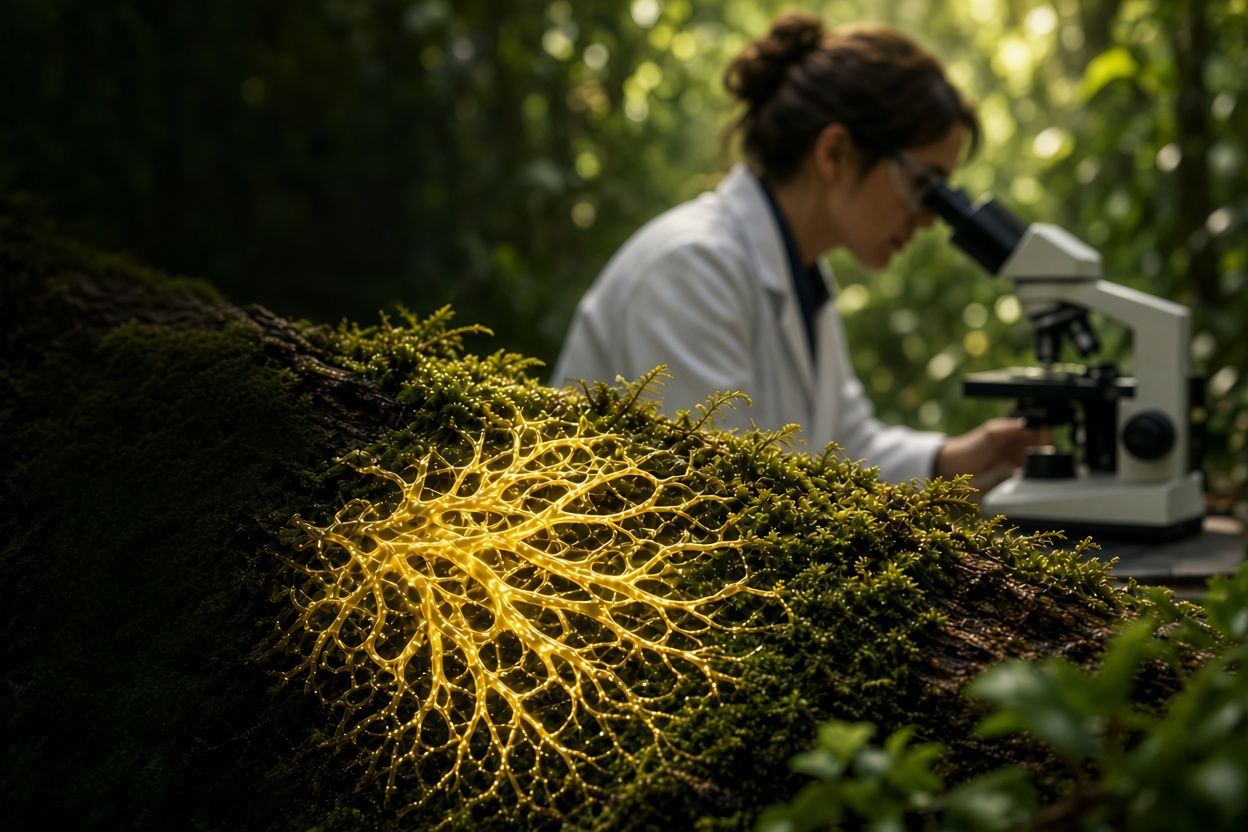
It has no brain. No neurons. No nervous system of any kind. Yet the humble slime mould Physarum polycephalum keeps forcing scientists to ask an uncomfortable question: can something this simple still learn, remember, and decide?
Slime moulds are not fungi, plants, or animals. In their active form they exist as a single giant cell containing thousands of nuclei, spreading across forest floors or rotting logs in search of food. Despite this radical simplicity, laboratory experiments over the past two decades have revealed behaviours that look strikingly intelligent.
Place a slime mould in a maze with food at the exit and it reliably finds the shortest path, pruning away dead ends until only the optimal route remains. Arrange oat flakes in the pattern of cities around Tokyo and the organism grows a network that closely matches the efficiency of the real rail system. Confront it with a mild but unpleasant substance such as salt or quinine and, after several encounters, it learns to ignore the barrier and cross more quickly — a classic form of habituation. Remarkably, that “memory” can survive periods of dormancy and even transfer to naïve individuals when two slime moulds fuse.
The organism also uses external memory. The trail of slime it leaves behind acts as a spatial map, helping it avoid areas it has already explored. Inside its body, information is stored in the very architecture of its tubular network: thicker tubes act as high-speed highways that encode past encounters with food, guiding future growth.
More recent work has shown that these decisions emerge from decentralised mechanical processes — rhythmic contractions and fluid flows that process environmental constraints without any central controller. The result looks like deliberation, even though no brain is involved.
Not everyone agrees on the language. Some researchers argue that terms such as “learning,” “memory,” and “intelligence” should be reserved for systems with neurons. Others insist that if an organism solves the same problems in functionally equivalent ways, the same words are justified. The debate is ongoing, and that is precisely why slime moulds matter.
They remind us that sophisticated information processing does not require a nervous system. Complex adaptive behaviour can arise from chemistry, physics, and distributed networks alone. In a world obsessed with brains and artificial intelligence, this brainless yellow blob quietly demonstrates that “thinking” may be far older — and far stranger — than we imagined.
Small organism. Very big questions.