




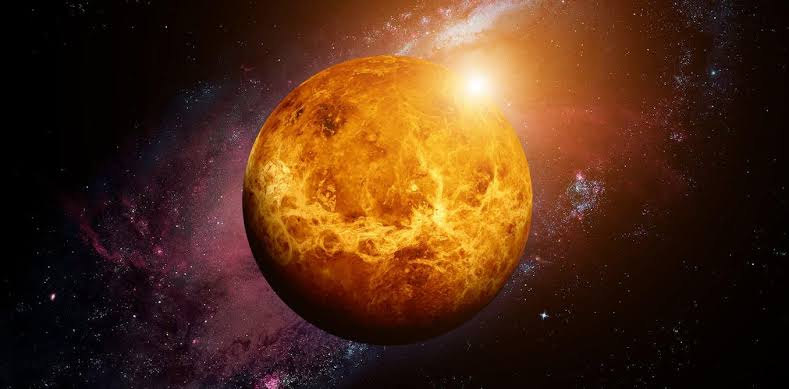
Imagine living on a planet where a single day lasts longer than an entire year. It may sound like science fiction, but this unusual phenomenon is a scientific reality on Venus, Earth’s closest planetary neighbour.
Venus has one of the strangest rotation patterns in our solar system. While most planets complete several rotations during one orbit around the Sun, Venus takes approximately 243 Earth days to rotate once on its axis, compared with just 225 Earth days to complete one orbit around the Sun.
In other words, Venus completes its year before completing a single rotation!
Why Is a Day on Venus So Long?
The main reason behind this extraordinary phenomenon is Venus’s extremely slow rotation.
Earth takes approximately 24 hours to rotate once on its axis. In comparison, Venus requires around 243 Earth days to complete one rotation. This makes Venus the slowest-rotating planet in our solar system.
Scientists believe that gravitational interactions with the Sun, as well as atmospheric and other dynamical effects, may have contributed to its unusual rotational behaviour over billions of years.
Venus Rotates in the Opposite Direction
Venus has another remarkable characteristic: it rotates backwards compared with most planets.
This movement is known as retrograde rotation. While Earth and most other planets rotate in a counterclockwise direction when viewed from above their northern poles, Venus rotates in the opposite direction.
As a result, the Sun would appear to rise in the west and set in the east on Venus.
How Long Is a Day on Venus Really?
There is an interesting scientific distinction worth understanding.
The 243-Earth-day figure refers to a Venus sidereal day, the time required for the planet to complete one rotation relative to distant stars.
However, because Venus rotates backwards while orbiting the Sun, the time between one sunrise and the next is approximately 117 Earth days.
This means that a solar day on Venus is considerably shorter than its orbital year, even though its rotation period is longer.
A Planet Full of Extremes
Venus is fascinating for more than its unusual rotation. It has an extremely dense atmosphere, made primarily of carbon dioxide, and surface temperatures averaging around 465°C (869°F).
Its thick atmosphere traps heat through an intense greenhouse effect, making Venus hotter than Mercury, despite Mercury being closer to the Sun.
The planet’s crushing atmospheric pressure and extreme temperatures make its surface one of the most hostile environments in our solar system.
A Reminder of How Strange Our Universe Can Be
Venus challenges our everyday understanding of time. On this neighbouring planet, a complete rotation takes longer than a journey around the Sun, while its backward spin creates an entirely different sunrise and sunset experience.
It is another remarkable example of how diverse and extraordinary the planets in our solar system can be.
Sometimes, the most fascinating discoveries are not in distant galaxies but on the planetary neighbour closest to Earth.