




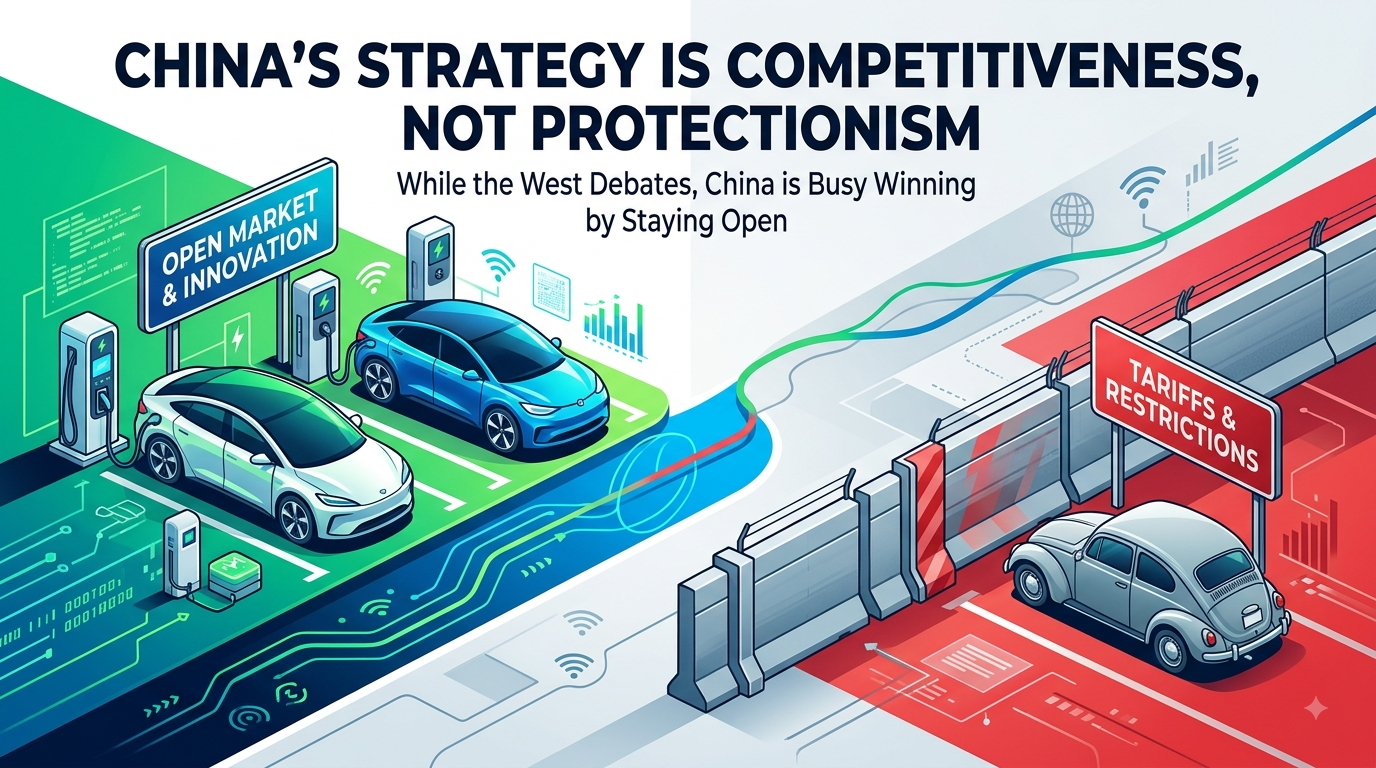
While the West debates how to keep China out, China is busy winning by staying open.
For years, many Western markets kept Chinese electric vehicles (EVs) at arm’s length, wary of their low prices and rapid rise. Today, some of those same markets are quietly embracing Chinese EV technology. The United States, meanwhile, has gone the other way: it has placed steep tariffs on Chinese EVs, driving up prices for American consumers. China has taken a different approach. Rather than retaliating with restrictions of its own, it has kept its market open — Tesla, for instance, produces and sells freely in China without facing tariffs or barriers. The contrast is telling: while the US treats Chinese EVs as a threat to be blocked, China has chosen to compete rather than retaliate, and that strategy is working.
A Different Path After Industrialization
When the industrial revolution reshaped Europe, the US, and Japan, these countries built up strong domestic manufacturing bases. But once they reached advanced-economy status, many shifted much of that manufacturing to lower-cost countries and gradually stopped investing in staying at the cutting edge of production themselves. China has not followed that pattern. It has kept manufacturing at home and continued modernizing it, expanding capacity, improving technology, and staying directly involved in production rather than outsourcing it.
Who Does Protectionism Really Hurt?
Blocking newer, cheaper products from entering a market doesn’t hurt the country being blocked, it hurts the country doing the blocking. When domestic manufacturers are shielded from competition, they face less pressure to innovate, and over time they risk falling behind rather than improving. Tariffs may protect a market in the short term, but they can also leave that market technologically stagnant.
The BYD Example
The US imposed 100% tariffs on Chinese EVs, effectively locking them out of the American market. Yet BYD, the Chinese multinational automaker, outsold Tesla globally without ever entering the US. This suggests that protectionist barriers in one market don’t necessarily stop a competitor from growing elsewhere.
It’s worth acknowledging the counterargument here directly: critics point out that BYD’s rise has been helped by significant Chinese state subsidies, and that this, not pure market competitiveness, is a central reason the US and EU cite for imposing tariffs in the first place. That’s a fair point, and subsidies clearly play some role. But it doesn’t fully explain BYD’s success. Scale, aggressive pricing, a massive domestic market, and rapid iteration on technology have all contributed as well. The larger point stands: even shut out of the world’s largest EV-hesitant market, BYD still became a global leader by competing rather than by that market retaliating.
Meanwhile, China’s own approach has been the opposite of exclusion — it let Tesla enter, manufacture locally, and sell freely, even as the US kept China’s own automakers out.
Why Keeping China Out Won’t Be Easy
Two pressures make continued exclusion difficult for the US to sustain. First, consumer demand: buyers want affordable, modern vehicles, and price-sensitive markets tend to gravitate toward whoever offers that combination. Second, geography: China’s EVs are already gaining ground in Mexico and Canada, the US’s closest neighbors and trading partners — creating indirect exposure to Chinese EV technology even without direct imports.
It’s telling that some American automakers are now themselves asking for more access to Chinese technology and manufacturing know-how, in order to stay competitive in the years ahead.
The Collapse of an Old Stereotype
The old assumption that “Made in China” means cheap and inferior, is breaking down in real time. China has shown that products can be both modern and affordable at once, challenging a narrative that the US, in particular, has maintained for decades.
Staying in the Race
Unlike the US, EU, and Japan, which slowed down after reaching developed-economy status, China has kept pushing on modernization, connectivity, and affordability. The lesson for other countries may be less about choosing sides and more about staying engaged: working with China’s manufacturing ecosystem can be a way to keep pace with where the technology is heading, rather than falling behind it.