




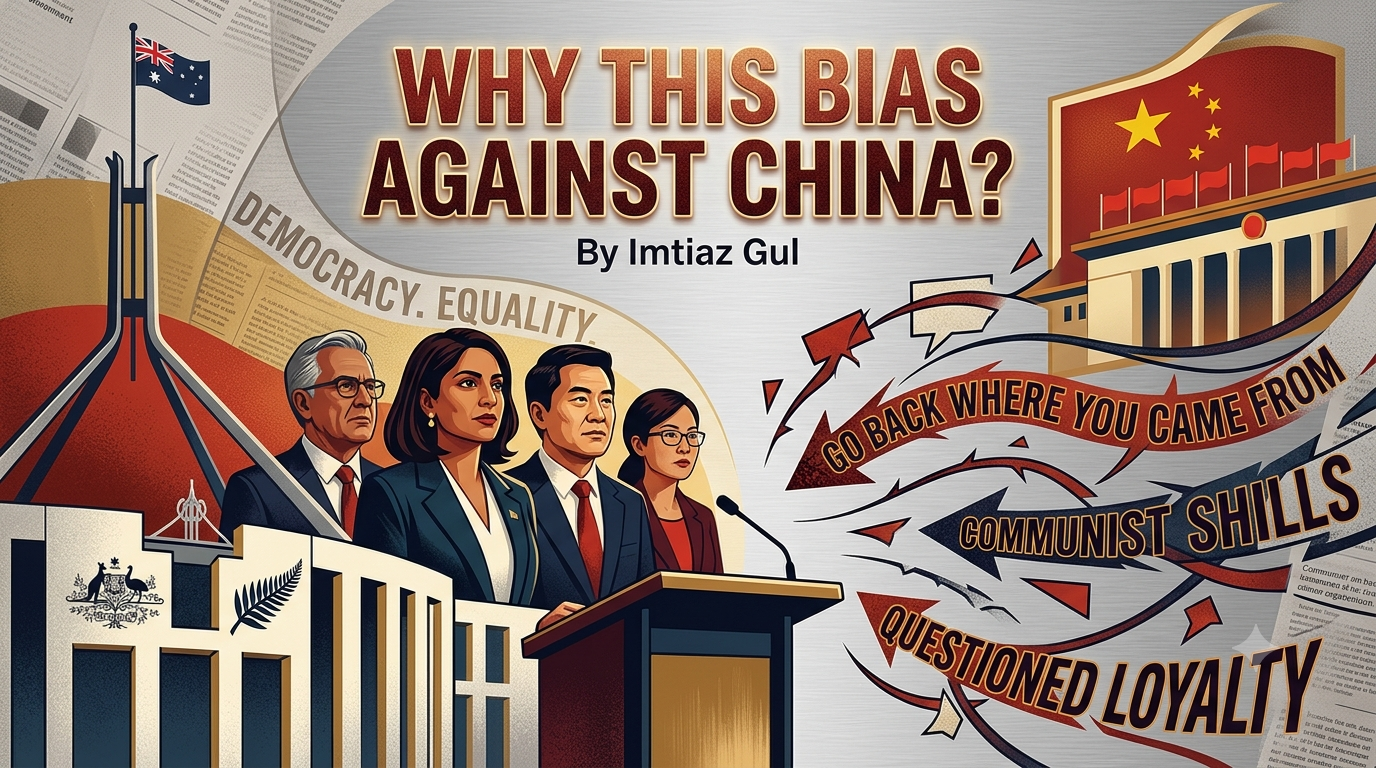
Within days of each other, Australia and New Zealand witnessed political controversies that carried an uncomfortable message. While the immediate targets were migrant-origin lawmakers, the deeper issue was the ease with which China—and people connected to it—became political targets.
In New Zealand, the controversy erupted during a parliamentary debate on 29 July. Green MP Lawrence Xu-Nan, born in Tianjin and a New Zealand resident since 1994, interrupted Foreign Minister Winston Peters with a question about COVID-19 vaccinations. Instead of answering, Peters responded by telling Xu-Nan that he had “come here five minutes ago,” should “go back to your own country,” and was not accustomed to democracy because of where he came from.
The remarks drew criticism from Prime Minister Christopher Luxon, Asian community leaders and opposition politicians. Yet Peters refused to apologise, insisting he had defended New Zealand’s democratic values and dismissing critics as “communist shills.”
China reacted swiftly. Ambassador Wang Xiaolong remarked that the comments reflected more on the speaker than on China itself. The Chinese Embassy lodged a formal protest, while Beijing’s Foreign Ministry urged New Zealand politicians not to use China as a tool in domestic politics and called for respect toward people of Chinese origin.
Only two days earlier, Australia had witnessed the conclusion of another high-profile case. The Full Federal Court upheld a ruling against Senator Pauline Hanson over her 2022 social media post telling Senator Mehreen Faruqi to “pack your bags and piss off back to Pakistan.” The court agreed that the statement amounted to unlawful racial discrimination. Faruqi described the judgment as a victory against one of the oldest racist slurs directed at immigrants.
Although Faruqi is Pakistani rather than Chinese, the underlying message was identical: political legitimacy was questioned because of ethnic origin rather than citizenship or democratic mandate. Hanson herself has a long history of anti-Asian rhetoric, making the connection difficult to ignore.
Taken together, these cases point to a recurring political instinct. When politicians of Asian origin participate fully in national debates, some opponents appear quick to remind them that they are somehow less authentic citizens. The phrase “go back where you came from” is not merely a personal insult. It suggests that citizenship, elections and public service cannot fully erase foreign origins.
The New Zealand case carries an additional dimension. Peters did not simply attack Xu-Nan’s birthplace. He connected his ethnic background with allegations about China’s political system, suggesting dishonesty and unfamiliarity with democracy. The individual became inseparable from the country of his birth.
That distinction matters.
Criticism of the Chinese government is a legitimate part of democratic debate. Governments everywhere should remain open to scrutiny. But criticism becomes prejudice when it assumes that people of Chinese origin carry the political values, loyalties or faults that others associate with Beijing. The line between opposing a state’s policies and stereotyping an entire community can quickly disappear.
This pattern has appeared before across parts of the English-speaking world. During periods of strained relations with Beijing, Chinese communities have often found themselves under greater public suspicion. Politicians with Chinese heritage have faced questions about their loyalties that would rarely be directed at colleagues with European backgrounds. Legitimate national security concerns can easily spill over into broad assumptions about ethnicity.
The result is a double standard. A politician born in Europe is rarely expected to defend every action of their country of birth. Yet politicians of Chinese background frequently find themselves viewed through the prism of Beijing’s policies, regardless of their personal beliefs or decades of citizenship.
Australia’s courts have attempted to define legal limits to such rhetoric. The Hanson ruling reaffirmed that telling fellow citizens to “go back” crosses the line from political disagreement into racial discrimination. New Zealand’s response, by contrast, has so far remained largely political and diplomatic, with no apology from the foreign minister.
Neither episode proves that Australia or New Zealand are racist societies. Both remain successful multicultural democracies where millions of immigrants have built prosperous lives. Equally significant is the fact that senior political leaders, courts, civil society groups and many citizens openly condemned these remarks rather than accepting them as normal.
Yet these controversies also demonstrate that old prejudices remain remarkably resilient. As strategic competition with China intensifies, political debate risks treating people of Chinese heritage not simply as citizens with equal rights but as symbols of a geopolitical rival. That weakens democratic principles rather than defending them.
The real test for any democracy is not how fiercely it criticises foreign governments. It is whether it can separate those governments from its own citizens whose only connection is ancestry. When elected representatives are told to “go back” despite being full citizens, the problem is no longer about foreign policy. It is about equal citizenship.
That is the lesson these two episodes should leave behind. Democracies earn credibility not merely by defending freedom of speech, but by ensuring that no citizen’s place in the national community depends on where they—or their parents—were born.