




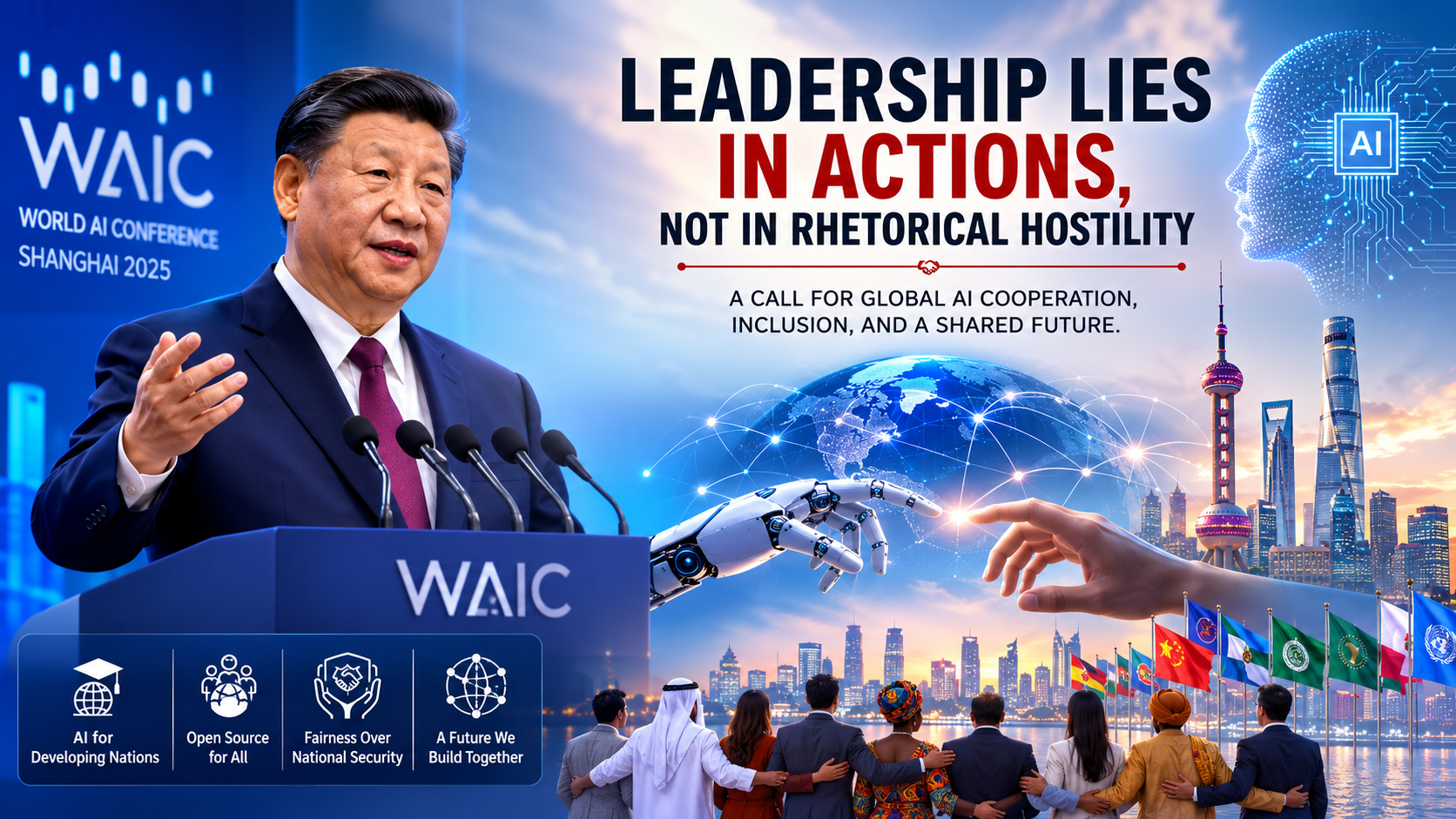
Some speeches are remembered for their words. This one should be remembered for what comes after it.
China’s president has addressed the World AI Conference by video before, every year since it started in 2018. Last week, for the first time, he showed up in person, in Shanghai, and used the moment to lay out something closer to a doctrine than a keynote. The intent for the conference: “Human Wisdom, International Consensus for AI.” Everything he said afterward was really an attempt to fill that banner with substance.
He opened with the line he reaches for on big occasions, that the world is living through changes unseen in a century. It’s become almost a throat-clear at this point, but it does real work here: it frames AI not as a product cycle but as a civilizational moment & infrastructure, the kind of shift that determines who gets a seat at the table for the next several decades. That framing matters, because everything that followed was really an argument about who that “we” includes.
The central metaphor made the stakes explicit. AI development, he said, should not be a solo performance by a single country, but a symphony of international cooperation. It’s a pointed line dressed up as a proverb. Read next to the rest of the speech, it’s hard not to hear it as a direct response to an AI race increasingly framed especially in Washington as a zero-sum contest for supremacy. Where that framing treats AI as something to be won, Xi’s framing treats it as something to be shared, or at least something China wants to be seen sharing.
That’s also where the open-source commitment fits. Reaffirming support for open AI models isn’t just a technical preference; it’s a companion piece to the cooperation argument. If AI development is genuinely collective, the tools have to be accessible rather than locked behind the walls of whichever lab or country gets there first. It’s the same logic showing up twice, once in a metaphor and once in a policy.
The sharpest moment in the speech was the warning against overstretching the concept of national security in AI — one country elevating its own security above everyone else’s — followed immediately by a line that China opposes the emergence of new historical injustices in AI. Neither line names a country. Neither has to. It’s a direct rebuttal to export controls and chip restrictions, reframed not as a security dispute between two powers but as a fairness question for the rest of the world: if AI becomes the deciding infrastructure of this century, who gets locked out of it because of a fight they weren’t part of?
That question is really what the second half of the speech tried to answer with numbers instead of rhetoric. Five thousand AI training slots for developing countries over the next five years, channeled through the coalitions that represent most of the Global South at once, ASEAN, the Arab League, the African Union, CELAC, the Shanghai Cooperation Organisation, BRICS. Thirty countries will be given access to MAZU, a Chinese AI weather system built for early disaster warnings, aimed squarely at the places that lose the most lives to storms they never saw coming. And a new institution, the World AI Cooperation Organization, headquartered in Shanghai, with 29 countries already signed on a full day before Xi.