




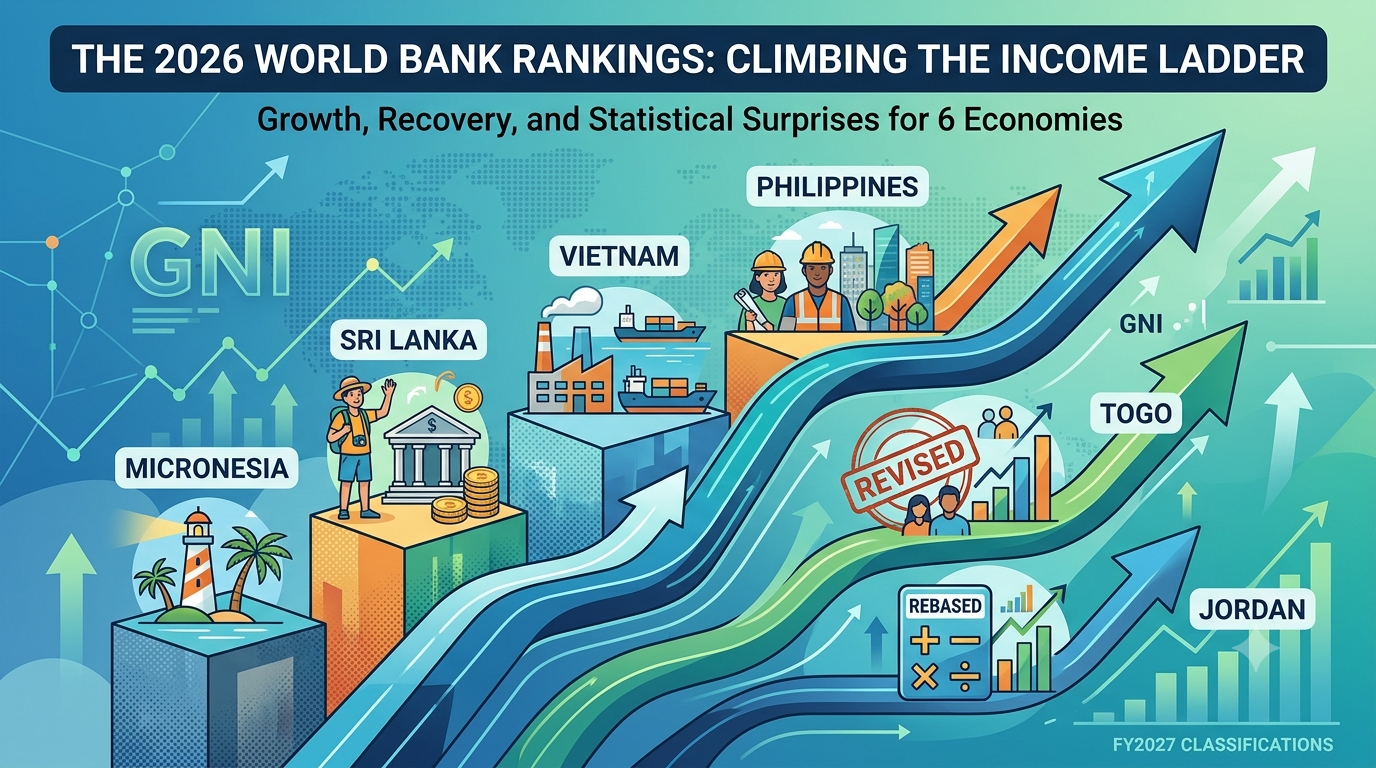
Growth, recovery, and a few statistical surprises — how six economies climbed the World Bank’s income ladder this year.
The World Bank classifies the world’s economies into four income groups:
- Low income
- Lower-middle income
- Upper-middle income
- High income
Countries are classified on the basis of Gross National Income (GNI) per capita, calculated using the Atlas method. The current four-tier system dates to 1987, when a “high income” category was added to the low/middle-income groupings first introduced in the 1987 World Development Report. In this year’s release, based on 2025 GNI data, 218 countries are covered, and the results serve as the global reference until the end of June 2027.
None of the countries assessed this year moved down a category. Six countries moved up: Togo, Vietnam, Sri Lanka, Micronesia, the Philippines, and Jordan.
The update matters because the classifications inform which countries can access concessional loans and development assistance, and help governments, researchers, and a wide range of international organizations track economic progress worldwide.
Who moved, and where
Five countries moved from lower-middle to upper-middle income: Jordan, Micronesia, the Philippines, Sri Lanka, and Vietnam. One country moved from low income to lower-middle income: Togo.
Sri Lanka: a story of recovery
Sri Lanka moved from lower-middle to upper-middle income. Just three years after a severe economic crisis brought the country to the brink of collapse in 2022, real GDP grew by 5% in 2025, driven by a rebound in tourism and financial services.
Togo: a story of population revision
Togo moved from low income to lower-middle income but the driver wasn’t economic growth alone. Following the release of detailed results from the 2022 census, Togo’s population estimate was revised down by 11.7%. Since income is measured per person, a smaller population produces a higher per-capita figure even without a change in total income. GDP itself grew 5.9% in 2025.
Micronesia: steady post-pandemic growth
Micronesia moved from lower-middle to upper-middle income, achieving modest but steady growth following a prolonged COVID-19 recovery, with construction and agriculture as the main drivers.
Vietnam: a story of growth
Vietnam moved from lower-middle to upper-middle income. Powered by an export-led model, the country saw exports surge by more than 15% in both 2024 and 2025, with GDP growing 7% and 8% those years respectively. GNI expanded at an average of 10% annually between 2021 and 2025 — one of the strongest sustained runs in the region.
Philippines: broad-based expansion
The Philippines moved from lower-middle to upper-middle income through broad-based expansion. GDP grew at an average of 5.8% per year over five years, reflecting gains across all major industries, not a single-sector boom, but an economy-wide shift.
Jordan: a statistical rebasing
Jordan moved from lower-middle to upper-middle income because of a comprehensive revision of its national accounts. When Jordan’s Department of Statistics completed a rebasing exercise, it found the economy was nearly 10% larger than previously estimated, reflecting expanded statistical coverage through updated surveys, new data sources, and enhanced national accounts methodology. Combined with steady growth of 2.8% in 2025, the revised data pushed the country clearly across the threshold.
Source: World Bank Group Country Income Classifications, FY2027