




Pakistan’s campaign against cross-border terrorism appears to be gaining greater international understanding, particularly from the United States. Following Pakistan’s recent strikes against what it described as terrorist infrastructure along the Afghan border—after a deadly attack on a Pakistan Rangers Sindh headquarters in Karachi’s Gulistan-i-Jauhar area—the US State Department reiterated a position it has expressed before.
“The Pakistani people have suffered greatly at the hands of terrorists,” Washington said, adding that it “supports Pakistan’s right to defend itself against terrorist attacks.”
Such statements appear to endorse Pakistan’s long-standing claim—that militant groups operating from Afghan soil, particularly the Tehreek-e-Taliban Pakistan (TTP), pose one of its gravest national security threats.
Yet there is another side to the story.
In early July, the United Nations General Assembly adopted the ninth review of the UN Global Counterterrorism Strategy (GCTS), first introduced in 2006 to guide international cooperation against terrorism.
Unlike previous reviews, this one exposed significant divisions. The United States, joined by Israel and Argentina, voted against the resolution, describing the 170-page document as outdated, unfocused and burdened with language that did little to improve operational cooperation against terrorism. Many observers believe the US and Israeli opposition was influenced by wider disagreements surrounding the Gaza conflict and criticism of Israel’s military actions. Despite these objections, the resolution passed comfortably with 140 countries, including Pakistan, voting in favour.
The episode underscored an important reality: while there is broad international agreement that terrorism remains a serious global threat, there is far less consensus on how it should be confronted and how international institutions should respond to evolving security challenges.
Addressing the General Assembly, Pakistan’s Permanent Representative to the United Nations, Ambassador Asim Iftikhar Ahmad, called for stronger international cooperation, action against online radicalisation, tighter regulation of digital financing, and a more transparent sanctions regime. Terrorist organisations today exploit encrypted communications, cryptocurrencies, social media and transnational financial systems in ways unimaginable two decades ago, making international cooperation indispensable.
However, Pakistan now confronts a larger strategic question.
Does growing international support for Pakistan’s right to defend itself also translate into support for a long-term policy of sustained military confrontation with Afghanistan?
The answer is far less certain.
Military action can disrupt terrorist networks and impose costs on militant groups. But by itself, it is unlikely to resolve the deeper political crisis that now defines Pakistan-Afghanistan relations.
The more probable outcome is a familiar cycle: retaliation, renewed violence, deeper mistrust, shrinking trade, declining investment, and increasing regional instability. There are no lasting winners in such a contest.
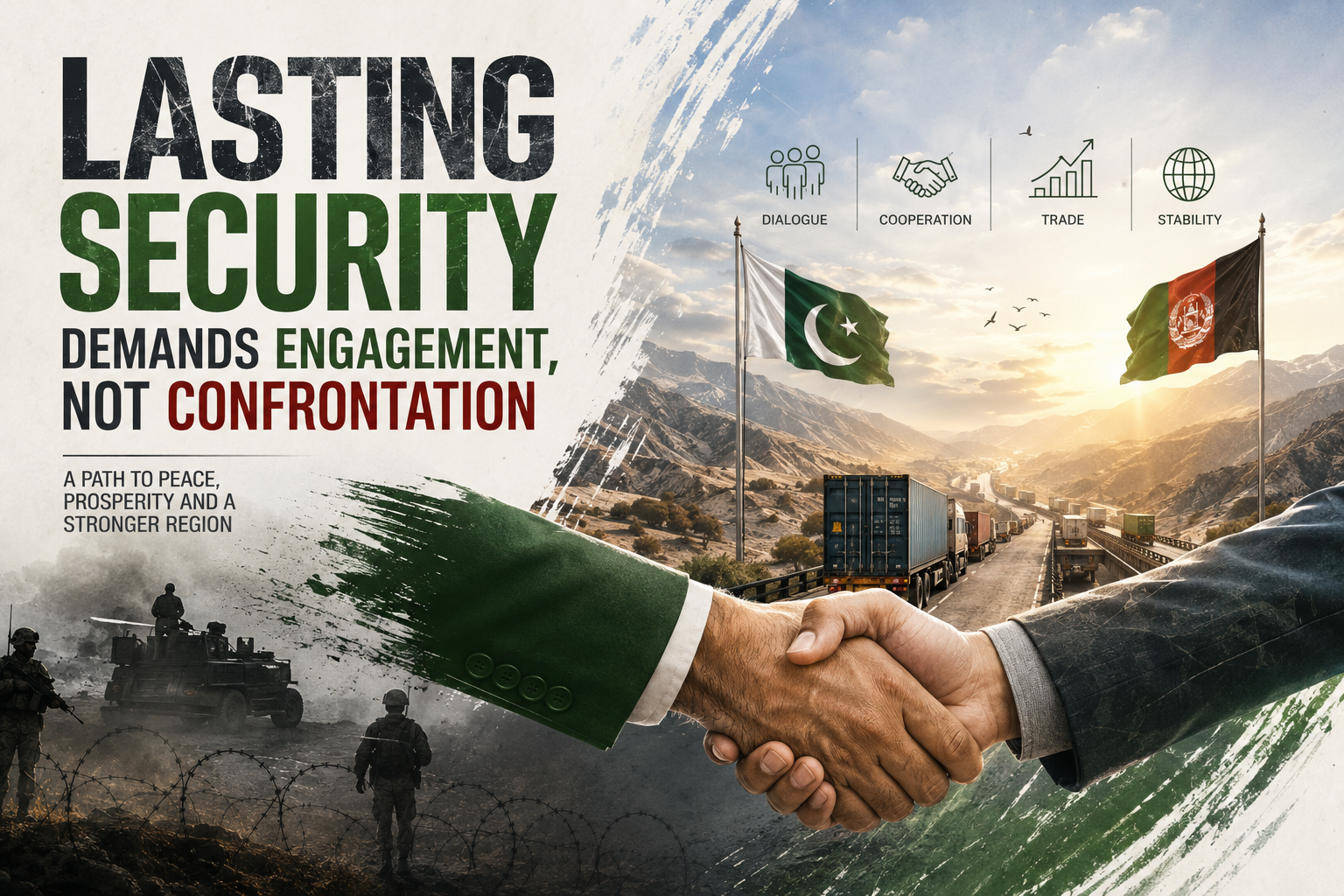
Sustainable security will ultimately depend not only on effective counterterrorism but also on sustained diplomacy, intelligence cooperation, incentive-based engagement, cross-border economic integration, and the gradual rebuilding of trust. If Pakistan seeks to project itself as a regional advocate of dialogue and connectivity, it must demonstrate those principles in its own neighbourhood.
This raises a difficult but unavoidable question.
Can an aggressive military and non-military strategy—combined with repeated closure of the Pakistan-Afghanistan border after every major terrorist attack—deliver lasting security while simultaneously promoting trade, investment and economic growth?
So far, the evidence suggests otherwise.
The experience of recent years indicates that kinetic operations and sealed borders may produce short-term tactical gains, but they have not delivered a durable strategic solution.
The Pakistan-Afghanistan border has remained largely closed since 11 October, disrupting the livelihoods of tens of thousands of farmers, traders, transporters, factory workers, shopkeepers and daily wage earners on both sides. At the same time, the 10 July deadline for undocumented Afghan nationals to leave Pakistan has once again placed the Afghan community—both documented and undocumented—under intense administrative and policing pressure.
Yet despite these measures, violent groups including the TTP, the Balochistan Liberation Army (BLA) and others continue to strike military, civilian and commercial targets, forcing Pakistan’s security forces to intensify cross-border operations against alleged militant sanctuaries.
The overall security picture remains deeply troubling. According to the Center for Research and Security Studies (CRSS), Pakistan recorded 774 violence-related fatalities and 336 injuries during the second quarter of 2026, arising from at least 267 incidents involving terrorist attacks and counterterrorism operations. Nearly 96 percent of all fatalities occurred in Khyber Pakhtunkhwa and Balochistan, with KP accounting for 475 deaths and Balochistan 265. These two provinces also recorded the overwhelming majority of violent incidents and injuries.
Meanwhile, deteriorating Pakistan-Afghanistan relations continue to impose heavy economic costs. Cross-border trade has suffered repeated disruptions, border communities remain divided, transport and logistics businesses have sustained losses, and Pakistan’s healthcare sector has also been affected. For years, Afghan patients relied on Pakistani hospitals, specialist clinics, diagnostic centres and pharmacies for treatment. Reduced cross-border mobility has affected both vulnerable patients and the healthcare providers serving them.
Beyond the headlines, another troubling pattern is emerging. Rather than confronting weaknesses in governance, policing, intelligence coordination and local conflict management, responsibility is often projected outward. While external militant sanctuaries undoubtedly remain a serious concern, durable internal security also requires stronger institutions, better governance and greater public confidence at home.
Recent statements from Washington undoubtedly strengthen Pakistan’s diplomatic position on cross-border terrorism. They acknowledge Islamabad’s legitimate security concerns. But they should not be mistaken for an endorsement of permanent hostility between Pakistan and Afghanistan.
Pakistan’s long-term success will not be measured by how many countries recognise its right to retaliate. It will be measured by whether it can simultaneously defeat terrorism and pursue a geo-economic strategy that reopens borders, expands regional trade, restores connectivity, and transforms one of South Asia’s most troubled frontiers into a corridor of commerce rather than conflict.
Military force may remain necessary against those who employ violence. But lasting peace will depend on something far more difficult: sustained political engagement, economic incentives, regional cooperation and the willingness to replace cycles of retaliation with a strategy that secures both Pakistan’s borders and its future.