




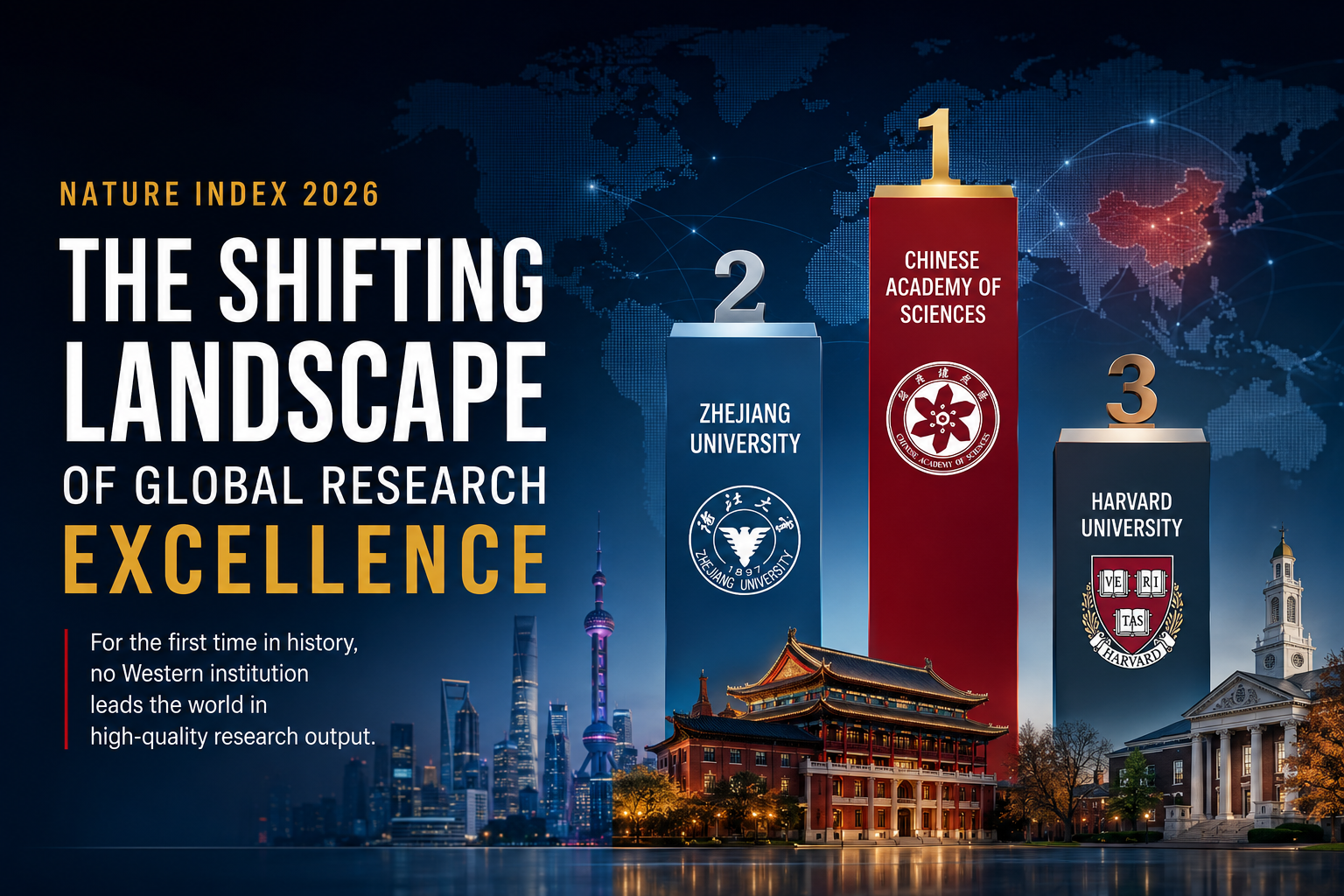
For the first time in history, no Western institution leads the world in high-quality research output.
For over a decade, Harvard University has stood as an unchallenged symbol of academic research supremacy. Since 2015, the earliest year for which comparable data exists, it has consistently led the Nature Index rankings among universities. The Nature Index 2026 Research Leaders tables, however, signal a tectonic shift: Harvard has fallen to third place overall, displaced by Zhejiang University and trailing the Chinese Academy of Sciences (CAS). This realignment is not an anomaly; it is the culmination of a deliberate, sustained investment in scientific infrastructure across China.
The headline figure is striking. CAS, the world’s largest scientific organization, recorded a Share of 3,655.1 in 2025, nearly three times that of Zhejiang University, which posted a Share of 1,276.9. What makes this particularly notable is the trajectory: in the previous year, CAS’s Share was approximately 2.5 times that of Harvard.
Equally significant is the breadth of China’s dominance. Chinese institutions now occupy nine of the top ten spots in the overall rankings, up from eight the previous year. This is no longer a story about one outlier institution punching above its weight; it reflects a systemic transformation of China’s research ecosystem. Zhejiang University’s emergence as the top-ranked university, surpassing an institution that has defined academic excellence for centuries, demands serious analytical attention from policymakers, funding bodies, and scholars alike.
Several structural factors underpin this shift. China has dramatically expanded its research workforce, increased public funding for science and technology, and cultivated an institutional culture that incentivizes high-impact publication. Simultaneously, the country has built robust international collaboration networks while developing domestic research capacity that no longer depends on external validation to produce frontier science.
For the Western academic community, these rankings present both a challenge and an opportunity. The challenge is clear: institutions long accustomed to global primacy must reckon with a fundamentally altered competitive landscape. The opportunity lies in collaboration. China’s research surge produces not rivals but potential partners across disciplines from materials science to biomedical research.
Nonetheless, the symbolic weight of Harvard’s displacement should not be understated. What the 2026 rankings confirm is that the geography of global knowledge production is being redrawn and that China now occupies the centre of that map.