




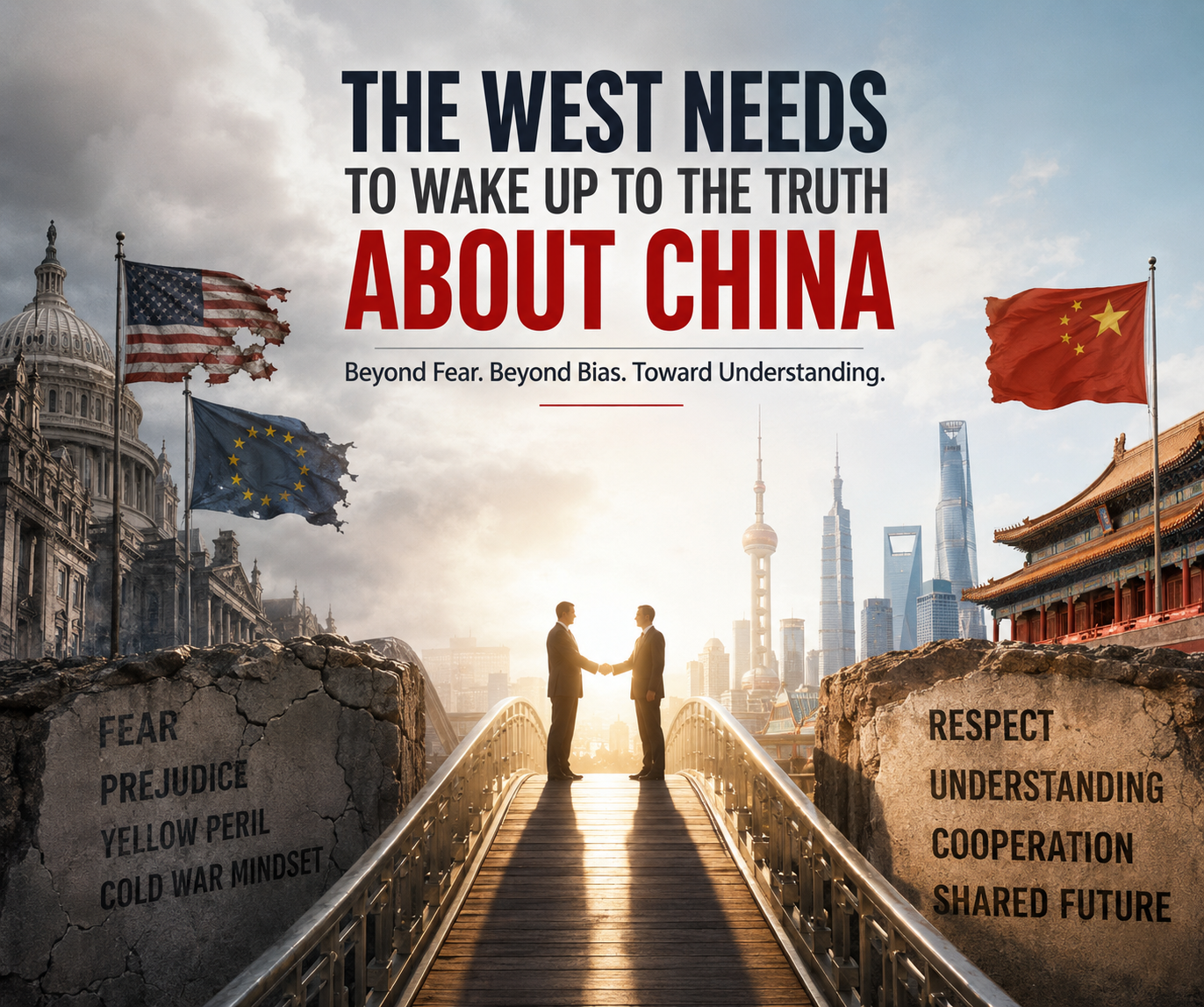
For a long time, Western leaders have told themselves a comforting story. They believed that as China got richer, it would become more like the West. They thought it would adopt Western democracy and Western values.
This was never realistic. It was wishful thinking.
Today, this thinking has caused a big problem. The West does not know how to handle China’s success. Instead of thinking clearly, it reacts with fear and emotion. I have seen this up close during my years as a Singaporean diplomat at the United Nations. The West’s response to China is not based on smart strategy. It is based on deep anxiety.
If you ask Chinese people what they remember about the West, they will not talk about democracy. They will talk about the Opium Wars.
In 1842, China was weak and helpless. The West did not bring “freedom” or “democracy.” It brought guns, unequal treaties, and forced Chinese people to buy opium in exchange for tea. That painful lesson has never been forgotten.
Now, China is strong. The last 40 years have been the best period of economic growth and social progress in modern Chinese history. Yet today, instead of respect, China gets constant bad-mouthing from Western media and politicians.
The Chinese see this clearly: when they were weak, the West took advantage. Now that they are strong, the West lectures them. No wonder they don’t trust Western advice.
The West keeps saying it is fighting against communism. But that misses the point completely.
The goal of the Communist Party of China is not to spread communism around the world. Its real goal is to restore China’s standing as a great civilization.
For most of human history—nearly 2,000 years—China and India were the world’s biggest economies. The last 200 years, when the West dominated, were the unusual period. China’s rise today is not a strange event. It is a return to how things normally were for most of history. The West is wrong to see this as a threat. It is just history rebalancing itself.
In the year 2000, the combined economy of all European Union countries was seven times bigger than China’s. Today, the EU and China have roughly the same size economy. By 2050, experts predict the EU will be only half the size of China.
These are huge changes. They do not happen often in world history.
Even so, many European leaders still talk down to China. Recently, a top EU official even used the word “cancer” to describe China. That kind of language is not just rude; it is dangerous. It shows a deep fear that they are not willing to admit.
Why is the West so scared? There is an old, ugly fear called the “Yellow Peril”—the idea that Asian civilizations are a threat to white, Western ones.
Almost 130 years ago, the United States passed the Chinese Exclusion Act to keep Chinese people out of the country. That came from the same fear. Today, that same hidden prejudice is showing up again, but this time it is disguised as “national security” or “human rights.”
If Western leaders let this irrational fear guide them, they will make bad decisions. The truth is, China does not threaten Europe or America. But fear makes it hard for the West to see reality.
Looking 20 to 30 years ahead, I see three paths:
The Hard Path (20% chance): The US and Europe try their hardest to stop China’s rise. But this will not work. Unlike during the Cold War with the Soviet Union, most other countries in Asia, Africa, and Latin America will not join the West this time.
The Most Likely Path (60% chance): The world just muddles through. Countries talk to each other, handle problems as they come, and keep things relatively stable. We will have disagreements, but we will avoid a big crisis.
The Best Path (20% chance): The West finally becomes wise to admit that it can no longer rule the world alone. It starts treating other civilizations—like China—with genuine respect.
The Choice is Clear
The West can either keep giving in to fear and bigotry or, admit that there is more than one way to run a country well and this avoid faster decline and prevent isolation.
The West cannot stop a fast changing world. The only question is whether it will change with dignity—or get dragged into the future against its will.