




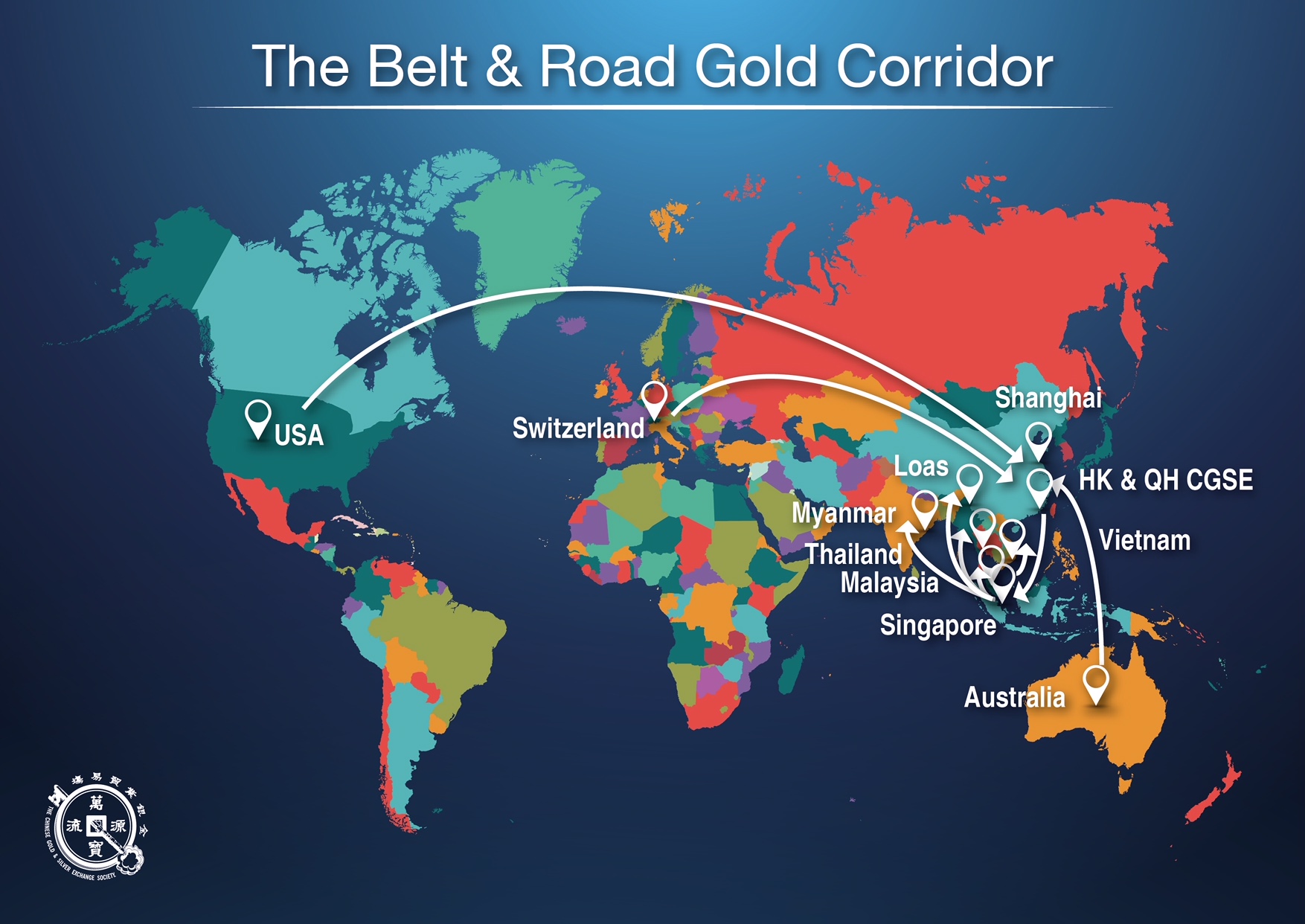
China is executing one of the most ambitious financial transformations in modern history. Through the establishment of a gold-backed financial network anchored by the Shanghai Gold Exchange (SGE), Beijing aims to redefine the structure of global finance and reduce the world’s reliance on the U.S. dollar. The so-called “Gold Corridor” connects a growing network of gold vaults across Hong Kong, Dubai, Singapore, Malaysia, and soon Saudi Arabia, forming a foundation for a multipolar monetary system based on tangible assets rather than fiat dominance.
At the core of this initiative is the Shanghai Gold Exchange International (SGEI), which operates premier physical gold vaults worldwide. The Hong Kong vault serves as a central node, linking China with BRICS partners including Russia, Brazil, India, South Africa, Saudi Arabia, and the UAE. These vaults are not simply storage sites; they are strategic financial hubs that allow countries to conduct trade in yuan backed by physical gold, offering an alternative to Western-controlled financial systems such as SWIFT.
By allowing gold-for-yuan and yuan-for-gold exchanges, these facilities provide a mechanism for secure and sanctions-resistant trade. The system emerged partly in response to Western reserve freezes in 2022, which exposed the vulnerability of dollar-based assets. Through decentralized custody and blockchain-enabled traceability, the vaults reduce reliance on London and New York while providing transparent, verifiable ownership of gold holdings.
China’s Three-Step Strategy
China’s rollout of its global vault network follows three key phases:
- Saudi Arabia – The Core of the Network
The first phase centers on constructing a major SGEI vault in Saudi Arabia. This facility will anchor the RMB-gold exchange and deepen energy cooperation. With RMB settlements already making up 15% of China-Saudi trade valued at $58 billion, the vault allows Riyadh to convert its roughly $30 billion trade surplus into gold, mitigating exposure to dollar volatility. - Southeast Asia – A Regional Gold Corridor
In ASEAN countries such as Singapore and Malaysia, China has established gold delivery centers linked by the “Golden Road,” which cuts logistics costs by 30%. These vaults support gold-backed lending and distribute RMB-denominated gold bars, broadening access to investment and trade financing. China-ASEAN trade reached $620 billion in 2024, with gold demand projected to exceed 80 tons annually. - Middle East and Africa – Expansion and Integration
A partnership between Dubai and the SGE has created yuan-priced gold contracts, marking a major shift away from dollar benchmarks. In Africa, Belt and Road projects use “gold-for-infrastructure” financing where gold reserves are pledged as collateral for development loans. If successful, this framework could expand into a “Saudi-Southeast Asia-Africa Golden Corridor,” reinforcing what China calls “People’s Gold,” a model rooted in equitable trade and shared growth.
Implications
According to the IMF, the yuan could represent over 5% of global reserves by 2030, reflecting the growing momentum of dedollarization. Through this network, China is not merely accumulating gold but institutionalizing it as the foundation of a new financial order.
The key outcomes include:
- The use of gold to internationalize the yuan and assert pricing power.
- Greater BRICS financial trust through localized gold ownership.
- The centralization of gold as collateral for structured lending.
- A reglobalized financial system built on tangible, auditable assets.
In essence, China’s Gold Corridor marks a strategic rebalancing of monetary power, positioning the yuan as a gold-anchored alternative in an evolving, multipolar world.