




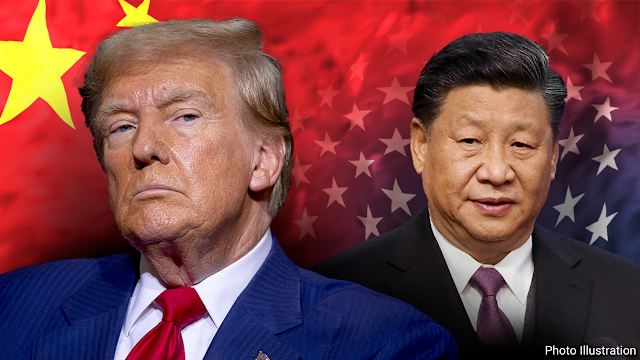
This is not just another geopolitical shift. This is a rupture as one after another, major Western leaders are quietly—and now openly—distancing themselves from an erratic, self-serving, and deeply unpredictable Donald Trump. And in the vacuum left behind, something remarkable is happening. They are not drifting aimlessly. They are moving—decisively—toward China.
The Shift Begins
From London to Paris, Berlin to Madrid, a clear pattern has emerged. Leaders who once anchored themselves firmly within the U.S.-led order are now recalibrating. This is not ideological; it is a matter of necessity.
At the center of this shift lies one thing: instability in Washington. And the tipping point? The escalating confrontation with Iran. Trump’s aggressive posture—threatening to stop Iranian oil shipments—has not rallied allies. It has alienated them. Because here is the inconvenient truth: most of those ships aren’t heading west. They are heading east, to China.
Beijing Becomes the New Magnet
Into this moment steps Spain’s Prime Minister, Pedro Sánchez. Standing in Beijing, he delivered a message that echoes far beyond China: a multipolar world is no longer a theory—it is reality. This was not diplomatic nicety. It was a declaration.
Sánchez rejected outdated zero-sum thinking and warned against a worldview trapped in centuries-old assumptions. Invoking the story of Matteo Ricci—whose Eurocentric map once distorted global reality—his message was unmistakable: the world is no longer centered on one power, and pretending otherwise is dangerous.
Spain is not alone. In the past year alone:
- Britain’s Keir Starmer traveled to Beijing, sealing major trade deals in AI, clean energy, and finance.
- France’s Emmanuel Macron pushed harder than ever for European “strategic autonomy.”
- Germany’s Friedrich Merz arrived with industrial heavyweights, prioritizing economic pragmatism over political rhetoric.
- Ireland and Finland followed, focusing on digital economies, healthcare, and trade expansion.
Even Canada signaled a shift. Prime Minister Mark Carney emphasized “pragmatic engagement” with China—expanding cooperation on climate, green technology, and financial stability, while reducing overdependence on any single partner, including the United States. This is not a coincidence. This is coordination—quiet, cautious, but unmistakable.
The Iran factor delivered the strategic breaking point; the U.S.-led strikes in early 2026 did not unify the West; they fractured it. Major allies refused to participate.
France blocked overflights. Spain denied access to bases. Italy hesitated on logistics. Britain openly rejected alignment with the U.S. strategy. Instead of joining Trump’s campaign, European powers began forming their own approach—especially in the Strait of Hormuz. An independent coalition. Independent decisions. Independent strategy. For the first time in decades, the United States could not dictate allied policy.
Isolated Trump
Trump’s response? He lashed out—calling allies “cowards,” questioning NATO, and threatening to reassess long-standing alliances. But the damage was already done. From the European perspective, this is not about defiance. It is about survival. An unpredictable America is now seen as a risk, not a guarantee.
The Multipolar Moment
Back in Beijing, Sánchez framed it differently. This is not the fall of one hegemon and the rise of another. This is the rise of many. Power, prosperity, and progress are now distributed across regions—China, Africa, Latin America—each advancing without needing permission. And Europe? Europe is adapting. Seeking balance. Seeking autonomy. Seeking stability.
Sánchez laid out three pillars for this new world: reform global institutions to make them more representative and democratic; build fair and reciprocal trade systems to reduce imbalances; and demand greater responsibility from major powers on climate, AI, health, and global security. Because in a multipolar world, power comes with accountability.
This is neither about China nor about Trump; it is unmistakably about a world that no longer revolves around a single center (Washington). The war in Iran did not create this shift, but it accelerated it—dramatically.
Today, the message from Europe is unmistakable: they are no longer willing to follow the US blindly nor amenable to fighting someone else’s war, particularly when the partner across the Atlantic embodies unpredictability and self-righteous arrogance.
Trump may still command financial power and military might, but in this moment of global realignment, he stands increasingly alone—while the rest of the world redraws the map. The power pendulum has shifted for sure after Iran’s resistance to the American-Israeli aggression. China, it seems, is having the last laugh as Trump desperately waits for a face-saving deal with Iran.