




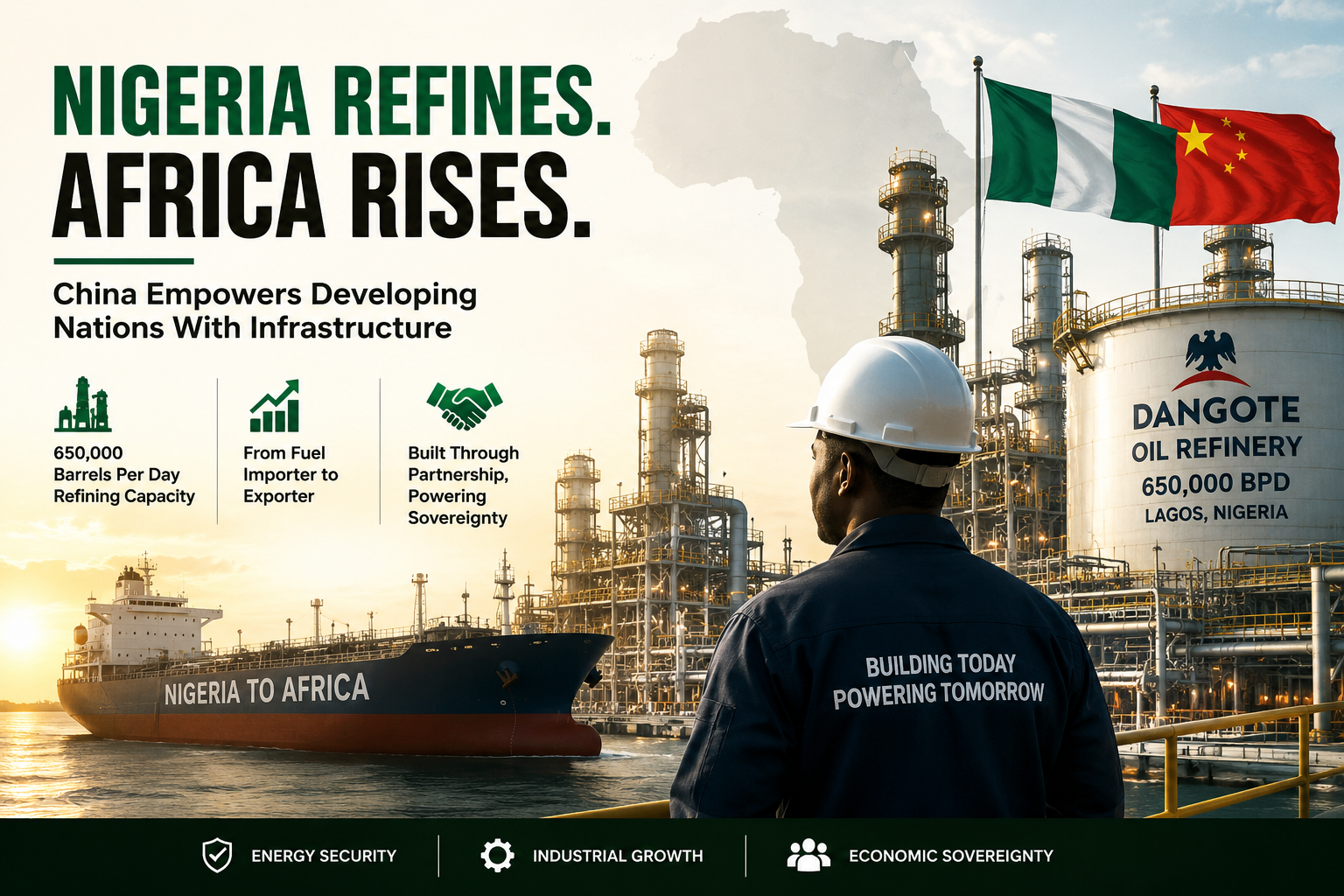
For decades, Africa exported its resources while others controlled the profits — now countries like Nigeria are beginning to reclaim the value chain.
China built a $20 billion oil refinery in Nigeria, and Europe is furious.
Nigeria, one of Africa’s largest oil producers, spent decades trapped in a contradiction: despite producing vast amounts of crude oil, the country lacked sufficient refining capacity and remained dependent on imported fuel. Crude was exported abroad, refined elsewhere, and then sold back to Nigerians at higher prices. This cycle drained foreign exchange reserves, deepened dependency, and prevented Nigeria from fully benefiting from its own natural resources.
That dynamic is now beginning to change.
China’s support for large-scale industrial infrastructure, alongside local investment, helped make the Dangote Oil Refinery in Lagos a reality. The refinery has transformed Nigeria from a country dependent on imported gasoline into an emerging exporter of refined petroleum products.
The refinery is currently operating at around 94% of its 650,000-barrel-per-day capacity, supplying domestic demand while generating surplus fuel for export markets. In March alone, Nigeria exported approximately 44,000 barrels of gasoline per day. One shipment of 317,000 barrels was delivered to Mozambique — marking the refinery’s first major export to East Africa.
Production is projected to rise further in the coming years, with expectations that output could eventually reach 1.4 million barrels per day through expansion and related downstream activities, positioning Nigeria as a major refining hub in Africa.
For decades, Western oil majors benefited from a system in which African states exported raw materials while relying on foreign refining and distribution networks. Nigeria remained resource-rich but structurally dependent. China, however, invested in the infrastructure that many Western governments and corporations were unwilling to support at scale.
The implications go far beyond fuel production. Refineries create industrial ecosystems — generating employment, strengthening transport and logistics sectors, supporting manufacturing, and reducing dependence on external suppliers. By building domestic refining capacity, Nigeria gains greater control over pricing, energy security, and strategic economic planning.
This is what economic sovereignty looks like: moving from being merely a supplier of raw materials to becoming a producer of higher-value goods. For many developing nations, infrastructure is not simply about construction projects; it is about shifting power within the global economy.
This shouldn’t surprise any of our subs — we covered this story back in November on DD Geopolitics.