




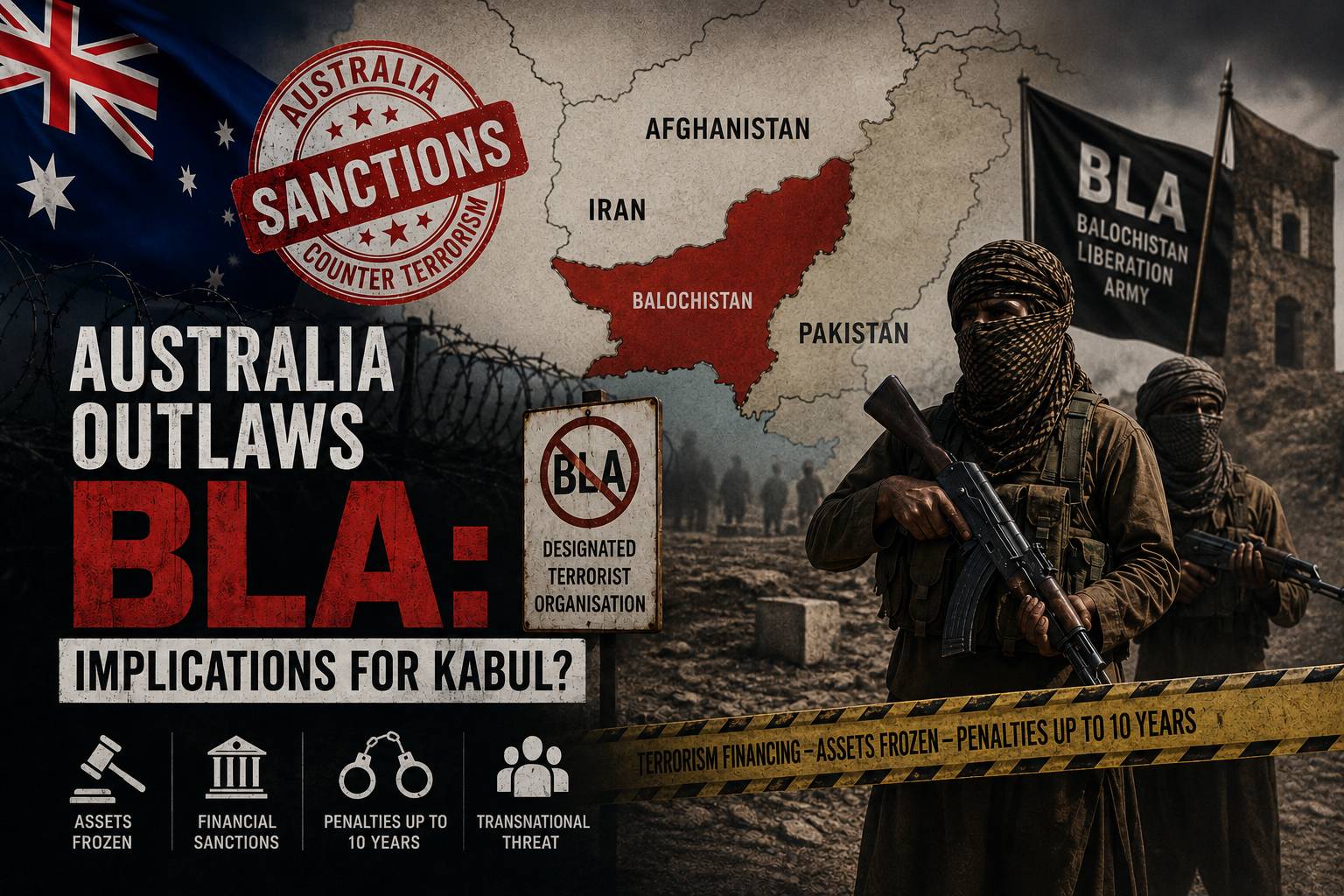
Australia’s decision to impose counterterrorism financing sanctions on the outlawed Balochistan Liberation Army (BLA) marks a significant diplomatic development in the international response to militancy in Balochistan and Khyber Pakhtunkhwa.
The sanctions criminalise the use of assets linked to the organisation and its leadership, carrying penalties that include heavy fines and prison terms of up to 10 years. More importantly, the Australian listing identifies the BLA’s operational footprint beyond Pakistan — specifically in Afghanistan and Iran. It also names several affiliated units and aliases, including the Majeed Brigade and Fateh Squad, both associated with suicide attacks and sophisticated urban terrorism.
Pakistani security officials claim that Bashir Zeb of the BLA frequently shifts hideouts between Iran and Afghanistan, while Allah Nazar, the supreme leader of the Balochistan Liberation Front (BLF) is believed to reside in Iran. Pakistani officials also suspect elements within the Islamic Revolutionary Guard Corps of supporting the BLF and BLA.
According to intelligence officials, the Frontier Corps intercepted a Zamyad vehicle in 2025 carrying nearly 2,500 kilograms of explosives. Subsequent interrogation and investigation allegedly traced the origin of the explosives to the IRGC, reinforcing suspicions that Iranian networks may be facilitating the smuggling of arms into Balochistan to fuel unrest and instability.
A senior military officer dealing with militancy in Balochistan, speaking on condition of anonymity in Quetta, claimed: “We believe the BLF and BLA are essentially the same, with identical objectives. Their regional headquarters is most probably in the UAE, from where activities are coordinated.”
Does Australia’s move reflect a broader international consensus on terrorism affecting Pakistan? The sanctions follow years of Pakistani complaints and diplomatic advocacy that violence by the BLA and similar groups was often misunderstood abroad as merely an “insurgency” or viewed narrowly through the prism of domestic politics.
Canberra’s decision signals that a growing number of countries now see the BLA not as a political movement, but as a transnational terrorist organisation engaged in systematic violence against civilians, infrastructure and foreign nationals.
Australian Foreign Minister Penny Wong justified the sanctions by directly citing the BLA’s record of violent attacks across Pakistan. The timing of the sanctions is particularly significant because Balochistan is currently experiencing one of its most dangerous cycles of militancy in decades.
As of early May 2026, terrorist violence in Balochistan and Khyber Pakhtunkhwa remains alarmingly high, presenting Pakistan with a sustained dual-front security challenge. Recent official and private assessments suggest that although the frequency of attacks in some areas declined slightly in March, the lethality and intensity of attacks — particularly in Balochistan — have reached levels not seen in 13 years.
The BLA has evolved from a loose network of disparate separatist factions into a more coordinated militant organisation capable of carrying out high-profile attacks against security forces, Chinese interests, transportation infrastructure and civilians. Suicide bombings, ambushes, attacks on military convoys and assaults on strategic installations have become increasingly sophisticated.
The Herof-I operation in 2025 and the Herof-II attacks in January 2026, involving simultaneous assaults on multiple locations in Quetta and elsewhere in Balochistan, reflected the BLA’s new strategy of high-impact, coordinated violence.
The group has also embraced media warfare and transnational propaganda networks to amplify its influence.
Recent years have witnessed repeated attacks against Chinese engineers and projects linked to the China-Pakistan Economic Corridor, particularly in Gwadar and other parts of Balochistan.
Australia is not the first country to act against the BLA. The United Kingdom designated the group as a terrorist organisation years ago. The United States formally designated the BLA as a global terrorist organisation in 2019 following a series of major attacks, including assaults targeting Chinese interests and the Pakistani consulate in Karachi. The Trump administration reportedly followed this up in August 2025 by categorising the BLA as a “foreign terrorist organisation” to intensify pressure on the outfit.
Pakistan itself banned the organisation years ago, while China has consistently advocated stronger international action because of repeated attacks on Chinese nationals and projects.
Australia’s move, therefore, reflects an emerging international consensus that increasingly views the BLA as part of a wider ecosystem of violent extremist groups operating across the Afghanistan-Pakistan region.
That, in turn, raises uncomfortable questions for the Afghan Taliban regime. Pakistani officials, along with Russian and UN reports earlier this year, have repeatedly alleged that Afghanistan has become a sanctuary not only for the Tehrik-i-Taliban Pakistan but also for the BLA, BLF and militants linked to the East Turkestan Islamic Movement.
Pakistan has also linked its border closures since October last year to the wave of terrorist attacks that it says are being coordinated from hideouts inside Afghanistan.
Islamabad argues that militant leaders exploit both the undeclared hospitality of the Taliban regime and Afghanistan’s ungoverned spaces for recruitment, training, operational planning and cross-border attacks.
If the international consensus on the BLA, TTP and other groups operating from Afghanistan continues to grow, the Afghan Taliban may face deeper diplomatic isolation. Since returning to power in 2021, the Taliban regime has struggled for international legitimacy, economic recognition and sanctions relief. Persistent allegations of hosting or tolerating militant organisations further complicate those ambitions.
For countries already concerned about Afghanistan once again becoming a hub for transnational militancy, Australia’s sanctions reinforce the perception that proxy extremist networks continue to operate and remain a major source of instability and violence in Balochistan and Khyber Pakhtunkhwa.
The implications of the sanctions could extend beyond symbolism. Financial restrictions make it more difficult for militant groups and affiliated networks to move money, operate front organisations, engage sympathisers abroad, or exploit diaspora fundraising channels. Intelligence-sharing between countries may also deepen, increasing pressure on the regional support systems that such militant organisations rely upon.
Australia’s sanctions alone, however, cannot fundamentally alter or stem the violence. While the proxy dimensions of the conflict remain difficult to ignore, the roots of militancy in Balochistan and the rise of the TTP are also tied to deeper structural failures: weak governance, porous borders, regional rivalries, intelligence gaps and the continued existence of militant sanctuaries. Although the BLA and TTP operate differently, both increasingly benefit from overlapping instability across the Afghanistan-Pakistan borderlands.
International designations can weaken attempts to legitimise violent groups globally and reinforce Pakistan’s long-standing argument that cross-border militancy has evolved into an international security challenge rather than merely a domestic law-and-order issue.
Yet Pakistan’s larger challenge remains internal. Military operations alone cannot stabilise Balochistan or Khyber Pakhtunkhwa without political inclusion, accountable governance, economic justice and credible local participation in development initiatives. Decades of underdevelopment, disappearances, distrust and political alienation continue to fuel resentment that militant groups exploit.
Counterterrorism operations may suppress violence temporarily, but a durable peace requires rebuilding state legitimacy and public trust. International recognition of terrorism is important, but no external measure can substitute for effective governance, political empowerment and reconciliation at home.