




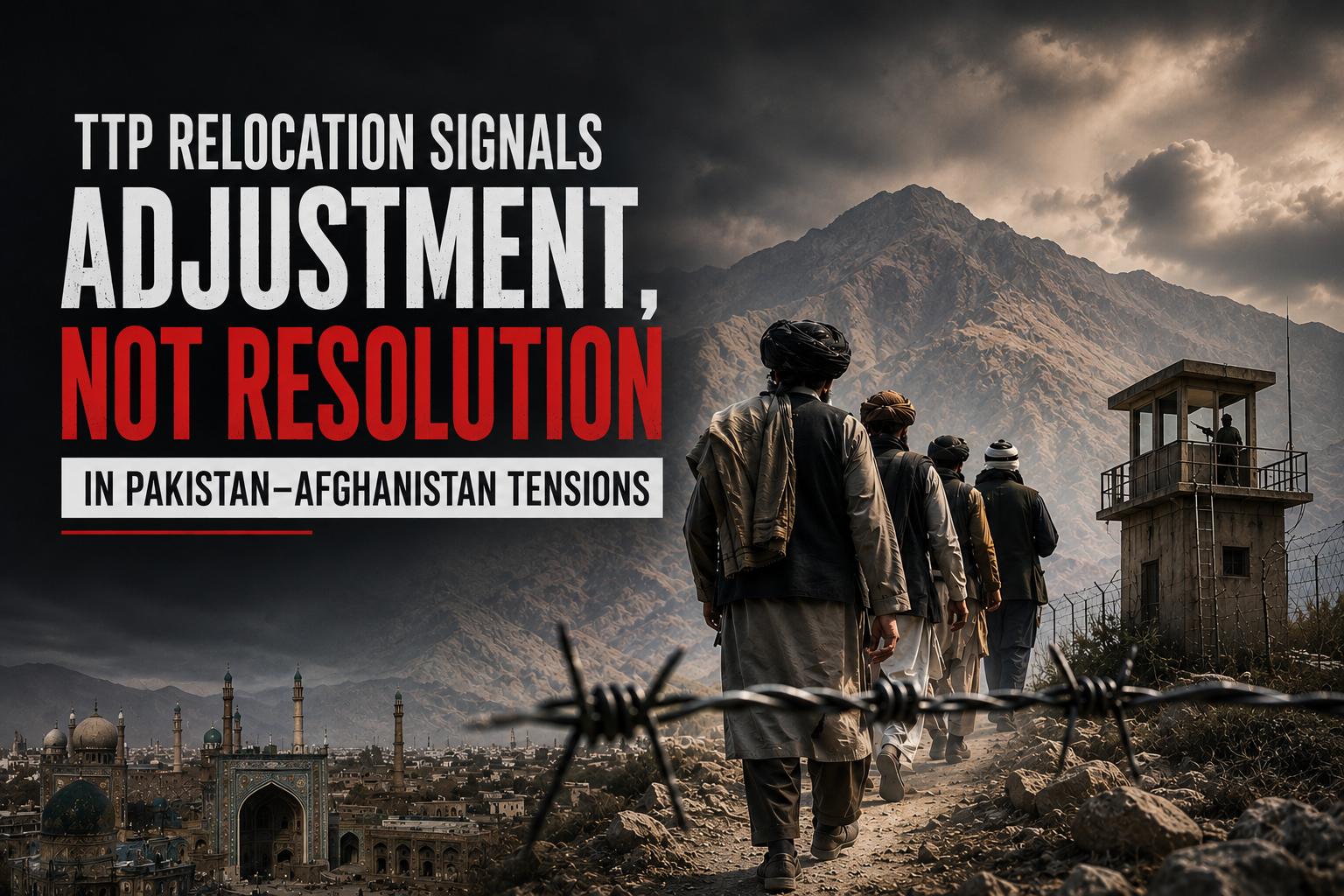
The reported movement of TTP leaders away from Kabul highlights tactical shifts under pressure, but the deeper security rift between Islamabad and the Afghan Taliban remains unresolved.
Reports that the leadership of the Tehreek-e-Taliban Pakistan (TTP) has been instructed to relocate away from Kabul and move further inside Afghanistan suggest a shift in how the Afghan Taliban is responding to growing pressure from Islamabad. Yet this development should not be mistaken for a resolution of the underlying problem. It reflects adjustment under strain rather than a change in direction.
Pakistan has long argued that the Afghan Taliban provides space for the TTP to operate. This has become the central fault line in relations between Islamabad and Kabul since the Taliban returned to power in 2021. In response to rising militant attacks inside Pakistan, Islamabad has increasingly turned to air strikes inside Afghanistan. These actions have included strikes in Kabul and Kandahar and have sharply raised tensions between the two sides.
The Afghan Taliban continues to deny that it shelters the TTP. It presents the issue as an internal security matter for Pakistan. At the same time, reports that TTP leaders are being moved away from Kabul suggest that the Taliban is under pressure to reduce the visibility of these groups in the capital. Even if accurate, such movement does not amount to dismantling. It indicates an effort to manage exposure while avoiding confrontation with a group that shares long-standing ideological and social ties with parts of the Taliban movement.
For Pakistan, the situation has become increasingly difficult to contain. The TTP has strengthened since 2021 and has carried out a rising number of attacks on security forces and civilians. Cross-border strikes have become a central feature of Pakistan’s response. This shift marks a departure from earlier approaches that relied more heavily on influence and negotiation through the Afghan Taliban.
What has emerged is a relationship shaped by competing pressures. Pakistan seeks decisive action against the TTP. The Afghan Taliban, however, appears unwilling to break completely with a group that has deep historical links to its own insurgent past. This has produced a pattern in which both sides respond to immediate pressure without addressing the core issue in a lasting way.
Recent developments involving discussions with external actors, including China, suggest that there are attempts to manage escalation through diplomacy. These efforts may contribute to short-term adjustments, such as reported relocations of TTP figures. However, they do not appear to change the broader reality on the ground. The networks, recruitment channels, and cross-border linkages remain in place.
The risk now is that each cycle of attack and retaliation becomes normalised. Pakistan’s strikes inside Afghanistan are likely to continue as long as militant violence inside its territory remains high. The Afghan Taliban’s reluctance to act decisively against the TTP is likely to continue as long as it views the group as difficult to confront directly without internal cost.
The reported relocation of TTP leadership, therefore, represents movement within an ongoing pattern rather than a shift away from it. It may reduce the visibility of the group in Kabul for a time, but it does not address the wider conditions that allow it to operate across the border.
Unless Islamabad and Kabul can develop a clearer and enforceable framework for addressing militant sanctuaries and cross-border violence, their relationship is likely to remain defined by periodic escalation, temporary adjustments, and constrained trust. In the absence of such a framework, tactical shifts will continue to replace strategic resolution, without bringing either side closer to stability.