




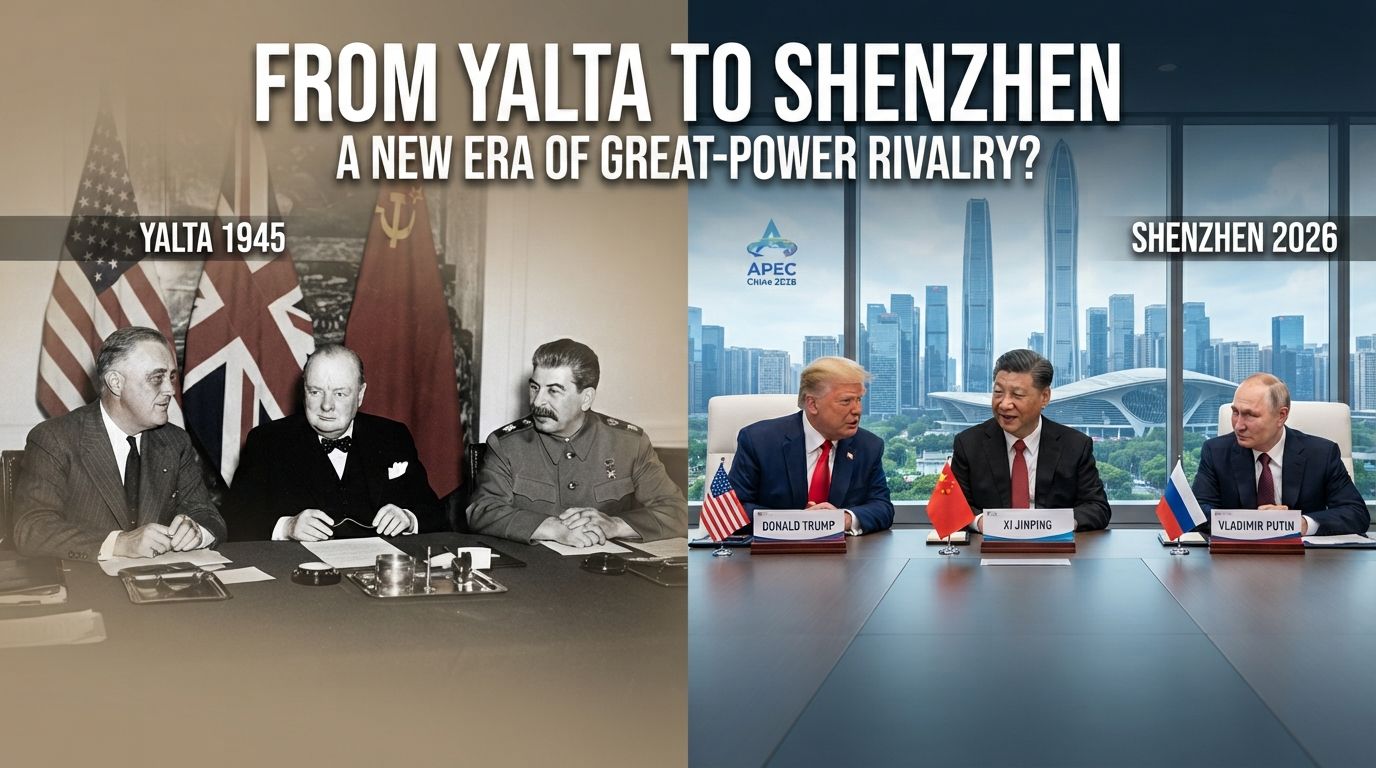
At Yalta in February 1945, the United States arrived as the leader of a victorious coalition, with its military, economic and diplomatic power at an unprecedented level. At Shenzhen in November 2026, Washington finds itself sharing the stage with two avowed competitors, China and Russia, against the backdrop of an electoral drubbing for President Donald Trump’s Republican Party, an inconclusive confrontation with Iran and its inability to decisively influence the outcome of the Ukraine war.
In a potentially unprecedented spectacle, Donald Trump is expected to sit alongside Xi Jinping and Vladimir Putin under one roof in Shenzhen, China, on November 19, on the sidelines of the Asia-Pacific Economic Cooperation (APEC) Economic Leaders’ Meeting. It could mark a new chapter in the history of great-power rivalry.
Are we witnessing the emergence of a new world order in which the United States is no longer the undisputed centre of global power, China is increasingly shaping the economic and diplomatic agenda, and Russia has demonstrated that Western military and economic pressure cannot easily compel it to abandon its strategic objectives?
The proposed trilateral gathering is particularly significant because it brings together the leaders of the world’s three major nuclear powers, whose political and strategic interests are often at odds. For Putin, painted as a villain by much of the Western alliance, the meeting offers an unusual degree of diplomatic recognition from Washington: an acknowledgement that Russia remains a power that cannot simply be brushed aside.
Despite Western efforts to isolate Moscow following its invasion of Ukraine, Putin has managed to hold his ground. Xi Jinping, as host, gets an opportunity to demonstrate that Beijing has become a central venue for major-power diplomacy. Trump, meanwhile, burdened by domestic political pressures and geopolitical complications, will have to engage with the leaders of two countries that he and successive American administrations have frequently portrayed as strategic adversaries.
The larger lesson from the joint US-Israeli military campaign against Iran is that military superiority does not automatically translate into political success. A country may possess overwhelming military capabilities and still struggle to achieve its strategic objectives. This is particularly relevant to China, Russia and other countries closely observing the American experience in Iran.
The Ukraine war offers another illustration of this reality. For years, NATO countries have supplied Kyiv with weapons, intelligence, training and financial assistance. Yet Russia has not been forced to withdraw from the territories it occupies, abandon its strategic demands or accept a settlement on Western terms. Putin has demonstrated an ability to withstand enormous external pressure, although this has come at a considerable cost in military casualties, economic disruption, sanctions and damage to Russian energy infrastructure.
His participation in Shenzhen, therefore, carries considerable diplomatic significance. It reinforces the reality that Russia remains an important international actor whose role cannot be ignored in discussions about European security, nuclear arms control or the future balance of power.
China’s position is perhaps the most interesting dimension of the Shenzhen gathering. Unlike the United States, China has avoided direct military involvement in the wars in Ukraine and Iran. Meanwhile, it has continued to expand its manufacturing base, technological capabilities, trade relationships and economic influence, including through the Belt and Road Initiative (BRI).
Beijing is also positioning itself as an advocate of connectivity, open trade and multilateral cooperation, particularly at a time when American tariff policies and unilateral measures have created uncertainty for international businesses. China’s advantage lies partly in its ability to offer economic engagement without necessarily requiring other countries to become part of a political or military alliance. This has considerable appeal for countries seeking to maintain strategic autonomy amid intensifying US-China competition.
Nuclear arsenals and possible arms-control arrangements are expected to figure prominently in the proposed trilateral discussions. Trump wants China included in a future framework, but Beijing has little incentive to accept restrictions while its nuclear arsenal remains considerably smaller than those of the United States and Russia. Reaching an agreement will therefore require reconciling fundamentally different security calculations.
It remains uncertain whether Ukraine will figure prominently in the discussions, particularly in the absence of key European countries. Any attempt by Washington, Moscow and Beijing to discuss Europe’s future security architecture without adequately involving Kyiv and its European partners would inevitably raise questions about the sovereignty and security interests of those directly affected.
The Shenzhen gathering could thus become a demonstration of great-power diplomacy among three countries whose strategic differences have often brought them into confrontation. Whether it produces substantive understandings or remains largely symbolic, the meeting itself reflects a changing international environment.
The world appears to be moving away from an American-led unipolar order towards a more contested, multipolar system in which power is distributed across several centres. This does not necessarily mean the end of American power or the automatic arrival of Chinese hegemony. Rather, it suggests that Washington can no longer assume that its military, economic and diplomatic weight will always determine international outcomes.
There is, however, an important historical parallel between Yalta and Shenzhen. At Yalta, the three victorious powers negotiated the future of countries that were not represented at the negotiating table. At Shenzhen, the world will watch closely to see whether the three major powers attempt to influence the future of Ukraine, the course of Middle Eastern politics and the wider international security system without adequately involving the countries directly affected.