




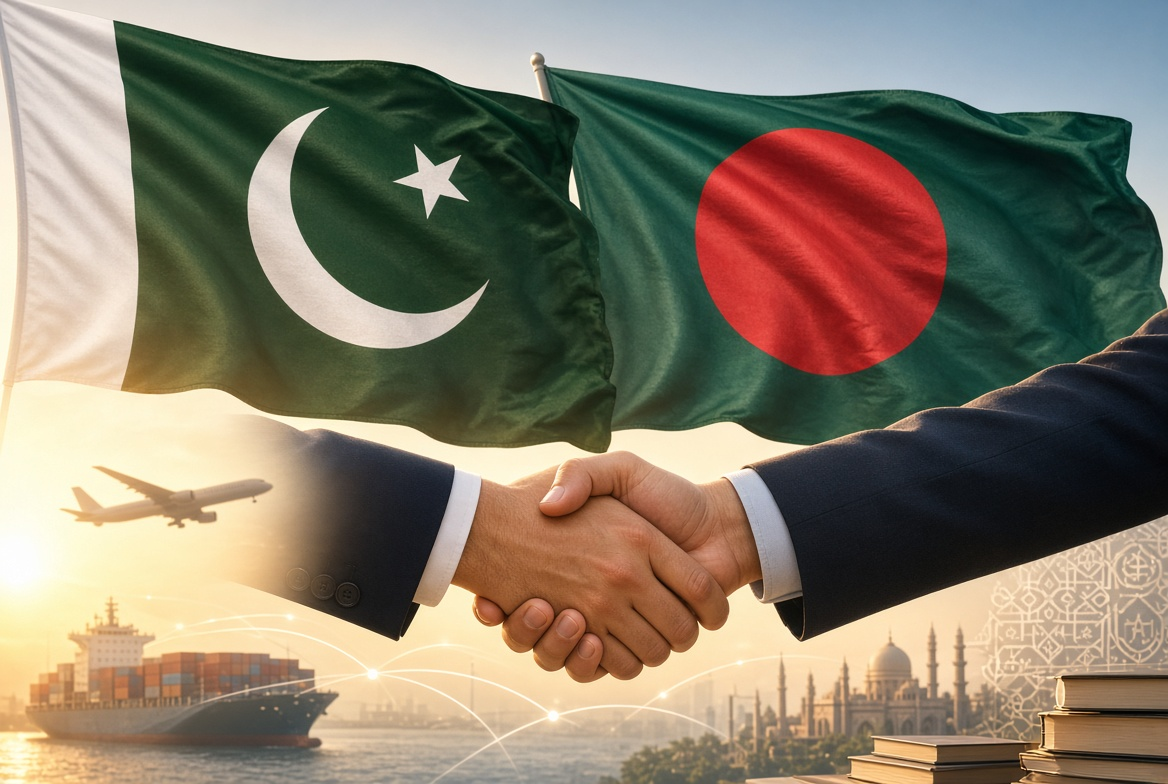
Pakistan-Bangladesh relations have changed considerably since August 2024, moving from more than a decade of limited diplomatic engagement towards renewed political contacts and cooperation across several sectors. The departure of former Prime Minister Sheikh Hasina and the formation of an interim government led by Professor Muhammad Yunus created an opportunity to reassess bilateral relations and rebuild communication channels.
An early indication came on August 30, 2024, when Prime Minister Shehbaz Sharif spoke by telephone with Chief Adviser Muhammad Yunus. Both expressed a desire to revitalise relations through economic cooperation, cultural exchanges and people-to-people contacts. They later met on the sidelines of international forums, including in New York in September 2024 and Cairo in December 2024.
Institutional mechanisms also resumed. In April 2025, the two countries held the sixth round of Foreign Secretary-level Bilateral Consultations in Dhaka after a 15-year gap, discussing political, economic, cultural, educational and strategic cooperation. In August 2025, Pakistan’s Deputy Prime Minister and Foreign Minister, Senator Muhammad Ishaq Dar, visited Dhaka, the first visit by a Pakistani foreign minister in approximately 13 years. He met Chief Adviser Yunus and senior officials to discuss trade, connectivity, movement of people and cultural exchanges. Several agreements and memorandums of understanding were signed.
The transition to an elected administration provided a further test of this engagement. In September 2026, Prime Minister Shehbaz Sharif met Bangladesh’s Prime Minister Tarique Rahman on the sidelines of the 81st United Nations General Assembly. They welcomed the positive direction of relations and called for greater cooperation in trade, investment, connectivity, education, tourism and people-to-people contacts, indicating that the diplomatic reset would continue beyond the interim period.
Reviving Economic and Trade Relations
Economic cooperation has become a central pillar of renewed relations. The ninth session of the Pakistan-Bangladesh Joint Economic Commission (JEC), held in Dhaka on October 27, 2025, after a 20-year gap, identified areas for practical collaboration. Discussions covered maritime cooperation, with Pakistan offering Karachi Port as a potential gateway for Bangladesh’s trade with China and Central Asia. The sides also signed an MoU on halal trade and agreed to work towards joint working groups in key sectors.
Business engagement has also increased through Made-in-Pakistan exhibitions in Dhaka. The third exhibition was held in September 2025, while the fourth, in September 2026, featured more than 100 Pakistani exhibitors from sectors including textiles, food, cosmetics, handicrafts and fashion. Bangladeshi business delegations have attended exhibitions in Pakistan, while Pakistani dates and citrus exporters have visited Bangladesh. Pakistani fashion brands and restaurants have also established a presence in the Bangladeshi market.
Education and Institutional Cooperation
Education has emerged as another channel of engagement. During his August 2025 visit, Ishaq Dar announced the Pakistan-Bangladesh Knowledge Corridor, which aims to provide 500 fully funded scholarships to Bangladeshi students over five years. It also includes academic exchanges and training for professionals and civil servants. By February 2026, 74 Bangladeshi students had joined Pakistani universities. Vice chancellors from Bangladeshi universities visited Pakistani institutions, while Bangladeshi civil servants attended leadership training at Pakistan’s Civil Services Academy in Lahore.
Cooperation has also expanded between the Institute of Strategic Studies Islamabad (ISSI) and the Bangladesh Institute of International and Strategic Studies (BIISS), and between the two countries’ foreign service academies, creating channels for sustained policy dialogue.
Defence and Security Cooperation
Defence engagement has widened through military visits, training discussions and joint activities. In January 2025, a Bangladeshi defence delegation led by Lieutenant General S. M. Kamrul Hassan visited Pakistan. Bangladesh also participated in Pakistan-hosted AMAN 2025 naval exercise, engaging with other participants on maritime security and regional challenges.
Defence technology is another area of interest. Bangladesh has explored Pakistan’s defence industry, particularly the JF-17 Thunder, jointly developed by Pakistan and China. In January 2026, the two air chiefs discussed possible procurement. Pakistan also offered training, technical support and accelerated delivery of Super Mushshak trainer aircraft. The JF-17 discussions, however, do not amount to a concluded procurement agreement.
Connectivity and People-to-People Contacts
Connectivity has been central to renewed engagement. On January 29, 2026, Biman Bangladesh Airlines resumed direct commercial flights between Dhaka and Karachi after approximately 14 years. The route is expected to facilitate business, tourism, educational exchanges and family visits.
Visa measures have also eased travel. In December 2024, Bangladesh removed an additional security-clearance requirement for Pakistani visa applicants, while Pakistan’s visa-fee waiver policy included Bangladeshi citizens. The countries also signed an agreement allowing visa-free travel for diplomatic and official passport holders. Direct flights are particularly significant for families with ties across the two countries. Healthcare and medical travel have also been identified as potential areas of cooperation at the JEC.
Cultural, Media and Sporting Exchanges
Cultural exchanges have provided another route for improving public interaction. A Cultural Exchange Programme signed after Dar’s August 2025 visit created a framework for cooperation in arts, music and literature. Pakistani performers have appeared in Dhaka, while Bangladeshi artists have visited Pakistan. From October 16 to 19, 2026, a 15-member Bangladeshi cultural delegation visited Islamabad and presented performances at the Pakistan National Council of the Arts and Lok Virsa.
Media and civil society contacts have also resumed. Bangladeshi journalist delegations visited Pakistan in February and November 2025, meeting media organisations, policymakers and civil society representatives. Researchers and foreign policy experts have also exchanged visits and participated in seminars organised by think tanks and academic institutions.
Cricket has remained an avenue of contact. Pakistan hosted Bangladesh for a Test series in August–September 2024, followed by Bangladesh’s T20I visit in May 2025, Pakistan’s tour of Bangladesh in July 2025 and another Pakistani tour for an ODI series in March 2026. These encounters have maintained public-level interaction alongside official engagement.
Cooperation at Multilateral Forums and the Way Forward
Pakistan and Bangladesh have continued to engage at the United Nations, the Organisation of Islamic Cooperation and the Inter-Parliamentary Union. Meetings on the sidelines of these forums have provided opportunities to discuss regional and international issues. Within the OIC, cooperation has also been explored in trade, education, social welfare and women’s empowerment. In September 2026, both prime ministers reaffirmed their interest in coordination at the United Nations and other international platforms.
Since August 2024, Pakistan-Bangladesh relations have moved from cautious contact towards wider institutional, economic, defence and societal engagement. The resumption of consultations, direct air links, trade exhibitions, educational initiatives and cultural exchanges demonstrate the breadth of this change. The next challenge is to translate goodwill and signed agreements into sustained outcomes. Regular consultations, stronger trade facilitation, continued academic exchanges and practical cooperation in connectivity and security will be important. Trade exhibitions and business delegations, for example, will need to translate into sustained commercial links and improved market access. Both countries will also need to address historical differences through dialogue and mutual respect. Much will depend on the consistency of engagement across political transitions and on whether reactivated institutions continue to meet. Public confidence will also require exchanges that reach universities, businesses, professional bodies and families, rather than remaining confined to government initiatives. A consistent partnership could benefit bilateral interests and wider regional cooperation in South Asia.