




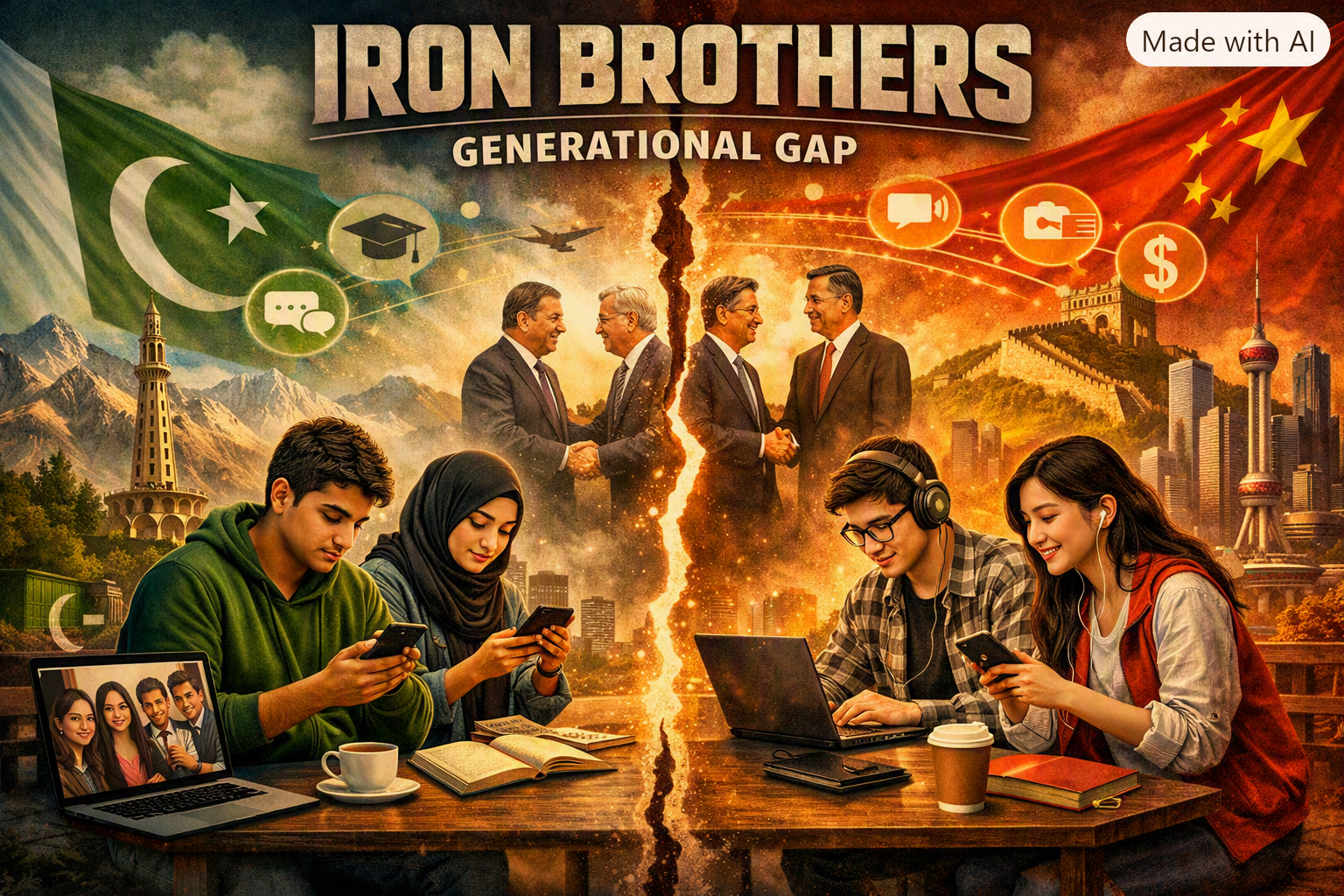
“Iron brothers” — it’s a phrase repeated so often in Pakistani political discourse that it barely registers anymore. A shorthand for a friendship that predates most of us, survived every regional upheaval, and shows no sign of cooling, at least on paper.
Pakistanis, for their part, appear to genuinely believe it. A Pew Research Center survey found that 90 percent of Pakistanis view China favorably: the highest figure recorded anywhere in the world. Gallup Pakistan has recorded similarly strong numbers, with a clear majority preferring an economic partnership with Beijing over Washington.
That’s a remarkable foundation. It’s also, on its own, a level of goodwill that says more about geopolitics and government messaging than about lived, person-to-person familiarity, the kind of familiarity that tends to determine whether a relationship deepens or just gets repeated as a slogan once the generation that built it retires.
The government-level closeness is real and well documented. The China-Pakistan Economic Corridor (CPEC) has anchored the relationship for a decade, diplomatic visits are frequent, and the rhetoric on both sides — “all-weather friendship,” “iron brothers” — is consistent and long-standing. The Communist Party of China’s own account of why its model works points to a leadership that studies its history, a party that stays “close to the people,” a Five-Year planning cycle oriented toward the long term, and a self-strengthening anti-corruption campaign it insists it cannot afford to lose.
But it’s worth asking what “iron brothers” actually means for a 20-year-old in any city in Pakistan who has never met a Chinese student their own age. This is where the picture gets more complicated and where the actual figures are worth putting next to the rhetoric.
The numbers, side by side
On education, China has become a genuinely major destination for Pakistani students. At its peak in 2025, official Chinese data put the number of Pakistani students in China at just over 28,000 making Pakistan the third-largest source of international students in the country, behind only South Korea and Thailand. Roughly 7,000 of those were on some form of scholarship. That’s a substantial number in aggregate, and it’s worth taking seriously on its own terms: a medical student who spends five or six years living and studying in a Chinese city is arguably building more sustained, everyday contact with Chinese peers than a one-semester exchange student ever does.
But almost all of that 28,000 is self-funded, largely students in medicine who chose China for cost and access rather than through any structured program, which matters, because it means this contact happens despite the absence of institutional scaffolding, not because of it. There’s no alumni network, no re-entry program, no organized way for that experience to compound into a broader relationship once the student graduates and goes home. It’s real contact, but it doesn’t scale or self-renew the way a deliberately built exchange pipeline does.
The flagship government-to-government channel, the Chinese Government Scholarship administered through Pakistan’s Higher Education Commission, the closest equivalent to a deliberate soft-power instrument is much narrower: around 75 seats a year (35 undergraduate, 25 master’s, 15 PhD).
Compare that to the US-run Fulbright program: smaller in absolute national reach, but built as deliberate soft-power infrastructure from the start, around 150–190 fully funded scholarships a year, with Pakistan at times hosting the single largest Fulbright program in the world by dollar value (over $18 million committed in 2022 alone) and more than 4,100 Pakistani alumni since the program began in 1951. That’s on top of a parallel US pipeline: the Global UGRAD program (which does not exist anymore after the Trump’s administration ended it – but all those who were part of UGRAD program are part of the community & well-connected to the US embassies/USEFP offices), Youth Exchanges and Study for high schoolers, the Humphrey Fellowship for young professionals, community programs, and language programs e.g. English Access Microscholarship Program, that starts reaching Pakistani students well before university.
The US has simply been doing this longer and more systematically.
Language, culture, and the digital gap
Language and cultural infrastructure tell a similar story. Pakistan currently has five Confucius Institutes and a couple of Confucius Classrooms, concentrated in a handful of universities — Punjab, Karachi, Sargodha, and NUML Islamabad, among others. Estimates of how many Pakistanis are learning Chinese range from roughly 8,700 (one academic count of formal university enrollment) to 26,000–30,000 (a broader Pakistan-China Institute figure including short courses and community programs). Compare that to the reach of English-medium education, American pop culture, and Western streaming platforms in urban Pakistan, and the asymmetry is obvious, not because China isn’t trying, but because it’s competing against decades of pre-existing cultural infrastructure it didn’t build.
It’s also worth noting this contact gap isn’t just institutional, it’s digital. Gen Z relationships increasingly form online, and Chinese platforms have nowhere near the everyday presence among young Pakistanis that American ones do. There’s no Chinese equivalent of the casual, daily cultural exposure that comes from Western social media, gaming, and streaming, the kind of low-effort, high-frequency contact that, at scale, does real work in making a country feel familiar rather than foreign.
Why this matters now
Every major power currently investing in Gen Z is making the same bet: that early, sustained, person-to-person contact; a semester abroad, a host family, a friend made at 19 rather than an opinion absorbed from official media, is what converts short-term favorability into a durable, self-renewing relationship. The US has run that playbook consistently since the 1950s, building people-to-people ties from the school level up. China, by its own numbers, is not yet doing this at a comparable scale in Pakistan.
The uncomfortable part is that Pakistan’s extraordinary favorability toward China is currently doing a lot of the relationship’s work on its own, without much grassroots scaffolding underneath it. That’s a strength today. It’s also a vulnerability; sentiment inherited from a government narrative can shift faster than a friendship built on shared classrooms, exchange years, and personal memory. A generation from now, the officials who built CPEC and signed the “all-weather” agreements will be gone. What replaces the relationship they built will be whatever the next generation actually experienced of each other and right now, that experience is thin.
The question for the CPC isn’t whether the goodwill exists, it clearly does. It’s what Beijing is actually doing to convert it: more scholarship seats, more language programs reaching students before university, more community and cultural exchange that doesn’t require a passport and a plane ticket. Not government delegations, not infrastructure ribbon-cuttings, the kind of contact that starts in a classroom rather than a communiqué.
Beijing has the resources and the stated intent: “openness, inclusiveness, and a community with a shared future.” What it doesn’t yet have, at least in Pakistan, is the school-level exchange infrastructure, the visible and widely accessible scholarship brand, or the everyday cultural presence that the US spent seventy years building. Until that changes, “iron brothers” will keep describing two governments that know each other well, and two generations of young people who mostly don’t.