




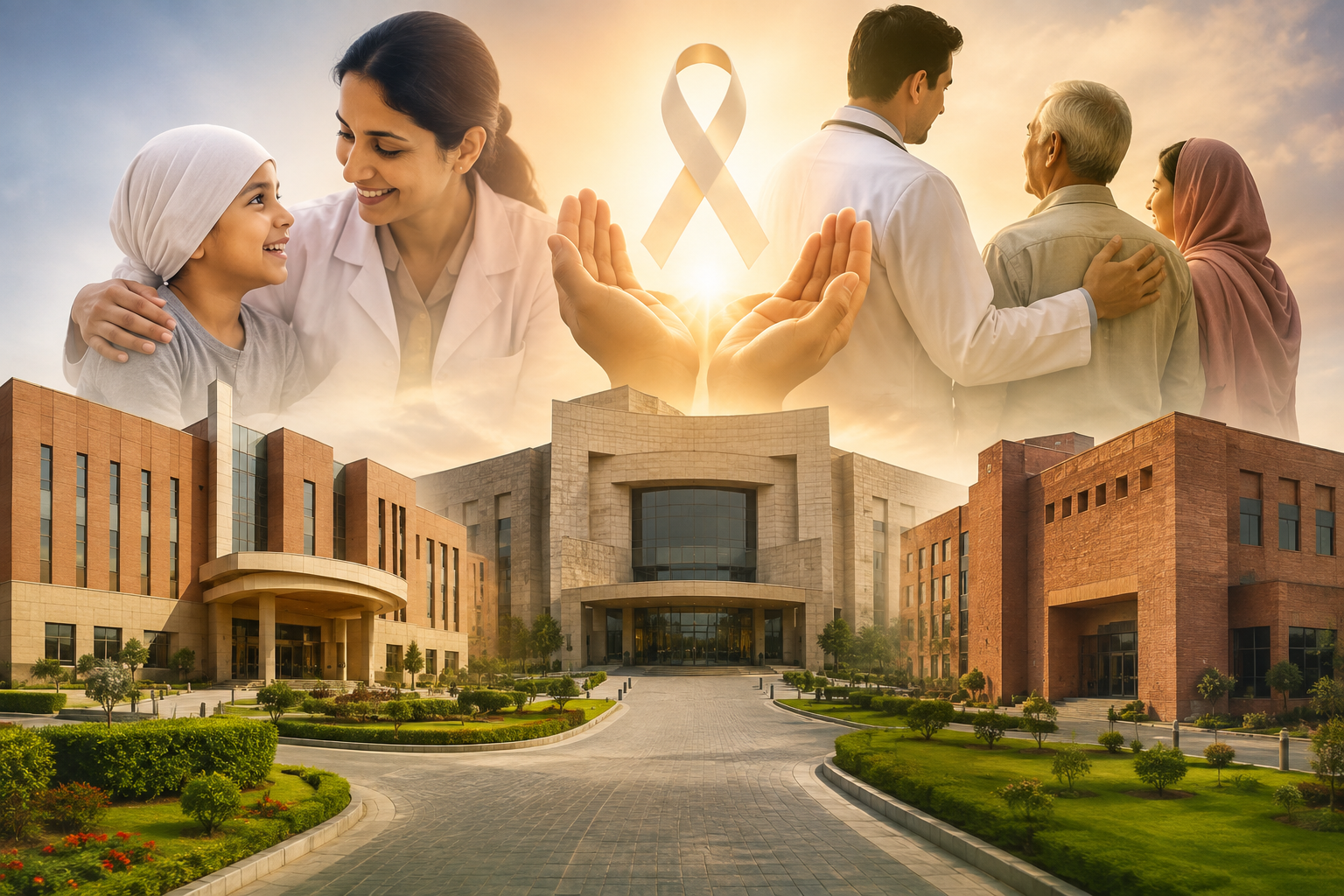
When Shaukat Khanum Memorial Cancer Hospital and Research Centre opened in Lahore in 1994, Pakistan had no dedicated cancer hospital offering comprehensive cancer treatment under one roof. The institution emerged from a vision of making quality cancer diagnosis and treatment accessible to patients regardless of their ability to pay.
From Lahore to Peshawar
The first Shaukat Khanum hospital was established in Lahore in 1994. Its creation marked a significant development in Pakistan’s healthcare landscape, providing patients with access to specialised cancer diagnosis, treatment and related medical facilities under one roof.
The institution expanded its reach with the establishment of a second hospital in Peshawar in 2015. The facility was intended to reduce the burden on patients from Khyber Pakhtunkhwa and surrounding areas who previously had to travel to Lahore for treatment.
The Peshawar hospital also serves patients arriving from Afghanistan, many of whom had previously lacked access to specialised cancer treatment.
Like the Lahore facility, the Peshawar hospital provides comprehensive cancer treatment and is equipped with modern medical technology. According to the institution’s account, 75 percent of patients at the Peshawar hospital receive high-quality cancer treatment completely free of charge.
The same model is planned for Karachi.
Karachi hospital: Expanding access to cancer care
The Shaukat Khanum Cancer Hospital in Karachi is scheduled to open in December. Its establishment is expected to significantly expand access to specialised cancer treatment for patients in Sindh, Balochistan and other underserved areas.
For patients travelling from remote parts of Balochistan in particular, Karachi could provide a substantially closer point of access to specialised cancer care than Lahore.
The new hospital is intended to provide comprehensive cancer treatment and care according to international standards. The institution describes the Karachi facility as another step towards its broader mission of ensuring that cancer patients can access treatment without discrimination based on their ability to pay.
The hospital’s development is also being presented as a reflection of public confidence in the institution and the philanthropic model that has sustained it.
A model built on free treatment
A central feature of Shaukat Khanum’s model is its reliance on public donations and Zakat to subsidise cancer treatment.
The institution says that funds received through Zakat are used for eligible cancer patients in accordance with Islamic principles. Donations and Zakat therefore form a central component of the hospital’s ability to provide free treatment.
The hospital also emphasises transparency in the management of these funds. Its accounts are audited, with audited reports made available to demonstrate how donated funds are being used.
According to the institution, its laboratories have also received international quality certifications, including accreditation associated with the Joint Commission International (JCI) and the College of American Pathologists (CAP). These certifications are cited as evidence of adherence to recognised quality standards.
More than a hospital
Shaukat Khanum’s significance extends beyond the provision of medical services. It represents a public-supported welfare model in which ordinary Pakistanis contribute through Zakat and donations to maintain a specialised healthcare institution.
The organisation credits the success of its hospitals to the combined efforts of its administration, doctors, nurses and other employees, as well as the continued support of donors.
The institution says that the trust placed in it by donors carries a corresponding responsibility: donated money must reach the patients for whom it was intended.
After more than 30 years of operation, the expansion from Lahore to Peshawar and Karachi reflects the evolution of that model from a single specialised hospital into a wider national cancer-care network.
For patients who previously had to travel long distances for treatment, the Karachi hospital could represent not only a new healthcare facility but a closer source of specialised care and financial support.
At its core, the Shaukat Khanum model remains built around a simple proposition: cancer treatment should not be determined solely by a patient’s ability to pay.
Source: Shaukat Khanum Memorial Cancer Hospital and Research Centre