




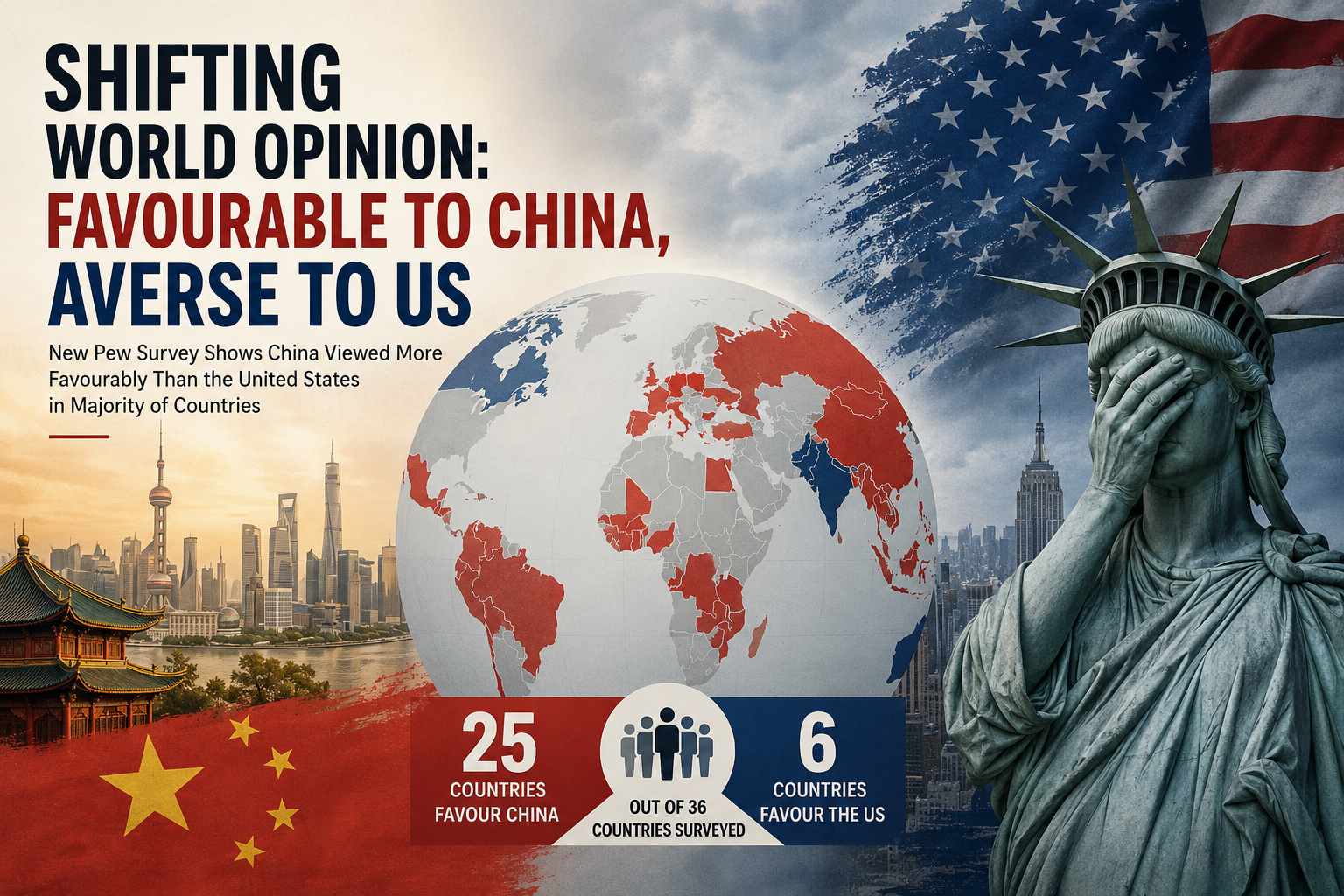
With surprising data on people’s views of China and the US, the latest Pew Research Center survey marks a significant geopolitical shift. For the first time in two decades of Pew polling, China is viewed more favorably than the United States in a majority of the surveyed countries. Across 36 countries, 25 now rate China more positively than the U.S., including traditional American allies such as Canada, the UK, France, Germany, Italy and Mexico. The U.S. retains a clear advantage in only six countries—Israel, Japan, South Korea, India, the Philippines and Kenya.
The findings reflect a relative decline in confidence in U.S. leadership, especially during the period surveyed (February–May 2026), which coincided with U.S. military action against Iran, trade disputes with allies, and renewed “America First” policies. Analysts quoted by BBC and other outlets argue that many countries increasingly see Washington as less predictable and more confrontational, whereas Beijing is viewed as a more stable—if not necessarily more democratic—global actor.
Several factors explain China’s improved standing:
- Perception of predictability: China’s foreign policy is widely viewed as more consistent than Washington’s changing positions under successive U.S. administrations. BBC cited analysts describing Beijing as a “more predictable entity,” even among those who remain skeptical of its political system.
- Economic engagement: Many countries see China primarily as a trading partner, investor and source of infrastructure financing through initiatives such as the Belt and Road Initiative, rather than as a military power. Economic ties often outweigh ideological concerns.
- Less interventionist image: Respondents in many countries increasingly perceive China as less likely than the U.S. to interfere militarily in other countries’ affairs. While many still criticize China’s human-rights record, Beijing is nevertheless viewed by some as contributing more to global stability than recent U.S. policies.
- Soft-power diplomacy: Beijing has invested heavily in diplomacy, trade, technology, green energy and development finance, particularly across the Global South, helping improve its international image.
Why do Canadians now rate China more favorably than the U.S.?
The Canadian result is among the survey’s most striking. Forty-four percent of Canadians expressed a favorable view of China, compared with just 33% for the United States. CTV News highlighted that this represents a dramatic reversal from only a few years ago.
Several developments appear to have contributed:
- U.S. tariffs and trade disputes affecting Canada;
- Repeated political friction between Ottawa and Washington;
- Rhetoric questioning Canada’s sovereignty and economic relationship with the U.S.;
- Concern that U.S. foreign policy has become increasingly unilateral and unpredictable.
The survey suggests Canadians are expressing reduced confidence in American leadership.
Also across much of Western Europe, the change reflects dissatisfaction with U.S. policy more than admiration for China.
European respondents increasingly cite:
- concern over U.S. unilateral military actions;
- uncertainty about long-term U.S. commitments to NATO and European security;
- economic disruption stemming from tariffs and trade disputes;
- A broader desire for a more multipolar international order.