




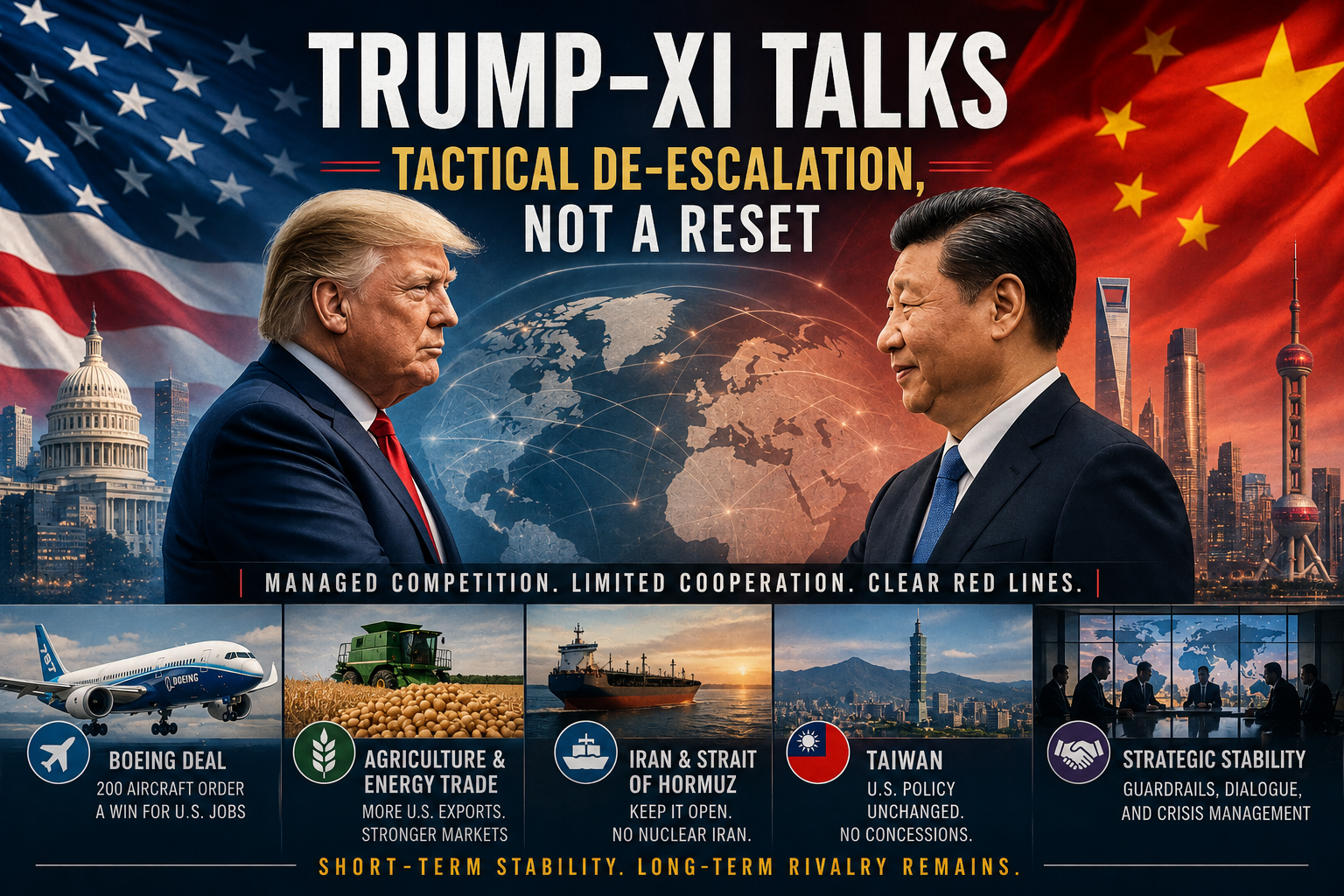
Trump–Xi talks offered tactical de-escalation and modest economic gains, but left the core U.S.–China rivalry unchanged.
The May 14 meetings between Presidents Donald Trump and Xi Jinping could be described as a crisis-management and tactical-stabilization maneuver, not a reset. It was a bilateral de-escalatory move, providing short-term predictability for markets and energy flows, reinforcing high-level channels, and delivering tangible (if modest) U.S. economic wins.
Risks such as disagreements over Taiwan and the Iran conflict persist, though both sides signaled a desire to avoid major escalation right now. These outcomes align with expectations for managed competition between the two powers. Trump’s invitation to Xi to visit Washington in September reinforced the desire to stay the course for de-escalating the relationship. No grand bargain emerged, and the optics-heavy meetings focused on de-escalation and incremental wins amid ongoing rivalry.
1. New Framework: “Constructive Strategic Stability.”
Xi and Trump agreed to build a “constructive China-U.S. relationship of strategic stability” as the guiding principle for the next three years and beyond.
Emphasis was placed on cooperation with “measured competition” and guardrails to prevent spiraling tensions. Xi stressed translating this into concrete actions, and both sides highlighted partnership over rivalry publicly.
2. Trade and Economic Outcomes (Incremental, Not Transformative)
Boeing deal: China agreed to purchase 200 Boeing aircraft (described as “large aircraft”) — the first major U.S. commercial jet order in nearly a decade. Trump highlighted this as a win for American jobs; Boeing shares initially dipped on the announcement (seen as smaller than some expectations).
Increased Chinese purchases of U.S. agricultural goods (e.g., soybeans), energy (oil and LNG), and other products.
Progress on mechanisms such as a “Board of Trade” and an investment board to oversee implementation, manage disputes, and support non-sensitive exchanges.
Broader talks on market access for U.S. tech businesses, rare earths and critical minerals, and fentanyl controls. U.S. CEOs (Elon Musk, Tim Cook, Jensen Huang, and Boeing’s CEO) accompanied Trump for business signaling, but few sweeping new deals emerged beyond the above.
3. Iran, Strait of Hormuz, and Regional Issues
There was strong alignment that the Strait of Hormuz must remain open, free of militarization or tolls, and that Iran must never acquire nuclear weapons.
China expressed interest in increasing imports of U.S. oil to reduce reliance on Middle Eastern supplies. Xi also offered diplomatic support to help de-escalate tensions and potentially reopen the Strait, leveraging Beijing’s ties to Iran.
Discussions also touched on Ukraine and the Korean Peninsula, though with limited public detail.
4. Taiwan: Stark Warning, No U.S. Concessions
Xi called Taiwan the “most important issue” in bilateral relations. He warned that mishandling it could lead to “clashes or even conflict,” pushing relations into an “extremely dangerous place.”
The U.S. readout (and Secretary of State Marco Rubio) emphasized that policy remains unchanged — Taiwan was raised routinely, positions were restated, and the discussion moved on. No changes were announced regarding arms sales or support.
The Trump–Xi meeting delivered short-term stability and limited economic wins, but no structural breakthrough in U.S.–China relations. Underlying strategic rivalry remains intact, with cooperation confined to narrow, transactional areas.