




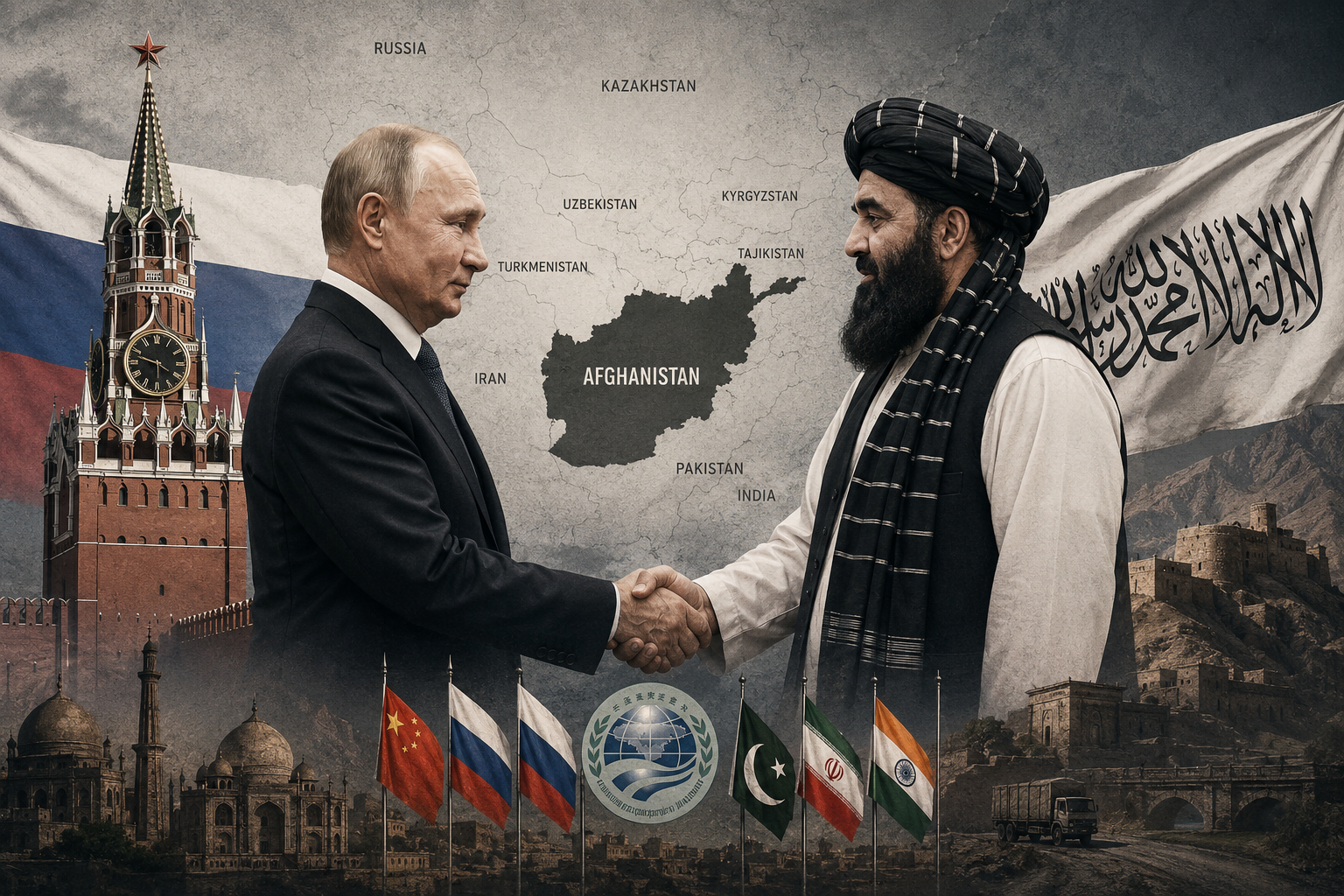
The Kremlin’s growing partnership with the Taliban reflects the hard strategic calculations driving a new regional order across Central and South Asia.
When Sergei Shoigu addressed the Shanghai Cooperation Organisation last week and announced a “full-fledged partnership” with the Taliban-led government in Afghanistan, the room received it as a diplomatic milestone. In historical terms, it marked one of the most striking geopolitical reversals in the region’s modern history.
The Soviet Union spent nearly a decade fighting a ruinous war in Afghanistan, a conflict that drained state resources, galvanized domestic opposition, and accelerated the USSR’s eventual collapse. The Taliban emerged, in part, from the very chaos that war left behind. That Russia’s Security Council secretary now calls building a “pragmatic dialogue” with the Islamic Emirate a strategic necessity is, by any historical measure, extraordinary.
The logic, though, holds together once ideology is set aside.
From Isolation to Institutionalization
When the Taliban swept back into power in August 2021, the international response was largely one of condemnation and disengagement. Western governments imposed sanctions, froze Afghan assets, and demanded sweeping political reforms as preconditions for any recognition. Moscow charted a different course.
Rather than joining the chorus of isolation, Russia opted for calibrated engagement, deepening political, economic, and security contacts with Taliban leadership while stopping short, initially, of formal recognition. The distinction mattered. Moscow was signaling openness without assuming the political costs of legitimization.
That calculus shifted decisively in 2025. Russia’s Supreme Court lifted the Taliban’s long-standing terrorist designation on April 17, clearing the legal pathway for normalized relations. By July 3, Moscow had extended formal recognition of the Taliban as Afghanistan’s legitimate government, becoming the first country to do so since the collapse of the U.S.-backed order in Kabul. The subsequent Moscow Format dialogue cemented Afghanistan’s status as a permanent participant in the multilateral framework Russia has championed for regional affairs.
Shoigu’s SCO address last week was, in this light, less an announcement than a consolidation.
Security Above All
At the core of Russia’s strategic rethink is a straightforward threat calculation. Moscow is well aware of the Taliban’s record on governance, women’s rights, and political pluralism. It considers these secondary to a more pressing concern: the northward spread of transnational militancy, particularly from Islamic State – Khorasan Province.
ISIS-K represents an existential challenge to stability across Central Asia, a region Russia still regards as its strategic backyard. The Taliban has emerged as ISIS-K’s most determined adversary on Afghan soil. A cooperative Kabul offers a more effective bulwark against that threat than an internationally isolated and internally fractured one ever could.
Shoigu’s call for the SCO to revive its formal contact group with Afghanistan fits squarely within this framework. Russia wants the organization’s members — among them China, India, Iran, and Pakistan — to coordinate on regional stability rather than leave the management of Afghan affairs to improvisation. The counter-narcotics dimension reinforces the point: shared threats, Moscow calculates, are best addressed through shared architecture.
The limits of this logic were on display in March 2024, when ISIS-K killed 151 people at the Crocus City Hall concert venue in Moscow. The Taliban’s rivalry with ISIS-K had not deterred the attack, and Russia’s evolving relationship with Kabul offered no warning and no shield. What Crocus illustrated was not the failure of engagement, but its ceiling: cooperation with the Taliban may contain certain threats while leaving others entirely intact.
The Vacuum and the Opportunity
Russia’s pivot cannot be separated from the broader regional consequences of America’s withdrawal. The abrupt collapse of the Western-backed government in Kabul created a vacuum that Moscow moved swiftly to fill. Where Washington saw failure, the Kremlin saw an opening.
Through the Moscow Format dialogues, Russia positioned itself as an indispensable convener, gathering China, Pakistan, Iran, and the Central Asian states around a framework for managing Afghan affairs that operates entirely outside Western leadership. The ambition running beneath all of it is clear: to establish Russia as the region’s default stabilizing power in a post-American Eurasia.
Shoigu’s reported push to integrate Afghanistan into SCO economic frameworks and to facilitate trade and labor migration agreements with Kabul, extends that ambition into the commercial sphere.
The Economic Dimension
Afghanistan sits at the intersection of Central Asia, South Asia, and the Middle East, a geographic position that makes it potentially pivotal to any serious regional connectivity project. Russia envisions integrating Afghanistan into the broader trade and infrastructure frameworks linked to the SCO, creating energy corridors and labor migration channels that deepen mutual dependency over time.
Whether this vision is achievable depends heavily on variables Moscow cannot control: Taliban governance, international humanitarian access, and the broader trajectory of Afghanistan’s economic collapse. For now, the commercial dimension of the relationship remains aspirational. Its articulation, nonetheless, signals that Moscow’s engagement is intended to be structural rather than situational.
The Risks Moscow Is Taking
Russia’s gamble carries significant exposure. The Taliban government remains internationally isolated, economically fragile, and governed by an internal logic that does not always align with the interests of its external partners. Questions about governance, human rights, and extremist networks continue to shadow Afghanistan’s international standing and constrain the depth of any formal partnership.
A major deterioration in Afghanistan’s internal security — whether driven by ISIS-K attacks, factional tensions within the Taliban, or economic implosion — would expose the limits of Moscow’s strategy and potentially increase pressure on Central Asian states that Russia seeks to keep within its security orbit. By extending recognition to one of the world’s most controversial governments, Moscow has assumed reputational costs that complicate its posture on governance norms elsewhere.
Engagement, in short, is a wager. The terms will be set by events in Kabul.
History, Reversed
What the Russia-Taliban relationship ultimately illustrates is a broader truth about contemporary geopolitics: ideological consistency is a luxury that great powers increasingly decline to afford. The same movement that waged jihad against Soviet soldiers in the Panjshir Valley is now being cultivated as a regional partner by their political successors in the Kremlin.
For Moscow, the arrangement is an exercise in threat management, influence preservation, and power projection. Unsentimental and transactional, it follows its own cold logic.
Whether it is wise is another question, one that events in Kabul and beyond will answer in due course.