




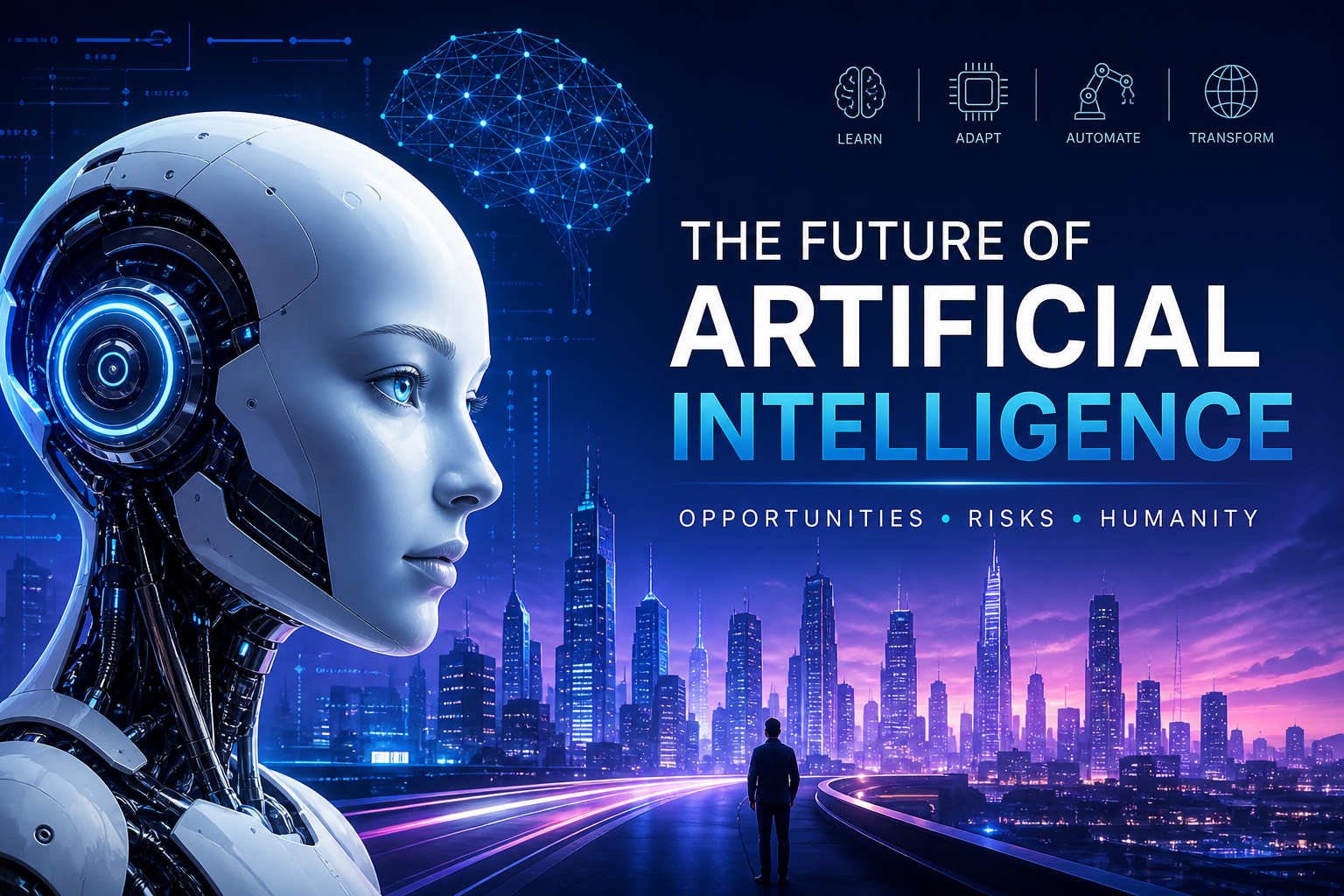
Artificial Intelligence (AI) is no longer a distant concept reserved for science fiction—it is rapidly transforming industries, economies, and everyday life. From smart assistants to autonomous vehicles, AI is shaping how we live and work. As we look ahead, the future of AI promises both unprecedented opportunities and complex challenges that society must carefully navigate.
The Evolution of Artificial Intelligence
AI has evolved significantly over the past decade, driven by advancements in machine learning, data availability, and computational power. Early AI systems were rule-based and limited in scope, but modern AI relies heavily on deep learning, enabling systems to learn patterns, make decisions, and even generate human-like content.
The future will likely see AI becoming more adaptive, context-aware, and capable of reasoning. Technologies such as artificial general intelligence (AGI)—machines that can perform any intellectual task a human can—are still in development but remain a long-term goal for researchers.
AI in Everyday Life
AI is expected to become even more integrated into daily life. Smart homes will become more intuitive, healthcare systems more predictive, and education more personalized.
- Healthcare: AI will assist in early diagnosis, drug discovery, and robotic surgeries.
- Education: Adaptive learning platforms will tailor lessons to individual students.
- Transportation: Autonomous vehicles and smart traffic systems will improve safety and efficiency.
As AI continues to evolve, it will move from being a tool to becoming an active collaborator in human decision-making.
Economic Impact and Job Transformation
One of the most discussed aspects of AI’s future is its impact on employment. While AI will automate repetitive and manual tasks, it will also create new job opportunities in fields such as AI development, data science, and digital ethics.
However, this transition may not be smooth. Many traditional jobs may become obsolete, requiring governments and organizations to invest in reskilling and upskilling programs. The workforce of the future will need to adapt to working alongside intelligent machines.
Ethical Considerations and Risks
With great power comes great responsibility. The rise of AI brings several ethical concerns that must be addressed:
- Bias and Fairness: AI systems can inherit biases from training data.
- Privacy: Increased data usage raises concerns about surveillance and personal security.
- Autonomy: Decisions made by AI systems can have significant real-world consequences.
Ensuring transparency, accountability, and fairness in AI systems will be critical to building public trust.
AI and Human Creativity
Contrary to fears that AI will replace human creativity, it is more likely to enhance it. AI tools are already being used in art, music, writing, and design. In the future, creators will collaborate with AI to produce innovative and hybrid forms of content.
Rather than replacing human imagination, AI will serve as a powerful assistant, expanding creative possibilities.
The Role of Governments and Regulation
As AI continues to grow, governments will play a crucial role in shaping its future. Regulations will be needed to ensure ethical use, prevent misuse, and protect citizens.
International cooperation will also be essential, as AI development is a global effort. Policies must strike a balance between encouraging innovation and safeguarding societal interests.
The Road Ahead
The future of artificial intelligence is both exciting and uncertain. It holds the potential to solve some of humanity’s biggest challenges—from climate change to disease eradication—but also poses risks that cannot be ignored.
Success in the AI-driven future will depend on how well we manage its development, ensuring that it benefits all of humanity rather than a select few.
Conclusion
Artificial intelligence is set to redefine the world in ways we are only beginning to understand. By embracing innovation while addressing ethical and societal challenges, we can shape a future where AI enhances human potential rather than diminishes it.
The journey ahead requires collaboration between technologists, policymakers, and society at large. If guided responsibly, AI could become one of the most transformative forces for good in human history.