




The Dawn report highlights a “Rs1 trillion annual loss” in the power sector — once again blaming DISCO inefficiency, T&D losses, and recoveries.
Yes, governance remains a serious issue. But that is no longer the core problem.
NEPRA’s own data shows distribution losses and recoveries have actually improved. The real crisis today is different:
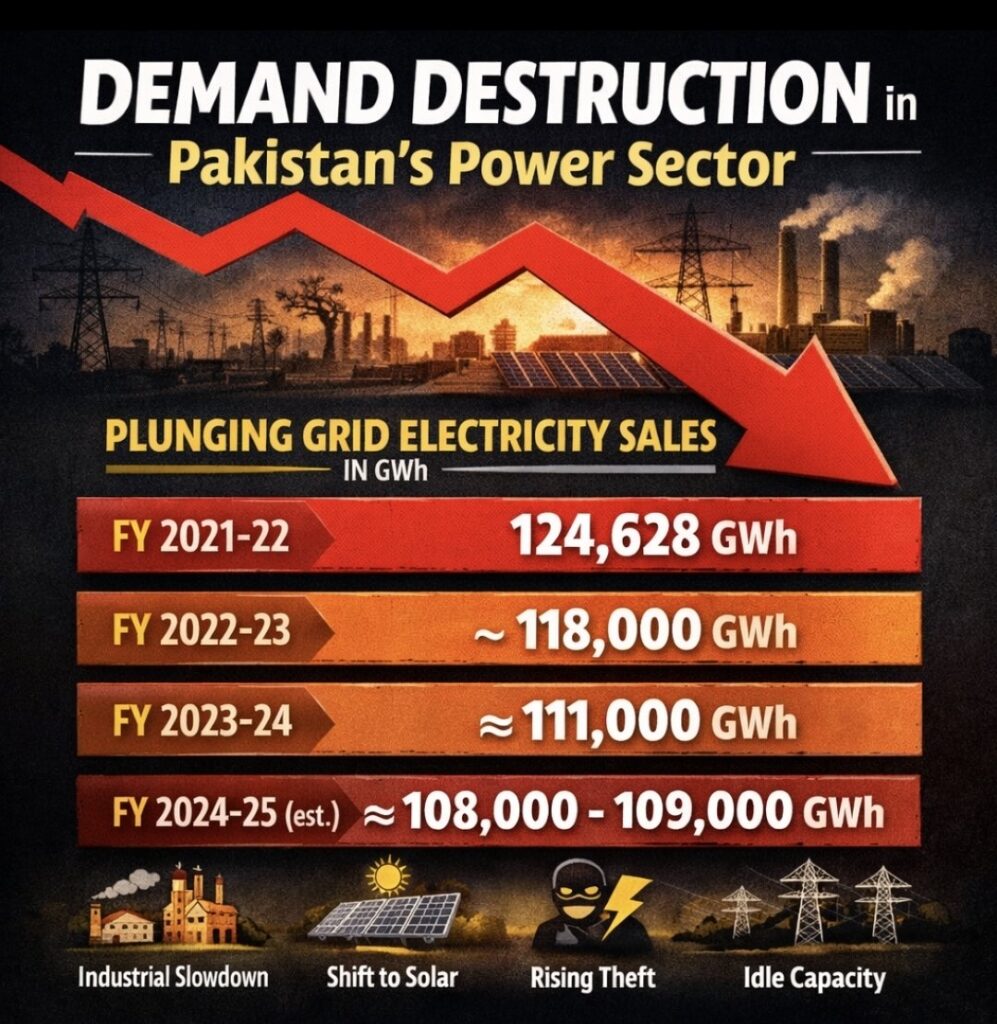
Demand destruction:
Grid electricity sales have fallen from 124,628 GWh in FY22 to nearly 108–110 TWh in FY2024-25 — despite surplus generation capacity.
Why?
Because electricity tariffs — heavily loaded with taxes, surcharges, and policy costs — have made grid power increasingly unaffordable.
At the same time, one of the region’s highest effective tax burdens has slowed business activity and compressed industrial demand.
When electricity becomes unaffordable:
• industry shifts to captive generation
• consumers migrate to solar
• economic activity slows
• theft increases
• available capacity remains idle
Pakistan today does not lack electricity — it lacks paying demand.
Massive fixed capacity costs, spread over shrinking sales, push tariffs even higher — creating a vicious cycle:
Higher tariffs → lower demand → higher tariffs again.
This is a classic utility death spiral.
Blaming DISCOs alone misses the structural reality:
Policies designed to reduce circular debt through ever-higher tariffs have instead destroyed demand — worsening the very problem they were meant to solve.
The real solution is demand expansion:
– Reduce electricity tariffs
– Remove excessive taxes embedded in power prices
– Restore industrial competitiveness
– Lower marginal electricity cost
– Utilise existing capacity through economic growth
As highlighted earlier in my Business Recorder article: Powerless growth – Opinion – Business Recorder https://share.google/JA2xd6i8xIRnBmHJC Pakistan must sell more electricity — not merely price it higher.
Without restoring demand, circular debt will keep returning — regardless of governance reforms.
Courtesy: X