




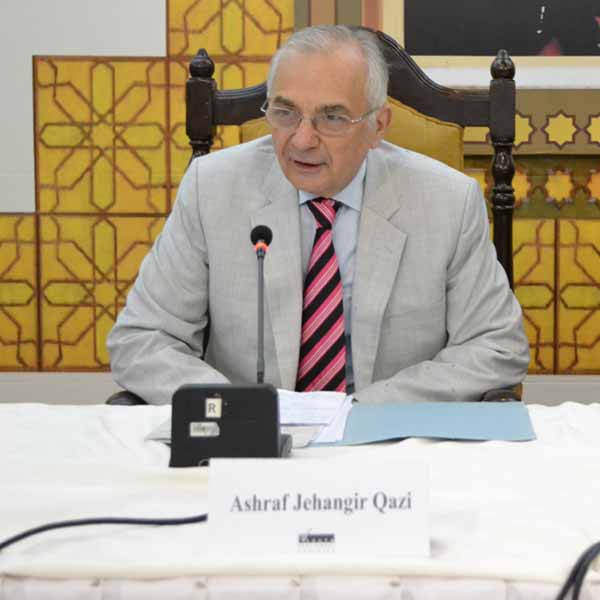
Ambassador Ashraf Jehangir Qazi delivered a stinging speech at the launch of a book on Kashmir at Islamabad (February 10) and said membership of the Gaza Peace Board amounted not only to a continuation of the genocide but also a contradiction of Pakistan’s long-standing policy on Kashmir and Palestine.
Below are excerpts of the speech
The world is talking about the 100-year genocide in Gaza that has resulted in the Board of Peace, which has rightly been portrayed as the continuation of the genocide.
The Board of Peace represents the Trump world order in place of the UN Charter-based legal world order. Pakistan’s position on Kashmir is based on the UN Charter and the resolutions of the UN Security Council.
To be a member of the Board of Peace is to undermine the legal basis of the position of Pakistan on the Kashmir dispute.
Trump is no friend of Pakistan or Kashmir. None of the Arab and Muslim world. He is far closer to India than to Pakistan. He demands that his ruling friends in Pakistan prioritize US interests over Pakistan’s interests.
He fully supports Israel’s determination to extinguish the Palestinian people as a nation and to eventually drive them out of Palestine.
In Kashmir, a similar, if somewhat slower, century-long genocide is taking place and continuing with no end in sight.
Pakistan is a recognized party to the Kashmir dispute and regards Kashmir as its jugular vein (shahrag) or critical to its own existence.
The tragedy of Kashmir has been comprehensively described in meticulous detail by the late Abdul Haq Suhrawardy in his book, The Tragedy of Kashmir, with an introduction by his daughter, Senator Zarqa Suhrawardy Taimur, which brings the tragedy up to date.
It is absolutely essential that important books such as The Tragedy of Kashmir be translated into Urdu so that it can be accessible to all Pakistanis.
Enlightened developing countries prioritize the translation of important books from all over the world into their national languages so they can have an educated and well informed public opinion, which is essential for effective policy making in the public interest.
Unfortunately, as in so many respects, Pakistan has failed to serve its public in this regard also, possibly because our ruling elites fear a better-informed public opinion.
Let us hope that this valuable book on a subject of critical importance for Pakistan will inaugurate a nationwide trend in making available essential books authored by the best minds of the world to our broader public in their national language. This will be a critical contribution to knowledge and human development, and an investment in the future of Pakistan.
The tragedy of Kashmir is a story of genocide, heroism, indifference, and betrayal: genocide perpetrated by India, incredible heroism demonstrated by generations of Kashmiris, indifference of the world community to the genocide perpetrated on the Kashmiri people and the consequent risk of confrontation and conflict between two nuclear powers, and betrayal by the short-sighted and self-centered policies of its main supporter.
As a result, the attitudes of the Kashmiri people are changing. They will, of course, never submit to India. But they are also losing faith in Pakistan.
A renowned Kashmiri leader who today languishes in an Indian death cell told me, if Pakistan were more sincere and committed to the Kashmiri freedom struggle it would find Pakistan written on the heart of every Kashmiri. But if the Kashmiris are left to do the impossible and should they somehow win their freedom on their own, they may well prefer the option of independence.
Today, the younger generation in Pakistan wants to forget about Kashmir because they are overwhelmed by so many challenges and problems created by unconstitutional, corrupt, incompetent, and uncaring elite and force-based governance.
Accordingly, an equitable solution to the Kashmir dispute lies in Pakistan overcoming its current constitutional and governance challenges. The stakes are existential. This requires the building of a nation that protects citizen rights and participation as well as socio-economic justice. Smart narratives by clever touts cannot disguise the absence of these essentials for nation-building. Even a casual look at what is happening in Balochistan demonstrates this truth.