




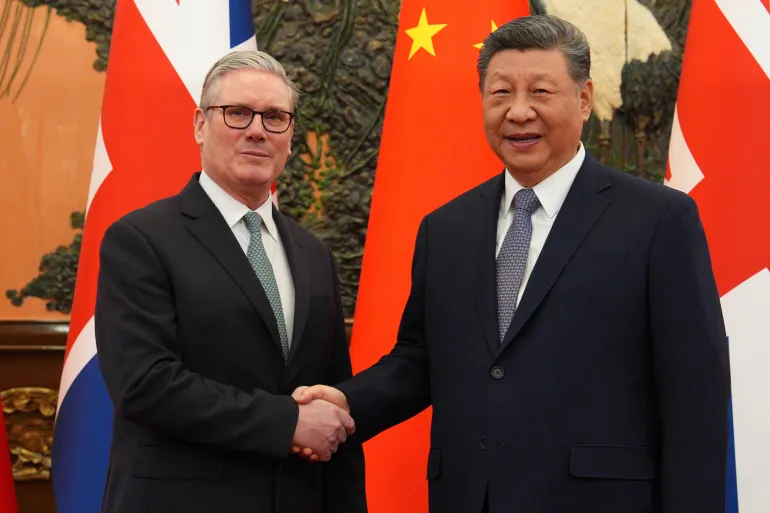
British Prime Minister Keir Starmer’s three-day visit to China marks the UK’s most significant effort in nearly a decade to reset relations with Beijing. The trip combines economic pragmatism, trade expansion, and selective security cooperation, while navigating longstanding tensions over human rights, espionage, and broader geopolitical dynamics. Starmer’s delegation of nearly 60 business, academic, and cultural leaders—including HSBC, GSK, Jaguar Land Rover, and the National Theatre—underscores the UK’s intent to convert diplomacy into tangible economic outcomes. Key developments include short-term visa relaxations for UK citizens, tariff reductions on whisky, exploration of a legally binding services trade agreement, and AstraZeneca’s commitment to invest $15 billion in China by 2030.
A defining theme of the visit has been Starmer’s call for engagement and dialogue. Speaking at a business forum in Beijing, he urged UK businesses to deepen their economic and cultural ties with China, emphasizing that sustained interaction builds long-term trust and mutual respect. “The more we engage, the more we exchange, the more we take advantage of opportunities in business, art, culture, and so many others, the more we build the mutual trust and respect that is so important,” Starmer said. He stressed that direct conversations between UK and Chinese business leaders and officials were critical for unlocking new areas of cooperation and growth, noting that dialogue is the “most important thing today.” This focus on engagement represents a deliberate strategy to foster confidence and a stable foundation for future economic and diplomatic initiatives.
For the UK, the stakes are high. Post-Brexit economic contraction, declining foreign investment, and global uncertainty have made China an essential market. Starmer’s visit is aimed at stimulating growth, providing immediate benefits for UK businesses, and reasserting the country’s relevance on the global stage. Security concerns remain significant. MI5 continues to flag Chinese state actors as daily threats, while Beijing’s approval for a “mega embassy” in London has raised concerns over potential espionage. Agreements on combating synthetic opioid trafficking and disrupting small boat smuggling reflect practical security cooperation, though some critics argue these steps are minor compared to broader strategic vulnerabilities. Human rights remain a sensitive front, with issues such as Xinjiang, Hong Kong, and political prosecutions—including the case of Jimmy Lai—likely to see little progress. Starmer’s approach emphasizes pragmatism over confrontation, seeking to engage China without abandoning principle.
The visit also has broader geopolitical implications. US President Donald Trump publicly criticized the engagement as “very dangerous,” reflecting concerns over the UK drifting toward a strategic competitor. At the same time, China’s outreach signals to Washington and other allies that it is willing to offer economic interdependence, trade opportunities, and cooperation on global challenges such as climate change and supply chain security. By engaging the UK, China projects itself as a pragmatic partner capable of maintaining influence over Western economies while safeguarding its domestic and regional interests.
From a strategic perspective, the UK seeks economic recovery, market access, and global relevance, balanced against domestic political and security risks. For China, the visit strengthens legitimacy, economic leverage, and strategic positioning vis-à-vis the United States. For Washington, the trip underscores the need to monitor and recalibrate alliances to prevent erosion of influence among traditional partners. Domestically, the UK faces public and parliamentary scrutiny.
The visit presents a mixture of opportunities and challenges. Economically, the UK stands to gain from expanded trade, investment, and professional services access. Diplomatically, it demonstrates a willingness to engage pragmatically in a multipolar world. Risks remain, including domestic political backlash, heightened security vulnerabilities, limited leverage on human rights issues, and potential friction with the US. Success will depend on the UK’s ability to maintain trade and security “guardrails,” engage China constructively without compromising strategic autonomy, and uphold credibility with domestic and international audiences.
Ultimately, Starmer’s China visit reflects a carefully calibrated balancing act. It is not a pivot toward being “pro-China,” but a pragmatic attempt to reconcile economic necessity with strategic caution. The emphasis on engagement, dialogue, and people-to-people exchanges signals an approach that values trust-building as a foundation for long-term cooperation. The visit underscores the complexities of UK foreign policy in a post-Brexit, multipolar world: engaging a major global power to secure economic growth while managing domestic skepticism. The true measure of success will extend beyond signed agreements to the UK’s ability to maintain a principled, secure, and credible position with both China and its key allies. In today’s interconnected global economy, opportunity and risk remain inseparable.