




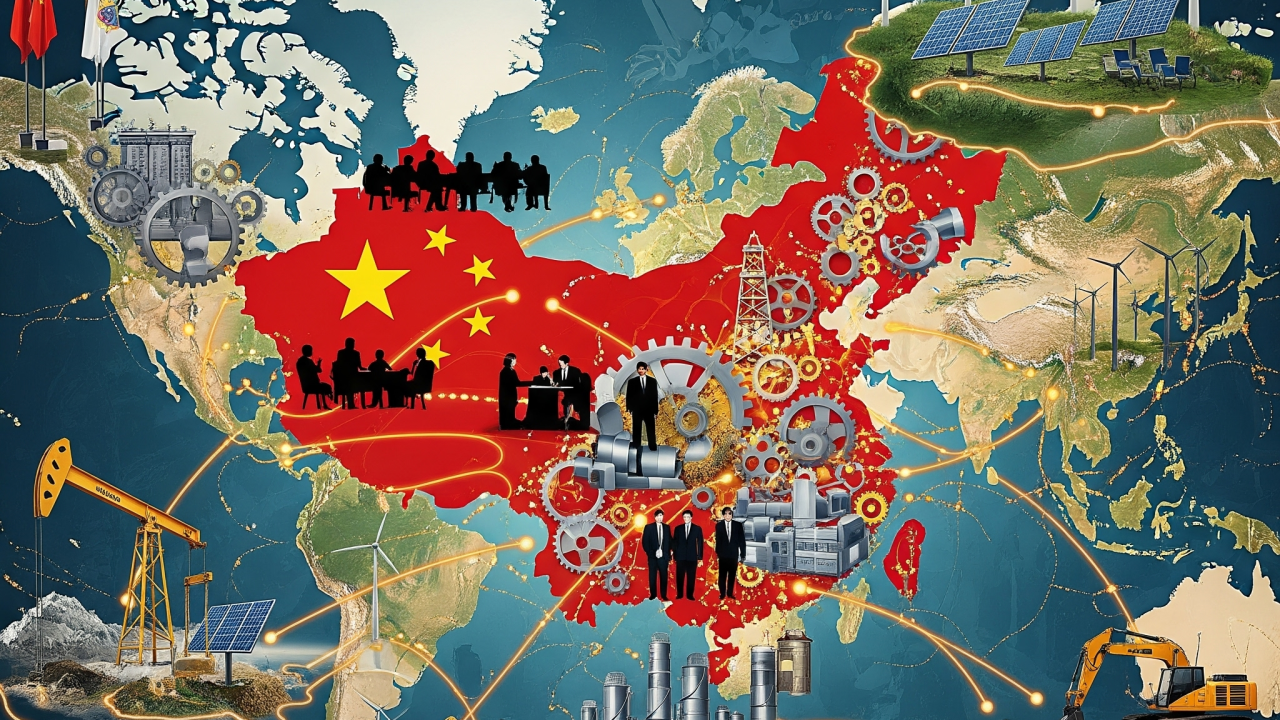
In a world where power is steadily shifting beyond the West, understanding China’s global role requires listening to voices from outside the traditional Western echo chambers.
Kishore Mahbubani, a veteran Singaporean diplomat and one of Asia’s most respected geopolitical thinkers, offers a starkly different lens through which to view China’s role in the world. Having served twice as Singapore’s Permanent Representative to the United Nations and as President of the UN Security Council, Mahbubani’s assessments carry the weight of long diplomatic experience rather than ideological alignment. His core argument is simple but unsettling for Western policymakers: the world has changed, and much of the West has failed to adjust.
Mahbubani begins with a statistic that reframes the entire global debate. Out of nearly eight billion people in the world today, only about 12 percent live in the West. The remaining 88 percent live outside it, primarily across Asia, Africa, and Latin America. This overwhelming majority, often grouped under the term “Global South,” is not turning away from China. On the contrary, it is actively engaging with and welcoming China.
From this perspective, attempts by Western countries to economically and strategically decouple from China amount to something far more consequential than a bilateral dispute. By trying to cut themselves off from China, Western states are, in effect, cutting themselves off from most of the world. While Western capitals debate containment and confrontation, countries across the Global South are focused on far more immediate priorities: economic growth, infrastructure development, trade, and poverty reduction.
Africa offers a clear illustration. For many African leaders, the central challenge is raising living standards by building roads, ports, railways, and power infrastructure, basic foundations for development. In today’s global system, China has emerged as the most visible and consistent partner in delivering these projects. Where Western-led institutions like the World Bank once played a major role in financing large-scale infrastructure, that role has significantly diminished. China has stepped into this vacuum.
The same pattern is visible in Latin America. Mahbubani points to Peru, home to one of the most technologically advanced ports in the region; built entirely by China. The project has enhanced not only Peru’s competitiveness but also that of its neighbors. These are tangible outcomes that governments in the Global South can measure in exports, jobs, and growth, rather than abstract promises about future alignment or values.
Brazil provides another striking example. Two decades ago, it took Brazil a full year to export goods worth one billion dollars to China. Today, it takes just 72 hours. This dramatic acceleration reflects deeper trade integration and improved logistics. Under such conditions, the idea that Brazil or any major Global South economy would sever ties with China simply to satisfy Western preferences appears deeply unrealistic.
Mahbubani is particularly critical of Europe’s strategic outlook. He recalls Henry Kissinger’s observation that the “quality of mind” among European leaders has declined, not in intelligence but in adaptability. While the global environment has shifted, Europe has struggled to rethink its assumptions. In Mahbubani’s words, Europeans have enjoyed a very good life for decades and now risk mistaking past comfort for future security.
Former EU foreign policy chief Josep Borrell once described Europe as a “garden” surrounded by a “jungle.” Mahbubani accepts the metaphor but turns it on its head. Gardens, he argues, cannot overtake jungles; jungles eventually overtake gardens. Power, dynamism, and demographic weight increasingly lie outside Europe, and ignoring this reality carries long-term consequences.
Europe’s greatest future challenge, Mahbubani argues, will not come from Russian tanks rolling into Western Europe. It will come from Africa’s demographic explosion. In 1950, Europe’s population was double that of Africa’s. Today, Africa’s population is already two-and-a-half times larger. By the end of this century, Africa could have ten times the population of Europe. If Africa does not develop, large-scale migration toward Europe will intensify, creating social and political strains far greater than current security fears.
From this standpoint, Chinese investment in Africa should be welcomed, not criticized. Every dollar invested in African development reduces future pressures on Europe. Yet European leaders routinely attack China’s role on the continent, displaying what Mahbubani calls a basic lack of strategic common sense. Instead of condemning Beijing, he argues, Europe should be thanking China for contributing to African growth.
This broader logic extends to China’s Belt and Road Initiative (BRI), which has directed billions of dollars into infrastructure across Asia and Africa. Countries such as Pakistan, Indonesia, Kenya, Ethiopia, Sri Lanka, and Laos have seen major investments in ports, railways, energy, and industrial zones. While debates about debt and governance continue, for many developing states, these projects represent opportunities that were long denied under Western-led systems.
Mahbubani’s message is ultimately not about praising China uncritically, but about recognizing global realities. The center of gravity is shifting, and most of the world is adapting accordingly. Those who refuse to adapt risk being left behind not by ideology, but by history itself.