




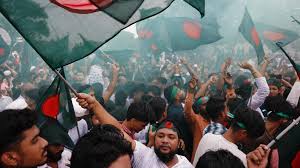
Fear and uncertainty currently cloud Bangladesh’s political horizon. Tentatively scheduled for February, the general elections—necessitated by the abrupt end of Sheikh Hasina’s 16-year rule in August 2024—appear heavily tilted in favor of the Bangladesh National Party (BNP). Hasina’s Awami League (AL) is barred from political activity, a technical maneuver aimed at keeping it out of the electoral fray. Meanwhile, its 80-year-old leader, Khaleda Zia, is indisposed, battling multiple health issues and unlikely to lead an effective campaign on the ground.
The unfolding situation in Bangladesh bears striking parallels with Pakistan’s post-Imran Khan era.
Sheikh Hasina, 78, now in India, has been convicted in five cases, including one that held her responsible for “crimes against humanity” during the violent crackdown on the nationwide, student-led uprising of July–August 2024. On November 17, 2025, the International Crimes Tribunal-1 (ICT) in Dhaka sentenced her to death, effectively ending her political career. While the legality of this “war crimes” conviction may face genuine legal scrutiny, the outcome has already rendered her and her party politically marginalized.
Four other convictions in graft cases by the Anti-Corruption Commission (ACC) mirror the workings of Pakistan’s National Accountability Bureau (NAB) and the Federal Investigation Agency (FIA), both notorious for politically motivated prosecutions. Allegations range from abuse of power to acquisition of properties domestically and abroad.
With Pakistan’s 26th and 27th Constitutional Amendments, the country seems to have entered a phase Bangladesh exited in August 2024: democratic regression, an emasculated judiciary, a sidelined parliament, and a toothless opposition. This mirrors a broader global trend of democratic backsliding. Since 2014, for example, 137 countries have occasionally invoked emergency powers to curtail democratic rights or infringe upon civil liberties.
Despite current setbacks, the Awami League remains a deeply rooted political entity with considerable popular support. Attempts to sideline it administratively are unlikely to erase its presence. The party maintains strong connections across Bangladeshi society—from the business sector to the intelligentsia and civil and military bureaucracy.
As Bangladesh navigates the aftermath of Hasina’s repressive rule, citizens are eager to exercise their right to choose a government that reflects their aspirations. Central questions include whether the new government will uphold secular democracy and whether political actors have learned from the past to promote an inclusive system based on the rule of law.
The coming weeks promise heightened uncertainty and tension. Whether the elections will defy apprehensions voiced during recent conferences remains a critical question, particularly given regional volatility. The strategic maneuvers of China, India, and the United States in the lead-up to the polls will be closely observed. Equally important is the role of the Bangladesh Army—whether it will maintain political neutrality or align with external preferences, particularly India’s. While the military appears largely detached from politics for now, memories linger of the army chief’s role in facilitating Sheikh Hasina’s departure.
Major General Muniruzzaman, President of the Bangladesh Institute of Peace and Security Studies, emphasizes that a clear and transparent national security strategy is essential for building a robust security infrastructure. Yet analysts caution against over-securitizing the political economy, noting that true security stems from economic progress that fosters political stability, not merely from military presence.
In today’s complex world, security is measured not by the visible presence of military or police forces but by institutional efficiency, adherence to the rule of law, and transparency. Good governance, accountability, and rule of law fundamentally determine the legitimacy of state institutions.
How Bangladesh’s post-election government addresses these challenges and restores public trust in institutions remains the billion-dollar question. Success will depend on the ability of political leaders to promote inclusive governance, economic stability, and institutional integrity, thereby creating a democratic system resilient to manipulation and authoritarian backsliding.
For Pakistan, the unfolding events in Bangladesh offer both lessons and warnings. The region’s political landscape is increasingly intertwined, and Islamabad must closely observe Dhaka’s trajectory while navigating its own democratic challenges. Ultimately, the elections in Bangladesh are not only a domestic affair—they are a litmus test for democratic resilience in South Asia.