




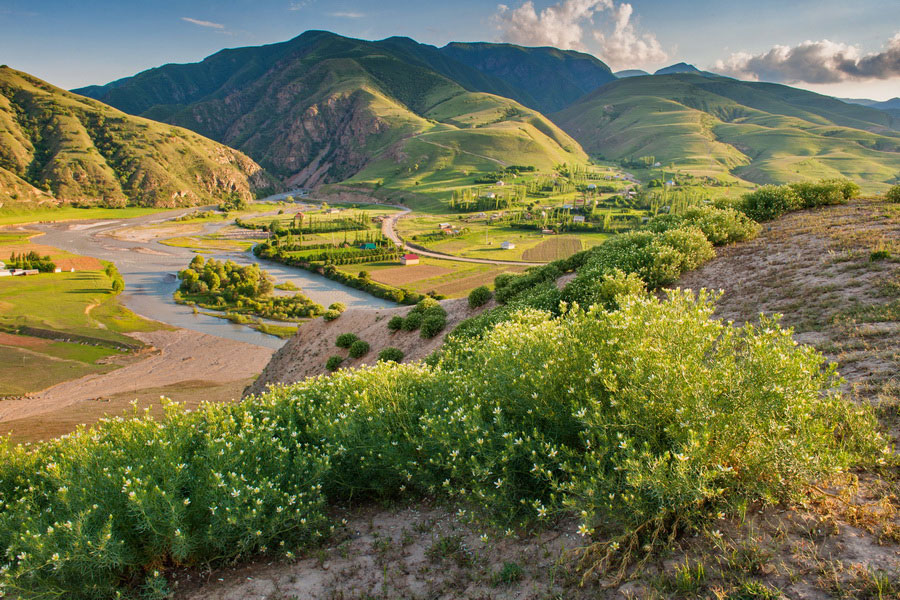
The Fergana Valley, cradle of Babur’s dreams and the seedbed of empire, remains a living testament to how geography shapes destiny.
Among the great works of early modern history, the Baburnama — the autobiography of Zahīr ud-Dīn Muhammad Babur, founder of the Mughal Empire, stands out as a remarkable record of geography, politics, and personal reflection. The best-known English version was translated by Annette Susannah Beveridge and published in 1922 as The Bābur-nāma in English (Memoirs of Babur).
The Baburnama runs to over five hundred pages in Beveridge’s edition, a mosaic of memory, geography, and self-reflection. It shows Babur’s unbroken attachment to his birthplace, the Fergana Valley in Central Asia, now divided among Uzbekistan, Kyrgyzstan, and Tajikistan. Within its pages, Babur records the political rivalries, orchards, customs, and faiths of his homeland. The book remains both a mirror of history and a bridge to the past.
The Mughal Empire (1526–1857 CE), founded by Babur, grew into one of the world’s great civilizations. Under Akbar the Great, it achieved its golden age, marked by tolerance, efficient administration, and artistic brilliance. The empire became a crossroads of trade, architecture, and learning, symbolized by monuments such as the Taj Mahal. By the eighteenth century, however, internal decline and external pressures weakened it. The British displaced its power after the exile of the last emperor, Bahadur Shah II, in 1857.
Babur’s ancestry shaped his ambition. On his father’s side, he descended from Timur, the conqueror of Transoxiana. On his mother’s side, he traced lineage to Genghis Khan. Born in Andijan, he wrote his memoir in Chagatai Turkic while adopting Persian poetic forms. Beveridge’s 1922 English translation remains the most complete, based on original Turkish manuscripts and Persian renderings prepared under Akbar’s patronage.
Memories of Babur: The Fergana Valley and the Heart of Central Asia
Here begin the memories of Babur, the restless prince whose heart never left the Fergana Valley. Though fate carried him from Central Asia to the plains of India, his Baburnama preserves the scent of orchards, the clarity of rivers, and the pulse of the mountains he loved. His words fuse observation and emotion; the landscape itself becomes a living character in his story.
I. The Lay of the Land: A Fortress of Fertility
Babur opens with geography, describing his homeland as “in the fifth climate and at the limit of settled habitation.” The valley is enclosed by high ranges on all sides but the west, where a narrow pass leads toward Khujand and Samarkand. This natural fortress, fertile yet confined, nurtured both abundance and rivalry.
The Syr Darya, then called the Saihun, watered its orchards and fields. Babur notes that the river “sinks into the sands,” capturing both its gift and its limits. The valley’s life depended on irrigation and fair governance. He lists seven main townships, each rich in produce: Andijan with grain and grapes, Marghilan with apricots and the famous Dāna-i-kalān pomegranate, and Kand-i-Badām with almonds exported to Hormuz and Hindustan.
“If people do justly,” he writes, “three or four thousand men may be maintained by the revenues of Fergana.” Beauty and economy are bound together, the valley is both garden and granary, capable of feeding soldiers and sustaining dreams.
II. A Tapestry of Peoples: The Cultural Mosaic of Fergana
Fergana’s richness extended beyond its soil. It was home to a mosaic of tongues and temperaments. In Andijan, Babur boasts, “all are Turks, not a man in town or bazar but knows Turki,” the same refined language once polished by the poet Mir ‘Ali-shir Nawa’i. Yet nearby Marghilan was “noisy and turbulent,” known for its bullies and fighters, while Asfara was “all Persian-speaking Sārts.”
This diversity — Turks, Sarts, and mountain tribes — made Fergana a miniature of Central Asia’s social complexity. Babur admired the courage of his followers, who “would not flinch from making offerings of their lives,” yet he lamented the disloyalty of nobles (begs) who shifted allegiance with the wind. To govern such a realm required grace and vigilance.
III. The Geopolitical Crucible: Fergana as Prize and Prison
Fergana’s blessings made it a battleground. Its fertile lands and trade routes drew the ambitions of neighbouring princes. When Babur’s father, Umar Shaikh Mirza II, died suddenly, the boy-king faced immediate threats from his uncles, Sultan Ahmad Mirza of Samarkand and Sultan Mahmud Khan of Tashkent.
The surrounding mountains that protected Fergana also trapped it. To capture Samarkand, the city of his Timurid ancestors, Babur had to leave his own valley exposed. The rise of the Uzbek warlord Muhammad Shaybani Khan proved fatal to his ambitions. Forced from Fergana, Babur fled first to the hills, then southward across the Hindu Kush toward Kabul.
In his memoir, the loss of Fergana is both a tragedy and a turning point. It transforms him from a local prince into a wanderer destined to found an empire elsewhere. The valley he could not keep became the seed of his future conquests.
IV. From Kabul to Panipat: The Road to Empire
In 1504, Babur seized Kabul, establishing it as his base of power. From there, he observed the politics of Hindustan and prepared his entry. Two decades later, in 1526, he met Ibrahim Lodi, the Sultan of Delhi, at the First Battle of Panipat. His disciplined army, supported by field artillery and the tulughma maneuver, defeated a vastly larger force.
That single victory transformed the course of South Asian history. Babur entered Delhi and Agra, laying the foundations of the Mughal Empire. His later victories at Khanwa and Chanderi consolidated control. By his death in 1530, he had carved out a realm that stretched from Kabul to Bengal.
V. The Man and the Memoir: Lineage, Language, and Character
Babur’s writing reveals both pride and vulnerability. He never conceals his failures or desires. His Baburnama is an early masterpiece of autobiography: direct, unsentimental, yet deeply human.
His dual heritage, Timurid by father, Mongol by mother shaped his outlook. He prized order and genealogy, yet mocked superstition. He spoke Turki, read Persian, and absorbed the arts of the Islamic courts. His prose flows with practical detail and poetic precision.
Later, under Akbar, his grandson, the Baburnama was translated into Persian to reach the broader Mughal elite. Beveridge’s English version based on those early manuscripts, brought his voice to modern readers, ensuring that Babur’s candour and curiosity survived five centuries.
VI. Gardens, Order, and Vision
Babur loved gardens. In every conquered city, he built charbaghs, fourfold gardens divided by water channels, symbolizing paradise and order. His landscape art was as deliberate as his campaigns. He viewed irrigation, terraces, and planting as acts of sovereignty.
From his Central Asian heritage, he inherited the idea of the ruler as gardener, one who shapes nature and polity alike. His descendants expanded this vision: Akbar reformed revenue, Jahangir advanced painting and observation, and Shah Jahan perfected Mughal architecture in the Taj Mahal. Through them, Babur’s blend of discipline and beauty endured long after his death.
VII. Decline and Afterlife of Empire
By the eighteenth century, Mughal authority waned. The Marathas, Sikhs, and regional nawabs eroded imperial control. European trading companies transformed into military powers.
The Indian Rebellion of 1857 marked the empire’s symbolic end. Rebels rallied around Bahadur Shah II, but British victory dissolved the Mughal court. Exiled to Rangoon, the last emperor died in 1862. Yet Mughal legacies, in architecture, language, cuisine, and governance continued to shape South Asia’s identity.
VIII. The Valley Today: Continuities and Tensions
Five hundred years after Babur, the Fergana Valley remains as he described “girt round by mountains.” Yet political borders have replaced natural ones. The valley is now split among Uzbekistan, Kyrgyzstan, and Tajikistan, its towns divided by fences and checkpoints.
Its rivers, once sources of fertility, are now contested for energy and irrigation. The Syr Darya, lifeline of Babur’s homeland, has become a measure of regional cooperation and tension alike. Ethnic mosaics persist, but old labels — Turk, Sart, Tajik — now align with modern nations. Periodic clashes, such as those in Osh in 1990 and 2010, echo Babur’s own accounts of loyalty and conflict.
Fergana remains Central Asia’s heart, fertile, restless, and strategic. Where caravans once crossed, pipelines and railways now run. The “great game” continues, not between Timurid princes but among Russia, China, and the United States. Today, its strategic position continues to attract global interest, particularly with China’s Belt and Road Initiative traversing its periphery.
IX. Memory as Power
Babur’s loss of Fergana gave him endurance. His longing shaped his identity. The empire he built in India carried the imprint of his Central Asian upbringing — the ordered garden, the disciplined camp, the poetic gaze.
In Baburnama, the valley becomes more than a place. It becomes a metaphor for the eternal paradox of Central Asia, rich yet contested, fertile yet fragile. Geography molds destiny; memory outlives empires