




The recent visit by Pakistan’s top leadership to China during and after the 2025 Shanghai Cooperation Organization (SCO) Summit in Tianjin has sparked regional interest and scrutiny. The simultaneous presence of the Prime Minister, Deputy PM, Foreign Minister, and Army Chief raised eyebrows—but it was the group photo with President Xi Jinping that truly made waves, especially in Indian media.
The group picture appeared to be a balancing act by Beijing, an attempt to upend the June 18 lunch that Donald Trump had with the Army Chief at White House, though no Trump-Munir photograph was released then. President Xi went a step further by conceding a group photograph. A message to Washington?
Secondly, Indian tv channels and social media savagely scrutinized the protocol-driven treatment of PM Sharif, who appeared to be in lost or tucked in insignificant corners during most multi-lateral occasions. This looked strange in a society where official protocols and placement of the guests reflect the nature of the relationship and priorities. Pakistanis have always enjoyed the privilege of being in the front row at such meetings, but not anymore it seems. Has something really changed in the Sino-Pak relations?
Thirdly, the SCO optics mostly involved Xi, Russian President Putin, and the Indian PM Modi, while Xi, Putin and Kim Jung Un – the Supreme Leader of North Kore – led the walk up to the stage set for the big Victory Day Parade on September 3.
Fourth, multiple Chinese sources confirmed that General Min Aung Hlaing was the only military Chief invited to the ceremony, while other guests were presidents, prime ministers, or royalty. Pakistan’s delegation at the parade was led by PM Shehbaz Sharif and the army chief was part of it. This meant bigger protocol arrangements for of a bigger delegation on a very busy occasion – additional burden on the hosts, so to say.
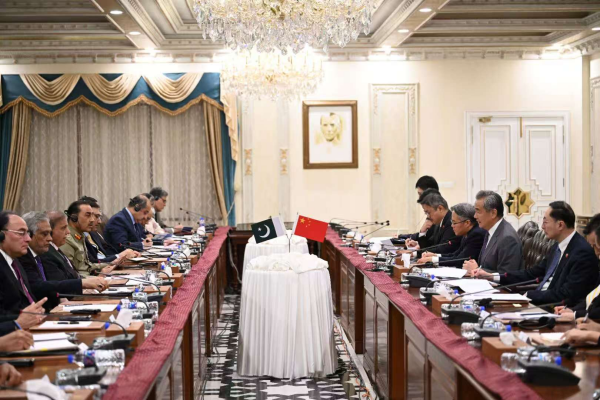
During his meeting with Prime Minister Shehbaz Sharif at the Great Hall of the People in Beijing, President Xi reiterated the importance of strengthening the China-Pakistan strategic partnership – essentially addressing economic cooperation, shared security concerns and regional stability. Xi reaffirmed China’s readiness to collaborate with Pakistan on developing an upgraded version of the China-Pakistan Economic Corridor (CPEC) and enhancing the China-Pakistan Free Trade Agreement.
China remains ready for “accelerated, high-quality development,” but is Pakistan ready too? is the big question.
Xi also renewed his call for Islamabad to enhance the security of Chinese nationals and projects in the country in the wake of repeated militant attacks on Chinese workers involved in CPEC projects.
“China hopes Pakistan will take solid and effective measures to ensure the safety and security of Chinese personnel, projects, and institutions in Pakistan, to create a secure environment for bilateral cooperation,” a post-meeting Chinese Foreign Ministry statement quoted Xi as telling Sharif.
Critics think that Xi’s direct call for improved security measures indicates China’s frustration with Pakistan’s inability to address these threats fully.
Very legitimate concerns on the security front indeed. But does Beijing’s concern on security reflect its frustration with the present security arrangements, or do the Chinese factor in the proxy nature of terrorism that targets Pakistani and Chinese interests? What is it actually that Beijing desires but Pakistanis fail to comply with?
The September 2, 2025, bilateral interaction occurred in Beijing on the sidelines of the Shanghai Cooperation Organisation (SCO) summit in Tianjin and was attended by Pakistan’s Army Chief, Field Marshal Asim Munir. It also coincided with the commemoration of the 80th anniversary of the victory of the Chinese People’s War of Resistance Against Japanese Aggression and the World Anti-Fascist War.
President Xi noted that “China and Pakistan share a resilient bond, a brotherly bond, and also a bond built on trust and common values—an ironclad friendship that was forged through historical twists and turns and has grown ever stronger over time.” The statement added: “As the once-in-a-century transformations are unfolding faster across the world, a robust China-Pakistan relationship is vital for regional peace and development.”
The Chinese president highlighted that the two sides should speed up the development of an even stronger China-Pakistan community with a shared future in the new era, aiming to provide greater benefits to both peoples and serve as a model for neighboring countries to build a community with a shared future.
Xi called for the two sides to “accelerate building an even closer China-Pakistan community with a shared future in the new era, to bring more benefits to the two peoples and set up a model for the broader neighborhood.”
Sharif reiterated Pakistan’s support for the One-China principle, underscoring Islamabad’s alignment with Beijing’s geopolitical stance, particularly on issues like Taiwan. The presence of Munir underscored the military dimension of the bilateral relationship, with over 80% of Pakistan’s military equipment reportedly sourced from China.
The meeting aligns with China’s broader SCO agenda of promoting a multipolar world order. By strengthening ties with Pakistan, China aims to secure its western flank and ensure the success of BRI projects. However, Pakistan’s domestic instability and security issues could limit the pace of progress, particularly for the next phase of the CPEC.
Field Marshal Munir’s recent meeting with U.S. President Donald Trump raised concerns in Beijing, considering the “all-weather” China-Pakistan relationship, which probably influenced Xi’s focus on security and loyalty to bilateral commitments.
Beijing recently added Russia to a list of 48 countries whose citizens can travel to China visa-free. However, Pakistan is not included in the list, and its citizens are not even allowed to get a visa on arrival. Neither side has explained what is preventing the “ironclad brothers” from resolving the issue and silencing critics of China-Pakistan relations.
President Xi announced yet another initiative… the Global Governance Initiative. Earlier, he has announced the Global Security Initiative, the Global Development Initiative and the Global Civilizational Initiative.
China is filling the void left by the US (and by default its partners). Ironically, China stands as the biggest champion of the UN system and international rule of law.
At SCO, another multilateral development bank was announced…the SCO bank. Not many details available yet. But as the largest economy, China can be expected to be in the lead.
Who is Xi’s Global Governance Initiative Directed At?
President Xi’s call for a Global Governance Initiative – that dovetails Xi’s previous four big ideas i.e. Global Security Initiative (GSI -April 2022), Global Civilization Initiative ((GCI -March 2023) Global Artificial Intelligence Governance Initiative (GAIGI- October 2023), and Global Development Initiative (GDI- September 2021) – stands out as yet another clarion call for setting “the house in order.”
Xi Jinping’s Four Global Initiatives are, in fact, a set of interconnected policy frameworks that he propounded to reshape global governance and promote a more multipolar international order.
Leaders in countries such as Pakistan and in the African continent must ask themselves why China – itself a staggering example in governance and development, particularly in underdeveloped regions such as Ladakh, Xinjiang, Tibet – would initiate something on governance?
Isn’t it a shot at democratic despots and military leaders of some SCO member countries to focus on governance and development if they want to stand tall in the world?
Pakistan’s present governance regime – both in the center and in provinces – is screaming for a rule-of-law-based governance, but a courtier bureaucracy is out to please some of the self-serving, narcissist rulers on financial resources half of which are literally borrowed money – loans.
The message out of Tianjin is: sovereignty, salvation from unilateral exceptionalism and long-term, sustainable financial autonomy lies in good governance at home as well as multi-lateral external cooperation anchored in mutual respect for the sovereignty of partner nations. This is the path China pursued with success, and SCO members can draw inspiration from it to survive as self-respecting nations.