




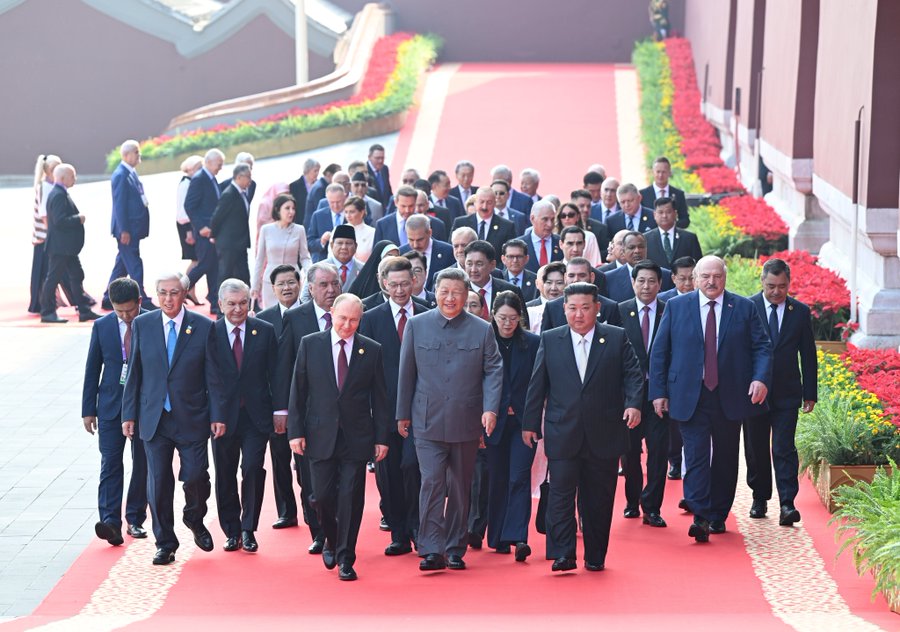
China’s massive military parade in central Beijing on Wednesday (Sept.3) to mark the 80th anniversary of its victory in World War II, was used both to project China’s staggering political-economic-military strength as well as strategic messaging to the world.
The Tian’anmen Square witnessed towering structures of national symbols like the Great Wall to project “the Chinese nation’s courage and solidarity in resisting foreign aggression.”
President Xi Jinping, who is also the chairman of the Central Military Commission, oversaw the parade and also delivered a speech with strong messaging on the multiple crises that the world faces and the possible options between war and peace.
Prominent among the leaders who occupied Tian’anmen Rostrum beside President Xi were Russian President Vladimir Putin and North Korea’s top leader Kim Jong-un.
Representatives of people who had supported China’s WWII fight, or their family members — from countries such as Russia, the United States, the United Kingdom, France, and Canada — were invited to the event.
This was the second military parade in a decade to commemorate the Chinese People’s victory against Japanese aggression.
Helicopters flew over Tian’anmen Square carrying banners that read “Justice Prevails,” “Peace Prevails,” and “The People Prevail.” The troops marched in tight, powerful formations, their faces lit with confidence and pride. Columns of new tanks, artillery and other military equipment rumbled through the square.
In his speech on the occasion, President Xi highlighted the significance of the victory 80 years ago.
Key Points from Xi’s Speech
# “Humanity again faces a choice: peace or war, dialogue or confrontation, win‑win cooperation or zero‑sum rivalry,” Xi said
This was a direct, powerful framing of the current global crossroads—pressuring conflicting nations to weigh paths of cooperation vs confrontation
# China is “strong, self‑reliant, and committed to peaceful development,” and “never intimidated by any bullies.”
Though the U.S. wasn’t named, the sentiment clearly underscores a defiant posture resistant to Western pressure
# Xi reiterated China’s rejuvenation and readiness to safeguard sovereignty, which analysts interpret as a signal that reunification with Taiwan—even by force—remains an integral objective
# Xi also called on the People’s Liberation Army to “protect sovereignty, unity and territorial to become world‑class.” This reinforces the strategic emphasis on military modernization
TheGuardian Reuters XinhuaNews TheWashingtonPost.
Geo‑Strategic Messaging
The parade offered glimpses of geo-strategic importance as well.
- Symbolic Alignment with Russia and North Korea: Xi shared the rostrum with Vladimir Putin and Kim Jong‑un—a rare appearance of the three at a global event. This visually communicates a deepening strategic alignment among these leaders.
- Showcasing Advanced Military Capabilities: The parade displayed new-generation weaponry—hypersonic missiles, ICBMs (including JL‑3 submarine-launched systems), cyber and drone units—underscoring China’s ambition to rival U.S. military
- Implicit Challenge to U.S. Hegemony: Xi proposed an alternative global order based on autonomy and multipolarity – a theme he has been advocating on multiple occasions, including the during the recent SCO summit at Tianjin.