




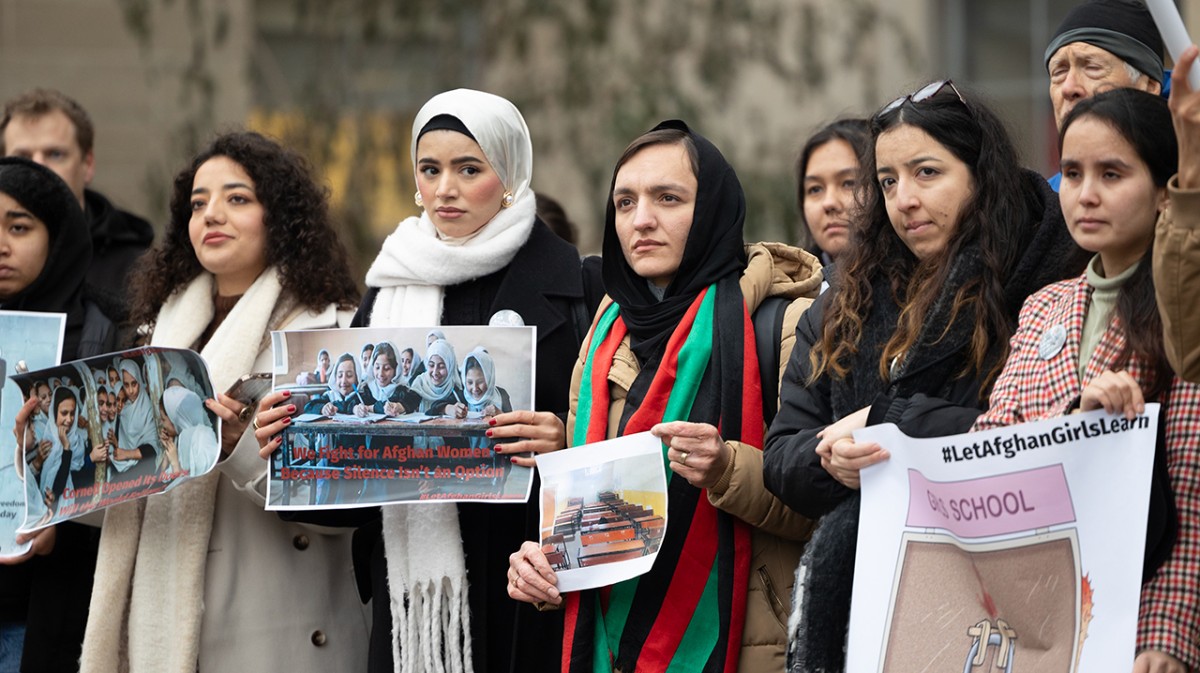
It is business as usual for the world, while four years on, Afghan women vanish from public life and men decide their fate.
When Taliban fighters entered Kabul on August 15, 2021, they inherited a country that had experienced two decades of uneven, often fragile, progress for women. In the early months, Taliban spokesmen spoke to international media about respecting women’s rights “within Islamic law.” Four years later, the record is precise and unambiguous: nearly one hundred decrees have been issued, every one reinforcing a policy of gender segregation and exclusion. None has been repealed.
The restrictions operate through interlocking systems. Girls are prohibited from attending secondary school and universities. In most cases, women, including humanitarian workers, cannot appear in public or work without a male guardian present. The mahram requirement, initially enforced inconsistently, has now been extended to private businesses and health clinics. In Herat and other provinces, women are barred from public spaces unless they wear a chador. In recent months, the Taliban have added a prohibition on public speaking by women, characterising it as a “moral violation.”
Taken together, these measures have removed Afghan women from almost every arena of public life. UN Women estimates that 78 per cent are now outside education, employment, or training. The country’s already fragile economy has lost a significant portion of its labour force in the midst of sanctions, foreign aid cuts, and climate-related crises. The Taliban continue to assert that Islam permits women to work, but the legal and logistical barriers they maintain make such participation functionally impossible.
The implications go beyond economics. In provinces where women cannot study medicine or be treated by male physicians, access to healthcare is collapsing. Maternal mortality is projected to rise by 50 per cent by next year. In rural districts, health clinics report turning away unaccompanied women even in emergency cases.
Social authority has contracted in parallel. UN data show that 62 per cent of women report no influence over decisions within their own households. Independent media has withered under censorship and intimidation; many journalists have left the country, while those who remain operate under constant monitoring. Social media posts are routinely scrutinised.
UNAMA’s latest reporting documents threats against female humanitarian workers. In May, several UN staff received explicit death threats in connection to their duties. A grassroots leader interviewed for the report described losing all funding in 2022, yet continuing to travel to remote districts to record women’s accounts of daily life under the new order.
The Taliban’s policy structure toward women is consistent in its design and enforcement. The absence of any reversal in four years suggests that, internally, these edicts are regarded as core to the regime’s legitimacy among its base. International engagement has not altered this trajectory. Negotiations over humanitarian aid, economic stabilisation, and counterterrorism have proceeded without substantive progress on women’s rights.
Susan Ferguson, UN Women’s representative in Afghanistan, argues that this is no longer only about Afghanistan. “If we allow Afghan women and girls to be silenced, we send a message that the rights of women and girls everywhere are disposable. And that’s an immensely dangerous precedent.”, she said in a statement.
Though Afghan women continue to operate in small, concealed spaces, teaching, documenting, and organising, without sustained international pressure and resources, these efforts risk being overwhelmed by the state’s capacity to regulate and suppress. The trends of the past four years leave little room for ambiguity about the Taliban’s intentions. The question is whether the international community will persist in a purely transactional, need-based engagement with the de facto rulers, content to manage crises as they arise, without demanding accountability for the dismantling of Afghan women’s rights — a tragedy deepened by the fact that nearly all decisions about their lives are still being made by men.