




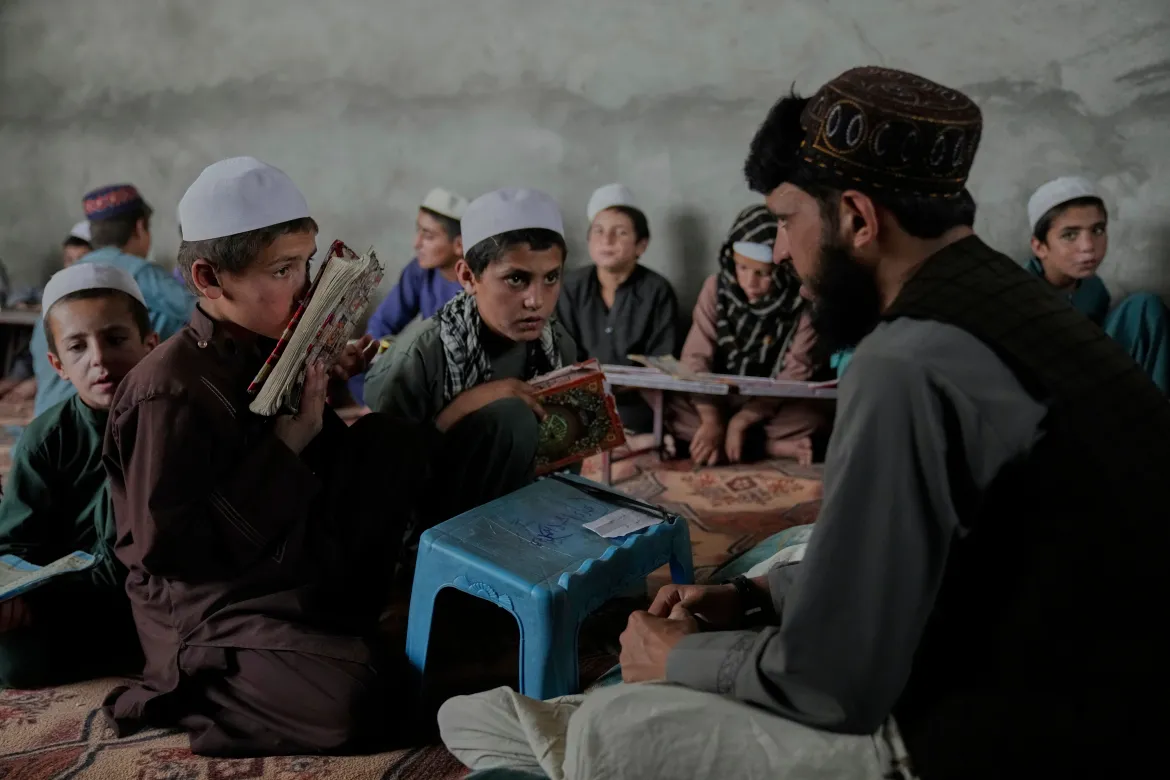
For millions of Afghan children, especially girls, madrassas have become the only doorway to learning. In a country where the public education system is strained to breaking point, these religious schools are stepping into the gap – though their rapid growth raises deep concerns about the future of education and society.
Public schools remain open, but decades of war, a shortage of qualified teachers, and chronic underfunding have eroded their quality. In this vacuum, the Taliban have dramatically expanded religious education. Over the past three years, they have built 85 madrassas for every new modern school – establishing 22,972 Islamic religious centers compared to just 269 modern schools. They have also set up 420 dormitories across various provinces, housing more than 21,000 students enrolled in these institutions.
One madrassa north of Kabul has seen enrolment grow from 35 to more than 160 students in just five years – a small example of a nationwide trend. For boys, madrassas offer Quran memorisation, Islamic jurisprudence, and Arabic, with a few adding mathematics or English. For girls, they are often the only educational option.
Since the Taliban’s return to power in August 2021, Afghanistan has become the only country in the world to ban girls and women from general education at the secondary and higher levels. According to UNESCO, nearly 1.5 million girls have been barred from attending secondary school since the ban began.
The Taliban have also overhauled madrassa curricula to reinforce their worldview. They have revised 18 religious textbooks – including in Hadith, Seerat (Islamic Biography), and Taaleem-ul-Islam (Islamic Teachings) – in both Persian Dari and Pashto, and amended history and geography textbooks for grades 7 to 12 to align with their ideology. Human rights monitors say these changes strip out concepts such as democracy, women’s rights, and human rights, instead promoting intolerance and opposition to a culture of peace.
The push is backed by a significant expansion in staffing: 87,592 positions have been created for madrassas, with 73,738 already filled.
While supporters argue that madrassas preserve cultural and religious values, critics warn they fail to prepare students – especially girls – for modern careers or civic participation. “They do not teach us what we need to learn,” says Nargis, a 23-year-old former economics student in Kabul who was forced out of university in 2021. She now informally teaches her younger sisters, whose secondary school was closed under Taliban rule, in secret.
For many Afghan families, sending children to a madrassa is not a matter of preference but of necessity. In today’s Afghanistan, for countless boys and girls, these schools may be the only classrooms they ever see.