




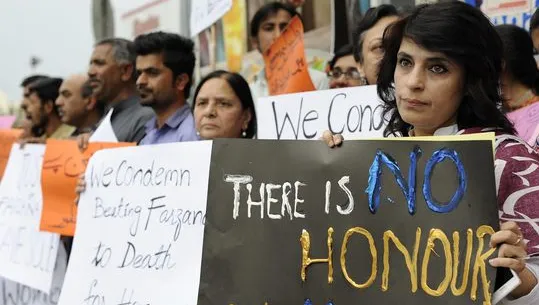
Some killings are not crimes in the eyes of society; they are customs, disguised as honor.
In Pakistan, honor is a heavy word. It carries weight, defines reputations and justifies violence. It not only holds the cultural value, but it is also used as a weapon, and women are its most frequent targets.
Women make up nearly half of Pakistan’s population, yet Pakistan ranked 148 out of 148 countries in the Global Gender Gap Report 2025. It is the lowest rank and a mirror held up to a society where women’s rights, autonomy, and lives are consistently sidelined. And behind that rank lies a deeper story, one that blends culture, silence, law, and impunity.
In South Asia, honor is deeply entangled with patriarchy. In Pakistan, especially, the idea of honor is often measured through women’s behaviour, what they wear, where they go, who they talk to, and whom they choose to marry. If a woman asserts herself by saying no, by choosing a partner, or by rejecting the rules of silence, it is seen as a stain on the family’s reputation. This is where honor becomes lethal.
Femicide, the killing of women because they are women, is not an unfamiliar concept in Pakistan. The culture of impunity is reinforced by loopholes and weak enforcement. Police often hesitate to file cases. Courts drag on for years. Survivors and families are blamed. But femicide doesn’t appear out of nowhere. It is the final link in a long chain of injustices: a culture that teaches boys they are superior, a system that allows for gendered leniency, and a society that romanticises male control. A girl bullied online, a wife beaten behind closed doors, a woman fired for reporting harassment; these are all part of the same story. When these violations go unchallenged, they pave the road to something worse.
The internet, once seen as a space of empowerment, has also become a new frontier for threats. As more women enter digital spaces, they face waves of harassment. What starts online often bleeds into real life, in stalking, blackmail, and physical violence. And yet, the system has not caught up. Most women don’t report because they don’t believe anyone will act. Sadly, they’re often right.
So, what needs to change?
First, Pakistan must acknowledge the crime for what it is. Femicide must be legally defined, with gender-based intent recognised as an aggravating factor in homicide cases. This is not symbolic, it’s strategic. Naming the crime makes it visible. Visibility brings accountability.
Second, the legal loopholes that allow families to forgive killers, especially in so-called “honor” cases, must be abolished. No one should be allowed to use culture as a cover for murder. Honor cannot be a defence in a just society.
Third, the country must invest in a National Femicide Observatory, a mechanism to collect data, identify patterns, and expose institutional failure. Countries like Mexico have shown how tracking and transparency can lead to targeted policy reforms. Without data, impunity thrives in the shadows.
Justice also needs to feel different. Victims and their families must be met with dignity, not dismissal. That means building specialised police and prosecutorial units, trained specifically in gender-based violence. It means ending delays and bureaucratic resistance. It means understanding that justice delayed is often justice denied.
But laws and systems alone cannot solve what is also a cultural crisis.
Pakistan needs a long-term strategy to challenge the toxic definition of honor. Public campaigns must call out harmful gender norms. Schools must teach young people about consent, gender equality, and respect. Social attitudes will only shift if the next generation is taught differently from the one before.
Shelters and helplines are another critical need. Survivors cannot be expected to fight without safe spaces. Today, such facilities are few, poorly funded, and difficult to access, especially outside urban centres. The state must step in and make protection a priority, not an afterthought. And let us not forget the families, the mothers, daughters, and siblings who carry the grief of a system that let them down. They need legal support, psychological care, and compensation, not just condolences. Their pain should not be invisible.
Lastly, this conversation cannot be limited to women. Men must be part of the solution, as partners and allies in building a more just society. Violence against women is not a woman’s problem; it is a societal wound that affects everyone. There is still time to change course. It will require political will, cultural courage, and a recognition that honor, when used as a justification for violence, has no honor at all.